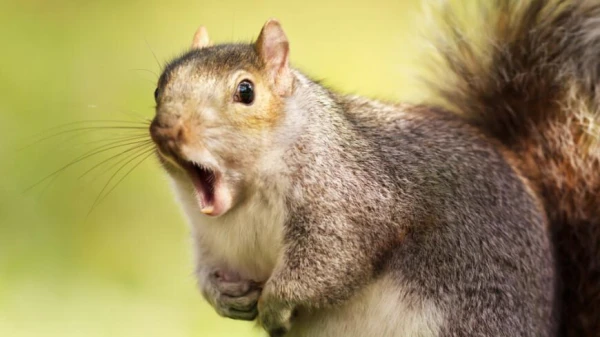
Squirrels gather a large number of acorns, nuts, and cones, distributing them in tree hollows or burying them among the roots. But how do they find the places where they hid their supplies? Do they create some kind of 'treasure map'?
In the animal world, active preparations for the cold have begun: some are already hibernating, some are just preparing their shelters, and it seems that the pace of life is slowing down for everyone. But not for squirrels.
Before winter, squirrels become more energetic than usual: they are doing their best to create significant food reserves for the cold period. One squirrel can hide up to 3000 nuts! And often they distribute them across many locations. But do they really remember where they put their precious stash? Or do they just indiscriminately raid others' “warehouses,” relying on their sense of smell?
An increasing number of studies suggest that these animals do remember all the places where they hid their nut supplies.
Squirrels are true strategists
Scientists claim that squirrels use two main approaches to storing their winter supplies. The first is to accumulate everything in one place, and the second is to distribute them across several locations. In choosing one of these strategies, the rodents take into account many factors: the characteristics of the local environment, threats from predators, and the number of relatives who may encroach on their food.
Generally, squirrels prefer the second approach, and this makes sense: by distributing food supplies across several locations, they reduce the risk of significant losses.
They also approach the choice of storage locations very carefully. Depending on the type of food, squirrels decide where to store it: cones are best hidden in the hollow of a pine tree, almonds in shallow places so they don’t get mushy, while peanuts can be buried deeper in the ground. Perhaps it is this strategy that allows squirrels to successfully find their supplies.
It has been proven that depending on the species of squirrels and the types of nuts they hide, these animals can find up to 95% of the food supplies they have hidden.
Spatial memory
However, some studies claim that squirrels have phenomenal memory. In 1991, Lucia Jacobs and a team of scientists from the University of California, Berkeley, placed eight lab-reared gray squirrels in a closed room and gave each ten nuts. The squirrels hid them in specific places, after which they were removed from the room.
Several days later, the subjects were reintroduced into the room to retrieve their nut supplies. With high probability, the rodents headed to the places where they had hidden their food: the squirrels collected twice as many of their own nuts as nuts from the caches of their relatives.
Another study conducted in 2017 supports the idea of good squirrel memory. Scientists conducted an experiment with lab-reared squirrels: they needed to retrieve hazelnuts from a closed box. Many succeeded — the boxes had a hidden hatch that opened with a small lever. Then, after 22 months, the experiment was repeated with the same squirrels, but with a different box — triangular in shape, although the principle of opening it remained the same. Even after almost two years, most of the animals completed the task faster than the first time. This indicates that they remembered how they had previously opened a similar box.
In another study, it was found that while in most small mammals the brain size decreases as winter approaches, in squirrels it increases. This may indicate a seasonal increase in cognitive load.
Red tricksters are not just about foxes!
Squirrels use their cognitive abilities not only to remember the locations of their supplies but also to camouflage their caches. If they bury their supplies in the ground, they carefully conceal their holes with fallen leaves, branches, and other small items they find nearby. Additionally, they can deceive their competitors by initially hiding their supplies in one place in their presence, and then re-hiding them. Brilliant!