Deep within the Earth's crust, in rocks over half a billion years old, molecular traces are stored that could rewrite the first chapters of the history of life. An international team of geochemists from the Massachusetts Institute of Technology may have solved one of the main mysteries of evolution—who were the very first animals on our planet.
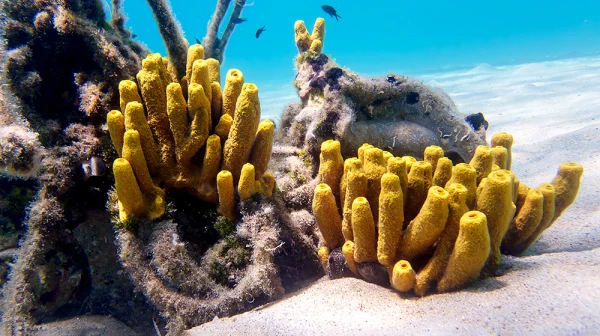
According to their study published in PNAS, the animal kingdom may have begun with primitive marine sponges. Their soft bodies did not leave traditional fossils but were preserved in the form of chemical signatures, writes Tech Explorist.
Scientists discovered unique organic molecules—steranes—in ancient rocks from Oman, India, and Siberia. These compounds are a geological "echo" of sterols that are part of the cell membranes of all complex organisms, that is, eukaryotes. In humans, for example, this role is played by cholesterol, which contains 27 carbon atoms. Plants have phytosterols. However, in samples dating back 541 million years, researchers found something unusual—steranes with 30 and 31 carbon atoms.
"You cannot be a eukaryote if you do not have sterols in your membranes. It is their molecular business card," explains one of the authors of the study.
From Modern Sponges to Ancient Rocks
To prove that these rare molecules belonged to ancient sponges, scientists conducted a scientific investigation along three independent lines. It turned out that living marine demosponges produce C31-sterols.
Chemists created several variants of C31-sterols in a test tube and subjected them to high temperatures and pressures, simulating geological processes. Only two of the eight synthesized compounds matched the samples from ancient rocks, which ruled out their non-biological origin.
Moreover, unique steranes were found in several geographically distant locations, but in rocks from the same Ediacaran period. "These are three independent lines of evidence that converged at one point," note the researchers.
Evolution Before the "Cambrian Explosion"
The discovery pushes back the emergence of animals into the depths of time, to the Ediacaran period, which preceded the famous "Cambrian explosion"—the sudden appearance in the paleontological record of many complex beings with hard skeletons. It turns out that millions of years before this, the ocean was already inhabited by soft-bodied but biologically complex organisms—sponges. They slowly filtered water, and their dominant role in the ecosystems of ancient Earth is now recorded at the molecular level.
"We do not know exactly what they looked like, but they lived in the ocean. They did not have a siliceous skeleton, and they probably resembled their modern soft-bodied relatives," says Professor Roger Summons.
Having confirmed the reliability of steranes as biomarkers, scientists plan to continue searching in other ancient rocks around the world. Their goal is to accurately determine when the first animals appeared and how the earliest ecosystems developed. This research shows that the history of life is written not only in bones and shells but also in the very chemistry of stone, and we are just learning to read it.