An old house in the village can fall victim to house mold that looks like cotton. How to deal with it?
To protect floors from house mold, one can use a time-tested method. It is necessary to fill the ground under the floor with dry clay mixed with gravel and lime, add a bit of cement or lime solution, and compact it thoroughly. The height of the floor above the ground should be approximately 30 cm. It is important that the beams on which the floorboards lie do not touch the ground.
To ensure ventilation in the floor, grilles or slotted baseboards should be made. Areas damaged by mold need to be carefully removed with an axe or scraped off, and the waste must be burned to prevent further spread of the mold. The cleaned wood is recommended to be treated 2-3 times with a chemical solution (for example, a 3% sodium fluoride solution or a 2% sodium silicate solution, or a 5% ammonium fluorosilicate or zinc chloride solution).
For protecting attic spaces and inter-floor coverings, dry antiseptic treatment can be used: the surface of the wood is moistened with water, and antiseptics are sifted through a sieve with a lid. Sometimes, dry antiseptic is mixed with moistened sand or sawdust and sprinkled on the wood in a layer of 1-2 cm.
IMPORTANT
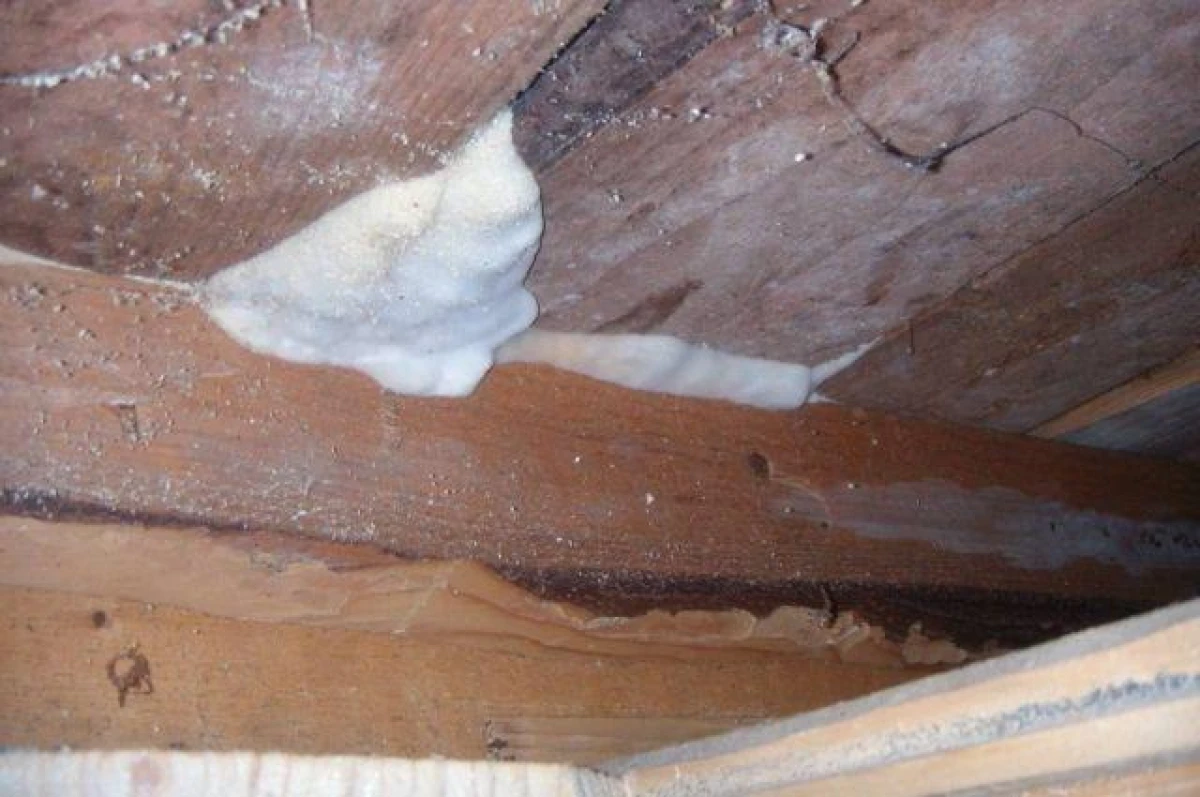
It is not difficult to detect house mold. First, a white fluff or cotton-like clusters of threads appear on the logs of the walls and floorboards. Later, yellow, pink, and lilac spots may appear, which gradually turn into light gray films with a silvery tint. Sometimes cords up to 10 mm thick form, penetrating through stone walls from one floor to another, facilitating the spread of mold throughout the building.
The wood that the mold settles on gradually changes color, darkens, cracks, crumbles easily, and can even turn to powder. Within 5-6 months, mold can destroy wood.