
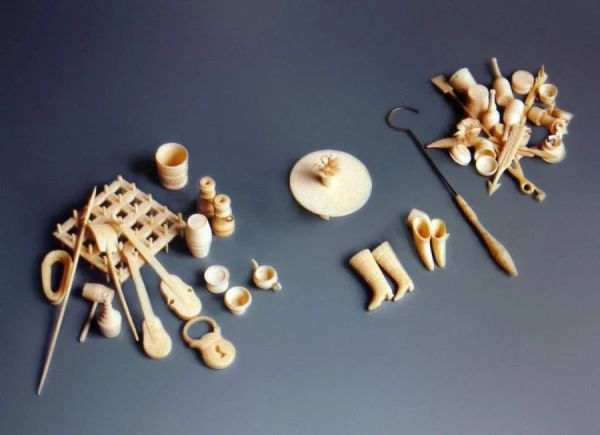
Most often made of wood or bone.
In modern language, the expression “to play birulki” is associated with a useless activity. However, this has not always been the case. For many centuries, both children and adults eagerly participated in this game, which developed patience, dexterity, and hand-eye coordination. Birulki were miniature wooden toys made in the shape of various kitchen utensils, which were stored in special wooden boxes that were also carved and shaped like apples, pears, or turnips. Each of these boxes usually contained 32 birulki.
Before the game began, they were poured onto the table in a pile, and participants took turns using a small hook made from a balalaika string to extract the birulki, trying not to disturb the others. If the pyramid shifted, the game would start over. The real “birulki boom,” including in Moscow and St. Petersburg, occurred in the second half of the 19th century.
This children's game attracted even very serious and business-minded people, including members of high society. Birulki were sold in confectioneries as a pleasant surprise, placed in boxes with candies, and tiny birulki toys, included in chocolate Christmas decorations, were given as gifts at Christmas.













Leave a comment