Can you grow a coffee tree in an apartment? Many are interested in this question. We answer: “Yes!” Give it a try, and you will succeed!
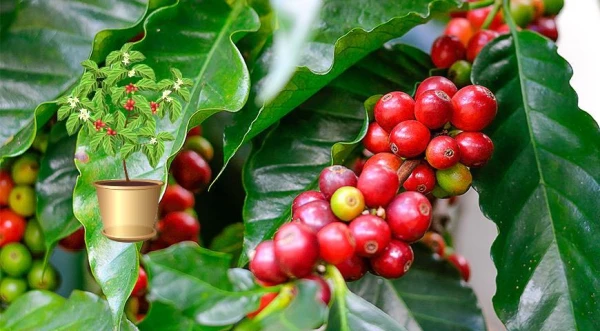
Indoor coffee is a small evergreen tree. Under optimal conditions and proper care, it can reach a height of up to one and a half meters. Flowering usually occurs in spring and summer. Ripe berries resemble small cherries, and their sweet pulp is edible. Inside the berries, there are two light green seeds. There are indoor coffee varieties with fruits of various shades — from pale pink and dark cherry to yellow.
Optimal Conditions for Growing Coffee Indoors
Coffee requires a lot of light. However, in hot tropics, it needs shading, and in our conditions, a southern windowsill. With insufficient lighting, the plant grows poorly and does not bear fruit. Young trees develop best in bright but diffused light. In summer, they can be taken outdoors, but direct sunlight should be avoided. In winter, coffee should only be placed on a southern window, at a temperature no lower than +18...+20°C.
The coffee tree is quite capricious and does not like changes in its position relative to the light. If you turn the plant, you will get a uniformly leafy crown, but you risk losing the harvest. Therefore, choose the location wisely.
Watering the coffee tree should be regular, especially in the summer — water generously. The water for irrigation should be soft, lime-free, and slightly warmer than room temperature. To maintain the necessary weak acidity of the soil, add 2-3 drops of acetic acid or a few crystals of citric acid to the settled water once a month.
Coffee tolerates dry air relatively well, but misting will not harm it, especially in the heat. From spring to autumn, except during the flowering period, it is advisable to give the coffee tree a warm shower once a week.
During the spring-summer period, the coffee tree needs regular feeding. During active growth — every 7-10 days, alternating a water infusion of cow manure (in a ratio of 1:10) and a complete mineral fertilizer with trace elements. In spring, the dose of nitrogen should be increased, during fruit formation — phosphorus, and by autumn — potassium. A good source of easily absorbable phosphorus is horn shavings or bone meal (0.2 liters per 10 kg of soil).
Transplanting the Coffee Tree
Coffee should be transplanted in spring, approximately every two years. The new pot should be 2-3 cm larger in diameter and height than the previous one. It is better to choose tall pots right away, as the coffee tree has a well-developed root system.
Coffee prefers clay, organically rich, and phosphorus soil, which must be weakly acidic, as well as air and moisture permeable. The mixture can be prepared independently. For this, take sod (garden) soil — 2 parts, humus — 1 part, acidic peat — 1 part, and river sand — 2 parts. If the plant is young, reduce the amount of sod soil by half. It is beneficial to add ash from deciduous trees (0.5 liters per 10 kg of soil). An alternative soil mixture option: sod soil, leaf soil, humus, and sand in a ratio of 4:2:1:1.