
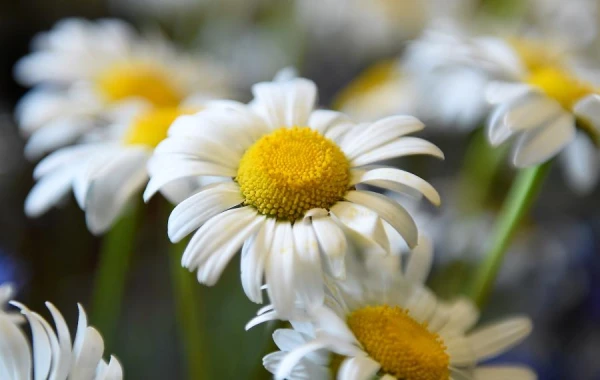
The name chamomile is familiar to everyone, like a simple melody. However, behind this name lies a multitude of interesting facts.
In fact, neither in Russian nor in Latin was the name "chamomile" used for a long time. Today, we use this word to refer to almost half of the species in the Asteraceae family. Chamomiles come in various shades: pink ones are echinaceas, yellow ones are rudbeckias and cornflowers, autumn ones are leycanthemella, spring ones are alpine asters, and the classic white ones are common and giant daisies. And all of this is not chamomile! Alas!
What is chamomile from a botanical point of view?
Pharmaceutical chamomile? Again, not quite right, but getting closer! Pharmaceutical chamomile is Matricaria (Matricaria chamomilla). Let’s continue to follow the developments...
So why do we call chamomiles that way?
Where did the name "chamomile" come from and when did it appear? The path to this name turned out to be quite complicated and confusing.
The plant we now know as noble cornflower (Anthemis nobilis) was once named, and in some places is still known by the names Chamaemelum nobile, synonym Chamaemelum romanum, or simply — Roman chamomile. Translated into Russian: chamomile noble, chamomile Roman, or just — Roman chamomile. And Roman means Romance — Romana (with the stress on the first "A"), Roma, Roman... chamomile). That is, by applying the suffix, we form a derivative from Roman — chamomile, just as Stepan — Stepanushka.
It turns out to be quite a strange path: the Roman flower with the name Chamaemelum was simplified to chamomile. Historians claim that this simplification came to us from Poland, where the flower was called Roman chamomile — romana.
This conditionally first chamomile is now better known as Anthemis nobilis, or English chamomile (note that it is no longer Roman, although it is widely known as Roman chamomile among homeopaths. The composition of the pills states: Chamaemelum romanum.









Leave a comment