The question is answered by culinary historian and writer Pavel Syutkin:
— First of all, it should be noted that the only thing connecting this dish to Ancient Rome is the use of Romaine lettuce. Otherwise, this famous culinary masterpiece has nothing to do with Gaius Julius Caesar.
However, the fate of its creator was no less fascinating and full of surprises. Caesar Cardini (1896-1956) was born in Italy. After World War I, he visited America several times, and in 1919 he decided to move there permanently. He tried his hand at the restaurant business in California, working in Sacramento and San Diego. However, the introduction of Prohibition in the U.S. in 1920 opened new horizons for the enterprising Italian. He opened a restaurant in the Mexican city of Tijuana, which was just a few miles from the U.S. border. This circumstance made his establishment particularly attractive to Americans, as it was not subject to restrictions on alcohol sales. Soon, Tijuana became a vacation hotspot for Hollywood elites, and Cardini's restaurant, called Caesar’s Palace, became its highlight.
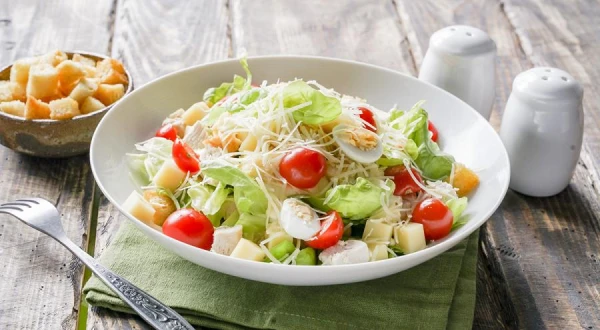
According to legend, it was there that he came up with the idea for a new dish. On Independence Day, July 4, 1924, the establishment was crowded with American guests. The drinks were fine, but there were problems with food. With no time to think, he used everything he had on hand, including Romaine lettuce. Chopping it finely, he drizzled it with olive oil and added a hastily prepared dressing. He mixed slightly undercooked eggs with garlic, lemon juice, Worcestershire sauce, and grated Parmesan. Toasted white bread croutons completed the composition. Of course, Cardini named the new dish after himself.
The dish quickly gained popularity as a light yet hearty snack thanks to the egg and oil. Julia Child, a classic of American cuisine, visited Cardini's restaurant in her childhood. Many years later, as a host on American television, she recalled how she managed to taste this legendary dish “from the source” in her childhood.
Today, Caesar salad is made with chicken, shrimp, and even anchovies. However, the original recipe will forever remain in the history of cuisine. In 1953, the Parisian Epicurean Society recognized Cardini's culinary creation as the best recipe to emerge in America in the last half-century.