White strawberry remains a mystery for many. Not everyone has had the opportunity to try or see it on store shelves. This type of strawberry appeared in supermarkets only a couple of years ago, and now everyone can find and appreciate it. In this article, we will discuss its origin, culinary combinations, and taste qualities.
What White Strawberry Is
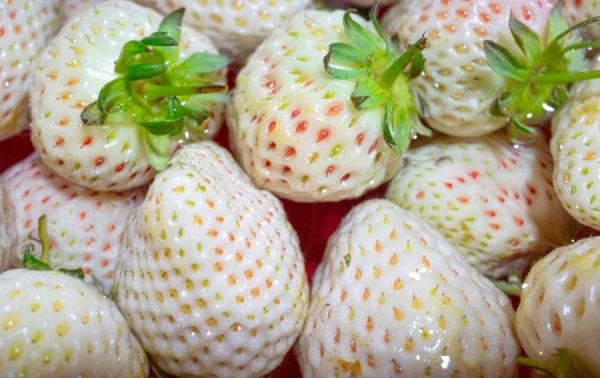
This is not an unripe berry. White strawberry was created through selective breeding or the introduction of a specific gene (not to be confused with genetic modification, or GMO!). White strawberries have the same seeds and green stems as regular ones, but they lack the rich color characteristic of ripe berries. Because of this property, this type of strawberry is ideal for people allergic to red pigments.
White strawberries were developed by crossing Chilean strawberries and Virginia strawberries. In this variety, the gene responsible for the red color is sometimes lost. Simply put, such strawberries do not produce a protein called Fra a1, which is responsible for changing white color to red (or its content is low).
However, this protein does not affect the taste qualities of the berries. White strawberries can be just as soft and tasty as their red counterparts. Sometimes these berries are even sweeter—possibly due to our expectations of a sour taste. Often, white berries resemble tropical fruits, which is why the English name for white strawberry—pineberry—includes the word “pineapple.”
Varieties of White Strawberry
Today, there are more than 50 varieties of white strawberries. One of the most famous and expensive is the “White Jewels” variety, developed in Japan and appearing on the market in 2012. Breeder Yasuhito Tesima spent many years crossing different types of strawberries to achieve a sweet taste, large size, and significantly paler color compared to red varieties. The price of one berry of this variety can reach 10 dollars, but connoisseurs highly value this product. Japanese strawberry Hatsukoi no Kaori (“Fragrance of First Love”) began to be sold in the early 2000s and quickly gained popularity.
The most common varieties are:
Fragaria vesca, known as alpine strawberry, native to Europe;
Fragaria chiloensis, or South American strawberry—this is the whitest variety from Chile;
Fragaria chiloensis x Virginiana, a hybrid of “high-grade” strawberries that was first developed in South America and then made its way to France. These berries acquire a slight pink hue in the sun, as they contain a little of the Fra a1 protein.
White strawberries always cost more than red ones, as they are more finicky and difficult to grow. They are often cultivated indoors to minimize exposure to sunlight. All of this is reflected in the final price of the product.
Can White Strawberry Be Replaced with Red in Cooking?
The answer to this question is yes. Despite some differences in taste between white and red strawberries, they are not significant enough to change the recipe of a dish. Red and white berries can be combined in decoration to make the dish more appealing. Strawberries are great for decorating pies, tiramisu, or yogurts.