Absinthe Day is celebrated on March 5. This drink was long popular among artists and poets. It was called the 'Green Goddess' and 'Green Fairy,' and representatives of the bohemia believed that it helped unlock creative abilities.
The exact history of absinthe's creation remains unknown; however, the first factory for its production was established in 1797 in Switzerland. In the 1840s, French soldiers received absinthe as a means of preventing malaria. Gradually, it gained popularity in Europe and the USA, and in France, it became one of the most sought-after alcoholic beverages until it was banned in several countries by the early 1900s. It is believed that the reason for the ban was the high alcohol content—its standard strength reaches 70%, and in rare cases, it can go up to 90%. Additionally, excessive consumption of absinthe can cause hallucinations. The drink was rehabilitated only at the end of the 20th century when previous restrictions on its sale were lifted.
Some mistakenly refer to absinthe as a liqueur; however, this is incorrect. It is not sweet and, strangely enough, belongs to distilled spirits. Its flavor features a light anise, bitterness, and pronounced herbal notes. The main component is the extract of bitter wormwood. The essential oils of wormwood contain thujone—a toxic substance that can cause negative effects with excessive consumption of absinthe. However, the drink contains only traces of thujone. Additionally, absinthe includes many plants such as coriander, licorice, mint, lemon balm, angelica, and parsley, and this is far from a complete list.
There is a belief that absinthe has a bright emerald color, but in reality, there are also yellow, red, and black variations of this drink.
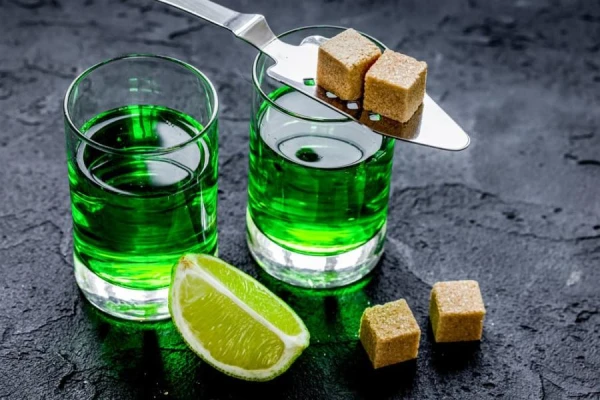
Absinthe can be consumed in cocktails or served in the traditional way. For this, a sugar cube is soaked in the drink, placed on a spoon, and set on fire. The sugar begins to melt and sinks to the bottom of the glass. After the flame goes out, the spoon is used to stir the remaining sugar into the absinthe.