
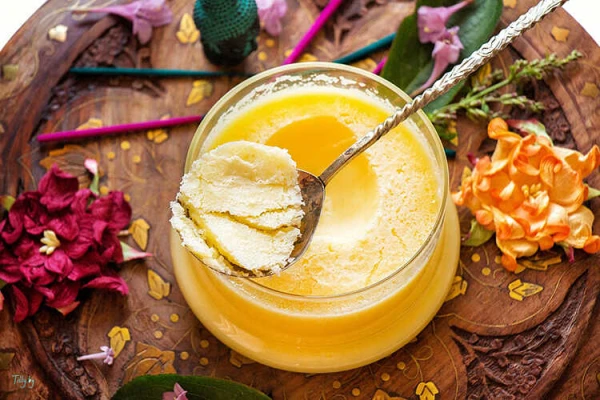
Ghee is a sought-after product that retains all the benefits of butter but is suitable even for those who suffer from lactose intolerance. In this article, we will discuss the origin of ghee, its differences from regular clarified butter, as well as its benefits and potential harms.
Ghee is an Indian variety of clarified butter used for culinary, medicinal purposes, and religious rituals.
Externally and in taste, ghee resembles clarified butter; however, there are important differences between them. Clarified butter is considered ready immediately after the components are separated: the liquid part is strained and poured into storage containers. In contrast, the process of making ghee takes significantly longer: butter is simmered for several hours, during which the protein sediment caramelizes due to the Maillard reaction, giving the final product a sweet taste and nutty aroma.
Origin of Ghee
Ghee has Indian roots and is widely used in the cuisines of South and Southeast Asia, with modified versions found in the Middle East and North and East Africa. With the advent of cattle, people began using butter for food, but the climate of India did not favor its long-term storage. In this context, ghee became an excellent alternative, as it can be stored much longer due to the filtration and removal of proteins and water, where bacteria can multiply.
In an article published in 1955 in the New York Times titled "Ghee is Good," Indian writer R.K. Narayan shared his thoughts on the product: "Ghee is certainly clarified butter, but it is also something more, just as wine is something more than the juice of pressed grapes. Ghee is like a genius born of a dull parent."
Benefits and Harms of Ghee
Ghee has become popular not only because of its longevity. The unique technology of its production allows for the removal of lactose, making it suitable for people with dairy intolerance.
Moreover, ghee has a high smoke point, allowing it to be used for frying without the risk of burning.
This oil is also widely used in Ayurveda, where it is considered an excellent remedy for dry skin and hair care. In addition to fats, which are the main moisturizing component, ghee contains a sufficient amount of vitamin A, necessary for skin health. In Ayurveda, it is used to improve digestion, eliminate toxins, and treat inflammatory processes. It is recommended to consume ghee with warm milk for sore throats. However, it is important to remember that Ayurveda is a system of alternative medicine and is not a scientific discipline, so it is better to consult doctors when health issues arise.
At the same time, ghee is a very fatty and high-calorie product: 100 g contains 98-99% fat, and the caloric content reaches 900 kcal, so its consumption should be moderate. Caution should also be exercised with ghee in case of casein allergies, the content of which decreases in properly prepared ghee but can still be sufficient to cause health problems.
Today, ghee is available both in online stores and in regular shops. It can be used for frying, added to cereals and other dishes, spread on pancakes, and used to prepare various Indian dishes.












Leave a comment