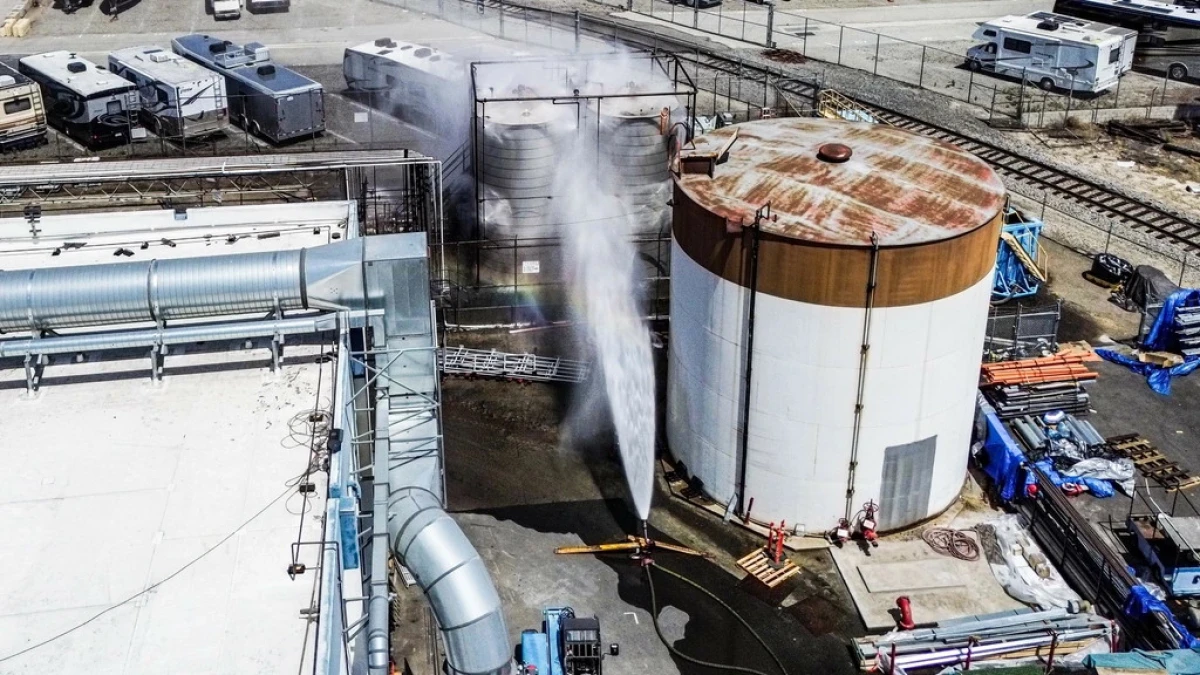
A large-scale evacuation has been declared in Southern California following an accident at a plastic parts manufacturing facility. About 40,000 people have been ordered to urgently leave their homes due to the threat of a powerful explosion from a tank containing hazardous chemicals.
The incident occurred at a plant near the city of Garden Grove. According to emergency services, a tank containing methyl methacrylate—a flammable chemical used in the production of plastic parts for the aerospace industry—overheated on Thursday, reports NOS.
After the evacuation was announced, the streets in nearby residential areas were almost deserted. Residents hurried to leave their homes, fearing a potential disaster.
Initially, firefighters reported that the situation was under control. However, by Friday, it became clear that one of the tank's valves was malfunctioning, and the risk of tank failure remained extremely high. Rescuers are now continuously cooling the tank with water, trying to prevent critical overheating and explosion.
According to the Orange County Fire Authority, there are between 22,700 and 26,500 liters of hazardous material inside the tank.
"There are literally two scenarios: the tank will either rupture or explode," a fire department representative told reporters.
Initially, the evacuation order applied only to part of Garden Grove, which has a population of over 170,000. Later, authorities expanded the evacuation zone to neighboring communities.
Experts remind that methyl methacrylate is considered a highly dangerous substance. It ignites easily and can release toxic fumes upon leakage, posing health risks to humans. In the event of an explosion, the consequences could affect several residential areas at once.
Authorities have not yet reported how long residents will have to stay out of their homes. Emergency services and chemical safety specialists continue to work at the site.
In the editorial's view, the situation in California once again shows how fragile safety can be even in technologically advanced regions. Sometimes, one technical malfunction is enough for tens of thousands of people to find themselves in a zone of potential disaster.