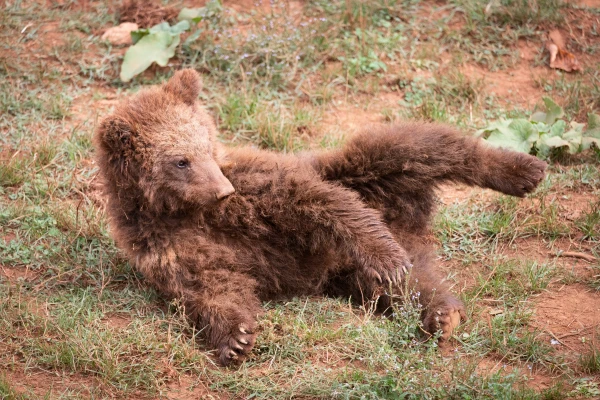
The prosecutor's office has submitted a case to the court against a man who caught a two-month-old brown bear cub in Latgale and illegally kept it in his private zoo. The animal lover faces serious punishment, but he claims that it is not so straightforward.
As the prosecutor's office explains, in the spring of last year, a man encountered a small bear cub in the forest of the Augšdaugava region, possibly separated from its mother. He caught the animal by an unspecified method and decided to take it to his private zoo, where he kept it in an enclosure, reports the show Degpunktā (TV3).
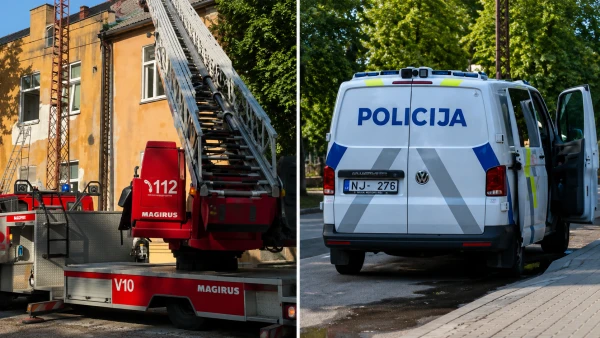
Soon, the animal was seized by the State Police. The criminal proceedings have been completed, and the man is set to stand trial.
The brown bear in Latvia is a specially protected species, and the law stipulates that the removal of such an animal from the wild is not only prohibited but also much more dangerous than it may seem.
Prosecutor Ieva Šomina explains:
"From the perspective of animal protection law, the removal of such a bear cub from the wild is interpreted as the removal of an individual from the population of brown bears in Latvia and is effectively equated to killing the animal, since, according to the biology of the species, it can no longer be rehabilitated to return to the wild. Consequently, it will no longer be able to fulfill its function in the population, for example, to reproduce."
This position is supported by Maris Lielkalns, a representative of the Riga Zoo and an animal expert. According to him, a two-month-old bear cub is comparable in size to an average dog, but even a brief habituation to humans makes its return to the wild impossible.
"If an animal grows up close to humans from an early age and receives their care, it practically loses the ability to return to the wild. It becomes accustomed to humans, does not fear them, and, once free, continues to seek contact with people. The animal becomes accustomed to a certain routine — regular feeding, water, and living conditions — and cannot fully adapt to the wild environment," he noted.
Journalists from "Degpunktā" managed to contact the owner of the private zoo to understand his motivation. A man named Alexander claims that everything was different: he did not lure or catch the bear cub in the forest, but saved it — he found one lying and on the brink of death. There was no mother nearby, so he decided to take the animal to himself and try to save it. According to Alexander, he contacted the Nature Conservation Agency himself and reported that the bear cub was with him and recovering. However, the state agency viewed the situation differently.
"This was a sick bear cub that almost died in the forest. We immediately understood that if we took it, we would have problems. They decided that we wanted to profit from it. We reported ourselves — we contacted the environmental agency, wrote a statement that we had a bear, and we found it right here. We asked what to do with it. But instead of figuring out what to do with it, they filed a report with the police," Alexander said.
It is difficult to determine whether everything was as the man describes. He is being accused by the Nature Conservation Agency, which refuses to comment on the case. It should only be noted that regardless of the condition of the animal and our intentions, the law prohibits the removal of wild animals from nature in any form.
The damage caused to the state is estimated by the prosecutor's office at 30,000 euros, and the maximum penalty provides for imprisonment for up to five years. The court date has not yet been set, but law enforcement agencies will consider both the testimonies of state agencies and the zoo owner himself.
According to unofficial information, the specific animal is now healthy, but unfortunately, it is no longer in the wild.