

Global experience shows that criminalization does not contribute to an increase in birth rates.
In Texas, a law has come into effect that prohibits the sale of medication for abortion to state residents. Since the U.S. Supreme Court allowed states to independently shape reproductive legislation in the summer of 2022, Texas has become one of the leaders in the country in terms of restricting women's abortion rights.
By 2025, this procedure is partially or fully banned in 14 states in the southern and midwestern United States. A direct consequence of these restrictions has been an increase in maternal and infant mortality in these regions. Global experience shows that the criminalization of abortion does not contribute to an increase in birth rates but raises health and life risks for women, complicating their access to legal medical assistance and forcing them to terminate pregnancies underground.
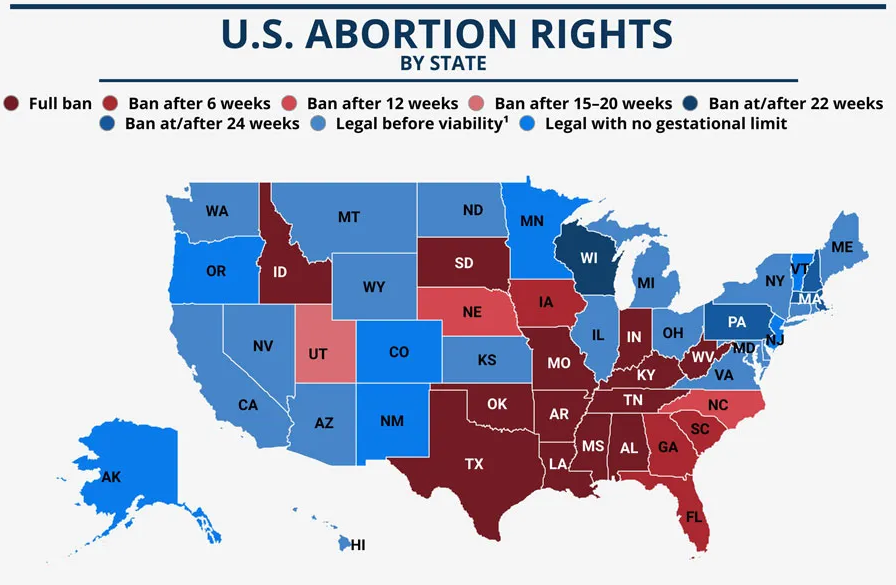
The results of granting states "freedom" in regulating abortions did not take long to manifest. Women facing the ban on abortion or delays in assistance due to doctors' fears of criminal liability described such consequences: anemia, severe infections, premature rupture of membranes, and threats to life. The Center for Reproductive Rights shares the story of a Texas resident who suffered due to the new restrictions:
"During her pregnancy, Samantha learned that her baby had anencephaly—a fatal developmental defect. Doctors stated that due to the abortion ban in Texas, they were not allowed to perform the termination. Samantha was forced to carry the pregnancy to term, fully aware that the baby would not survive. She described what was happening as torture. Samantha's daughter died four hours after birth."
Until 2022, abortion in the U.S. was considered a constitutional right of any woman. This was facilitated by the 1973 decision in Roe v. Wade, when Norma McCorvey (under the pseudonym Jane Roe) from Texas challenged the state law banning abortions in the Supreme Court and won the case.
The question before the court was: "Does a woman have a constitutional right to terminate a pregnancy?" The court answered affirmatively. The decision was based on the 14th Amendment to the U.S. Constitution, adopted after the Civil War, which prohibits states from interfering in the fundamental personal freedoms of Americans.
In states where abortion is banned, maternal mortality is nearly twice as high as in those where it remains legal, according to a report by the Gender Equity Policy Institute (GEPI) for 2025. A particularly sharp increase in mortality was recorded in Texas.
According to the Institute for Women’s Policy Research (IWPR), from 2019 to 2022, maternal mortality in this state increased by 56%, while the national average rose by about 11%. The fact is that back in 2021, Texas authorities passed amendment SB8 (Senate Bill 8), which prohibits abortion from the moment a fetal heartbeat begins (approximately six weeks into the pregnancy).
Modern medical guidelines allow for early termination of pregnancy in cases of fetal demise, early rupture of membranes, or severe fetal developmental defects—this is how doctors prevent bleeding, sepsis, and multiple organ failure (1, 2, 3). However, due to the severity of penalties for violations of anti-abortion legislation (loss of license, criminal prosecution, and long prison sentences), many medical professionals are afraid to perform even those procedures that are formally permitted.
















Leave a comment