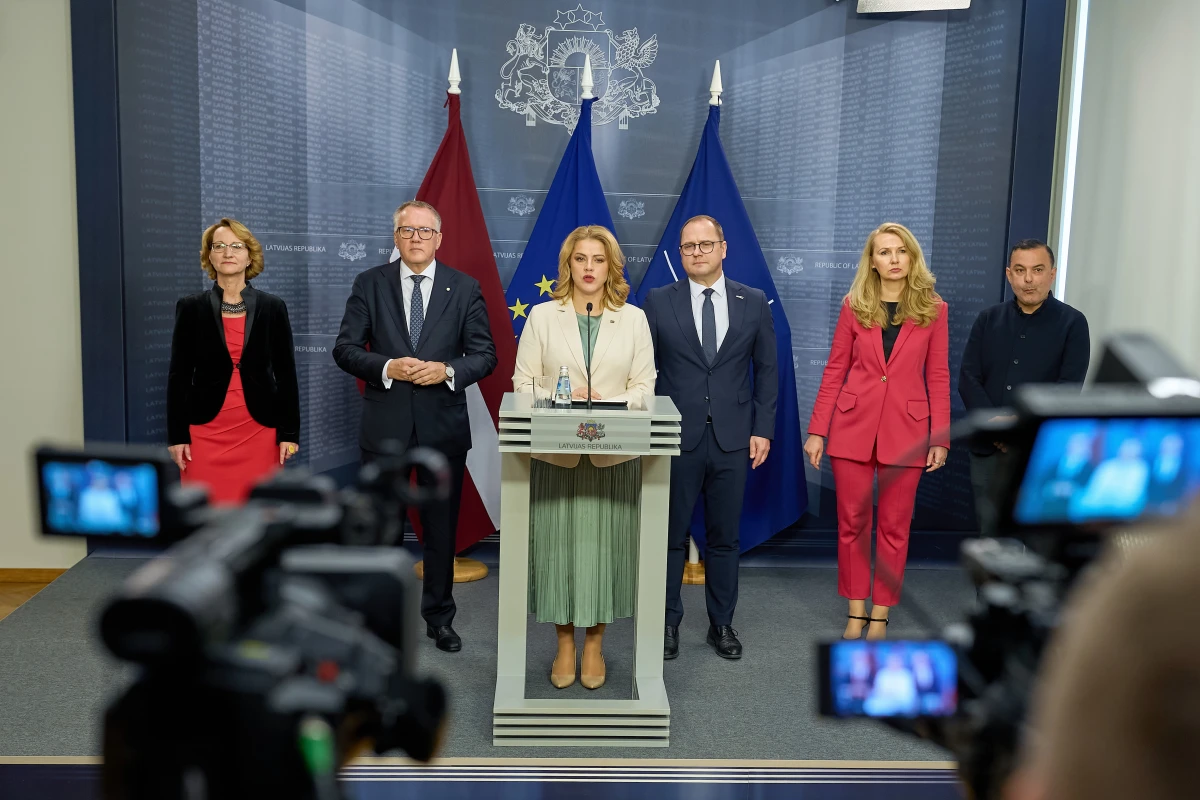
The resignation of the Prime Minister of Latvia was preceded by scandalous dismissals of two ministers – defense and agriculture. All this has significantly shaken the political environment of the republic. But what about the economic environment?
The government's inability to make strategic decisions, as well as delays in budget preparation, may affect the development and economy of Latvia in the future. This is stated by banking economists commenting on the fall of the government of Evika Silina.
"A Restart Was Necessary"
Dainis Gashpuitis, economist:
– The government's work has long been failing. As disagreements continued, the government's ability to advance strategic issues diminished week by week.
Some sort of restart was necessary. However, there are doubts that a new and stable coalition can be quickly formed shortly before the elections. It will take time before any political decisions emerge, which means a period of uncertainty.
At the same time, day-to-day work will continue, technical decisions will be made, and economic processes will continue to develop.
The inability to make strategic decisions, which may now take months or even longer, creates a cost that will manifest in the future and become noticeable against the backdrop of developments in other countries.
At the same time, the government's resignation affects public assessments and sentiments; however, internal political passions often appear differently on a broader scale and from the outside.
For example, in a survey of chief financial officers from large companies in the Baltic states, entrepreneurs from the two neighboring countries rated the Latvian government most positively among all three Baltic governments.
Such passions occur in other countries as well, so it is important not to overestimate what is happening. Investors are still looking at the long term. There is no reason to believe that current events will cause sharp changes in opinions or assessments from investors.
Moreover, the outgoing government lacked effective cooperation and communication with business groups, and this should be improved in the future. It is also necessary to work more actively and directly on attracting potential investors.
Regarding the detentions of the Minister of Agriculture and the head of the State Chancellery of Latvia, investors are often quite well informed about specific sectors and the processes within them even before investing begins, so opinions are not formed based on a single event. All this provides an opportunity to increase the transparency of processes, which in the long term may improve the investment climate.
The Main Risk Is Not in the Scandal Itself
Karlis Purgalis, economist:
– From an economic standpoint, the fall of the government itself does not create significant direct impact. An important issue is the preparation of the state budget for the next year. If the development and adoption of the budget are delayed, it may lead to negative consequences for the economy, as decision-making and the flow of funding into priority sectors will slow down.
In the eyes of foreign investors, events in the Latvian government are likely an unpleasant signal, but for now, it appears more as political turbulence rather than a systemic problem of the state.
Reputational risks have increased, but this is not yet an investment disaster. The main risk lies not in the scandal itself, but in the prolongation of political uncertainty.
Theoretically, some investors may postpone new decisions, as political instability has previously been cited as one of the factors hindering investment sentiment in Latvia.
However, if clarity regarding the succession of power emerges soon and it is evident that state institutions continue to function, the negative impact on attracting investors is likely to be limited and short-term.
Furthermore, the detention of the Minister of Agriculture and the head of the State Chancellery sends a signal to investors that Latvia is a rule-of-law state ready to actively combat potential cases of corruption.
A low level of corruption and non-interference by the state in the free entrepreneurial environment would reduce risks for investors and increase Latvia's attractiveness when evaluating potential investments.
The State Will Not Stop Functioning
Peters Strautins, economist:
– Political events should not significantly affect investment attraction in Latvia. The main investors in Latvia are companies from democratic countries. I think we want to maintain this in the future. They understand well: governments may change, but the state does not stop functioning because of that.
Moreover, the ability of law enforcement agencies to investigate suspicions regarding influential individuals is not a sign of state weakness, but rather the opposite.
Investment attraction would suffer in the case of prolonged political instability threatening budget discipline and the implementation of structural reforms. However, Latvia is not currently in such a situation.