In recent weeks, the public discourse in our country has increasingly raised the question – is it possible to have economic interaction with neighbors to the East? The Saeima has also voiced its significant opinion in this regard...
Where the money goes
Entrepreneurs cooperating with Russia and Belarus should not receive any state support, including their participation in public tenders being excluded – this was the directive given last week by the Chair of the Saeima Foreign Affairs Commission, Ināra Mūrniece (National Alliance).
"Russia is a threat," the politician emphasized, once again highlighting the need to publish information about enterprises that continue to do business with the Russian Federation and Belarus.
Despite the fact that the parliamentary commission meeting was open, and its audio recording was distributed on the saeima.lv resource, some informational materials were marked with a restricted access label and sent only to deputies.
At the public meeting, the Deputy State Secretary of the Ministry of Economics, Edgars Šadriš, reported that over the past 10 years, investments from Russian and Belarusian citizens in Latvia have significantly decreased. In the first quarter of 2026, the reduction in accumulated capital from the Russian Federation (currently totaling 112 million euros) amounted to 70% compared to 2016, and from Belarus (with a total of 16 million) – minus 24%.
– On average, capital has fallen by 11 percent per year, – concluded the official. – If we talk about the number of enterprises, there are a total of 2907 registered, where at least 1 euro has been invested; and 122 enterprises have ceased economic activity. 60% of these enterprises were registered in 2016 or earlier.
Focus on trade
Meanwhile, E. Šadriš pointed out that 17% of Russian-Latvian enterprises were registered after 2022. And 59% of the total investments belong to the 10 largest enterprises.
After studying the activities of 275 joint ventures, the Ministry of Economics concluded that they are fully or mostly owned by Russians. Most often, these companies operate in wholesale and retail trade, manufacturing, real estate, and 1% – in the financial and insurance sector.
The "lion's share" of firms is registered in Riga, Jūrmala, the capital region as a whole – and Daugavpils. 22%, or 624 enterprises, have 1 beneficial owner, respectively from Russia or Belarus. There are also enterprises where it is not possible to establish the true beneficiary.
The Secretary of the Foreign Affairs Commission, Jānis Vucāns (Union of Greens and Farmers), expressed that a differentiated approach is necessary for those Russians living in Latvia and owning enterprises – and owners from abroad.
"Hard to believe!"
For her part, I. Mūrniece reminded that enterprises may not have owners from the Russian Federation or Belarus at all, but still trade or otherwise interact with these states. She is not satisfied with the Ministry of Economics' policy regarding such enterprises: "Where is the result of all this activity?"
– Where have you spent this money, have your goals been achieved or not? – the politician posed a rhetorical question.
E. Šadriš admitted that the ministry cannot yet sum up the overall effect of the decline in trade turnover. The current restrictions, emphasized the Deputy State Secretary, are based on sanctions legislation. However, the established threshold for the participation of owners or enterprises from the Russian Federation and Belarus in a company's activities is 50%.
Inta Prauliņa, head of the export support and development department at the Latvian Investment and Development Agency, stated that this institution does not facilitate trade with the Russian Federation or Belarus. "This is quite clear," added Ināra Mūrniece.
– But whether the enterprise continues to trade with these states, we unfortunately cannot determine, as this information is not reflected in annual reports, – admitted Ms. Prauliņa. "We occasionally request information from the Central Statistical Bureau." However, data on specific enterprises is still unavailable.
– You are still continuing to export to Russia and Belarus, after all these measures! – Ināra Mūrniece stated accusatorily. She called the activities of state bodies "toothless."
– Are we really hearing this? Hard to believe!
"And should it be banned?"
The Deputy Chair of the commission, Irma Kalniņa (New Unity), reminded that there are also offshore companies behind which Russians stand.
– Is there any statistics on enterprises registered in Cyprus, with shareholders being Russians in Latvia?
Mr. Šadriš said that he does not possess such information...
However, structures such as the Central Financial and Contracting Agency, the financial institution Altum – similar to banks, know their clients and filter out those belonging to "high-risk jurisdictions."
Elīza Berziņa, head of the Risk Assessment Department at Altum, stated that participation of Russia – even at 1% ownership – excludes from possible support programs. In turn, Jānis Vucāns noted that if the shares of an enterprise are traded on the stock exchange, they can also be purchased by Russians. "How will you be able to control this? And should it be banned if we want this enterprise to survive?"
Zanda Kalniņa-Lukaševica (New Unity) expressed that political pressure should not be exerted on employees – but the director of the Latvian Investment and Development Agency, as well as the parliamentary secretary of the Ministry of Economics, should be summoned to the Saeima. It should be noted that the aforementioned agency is under the patronage of the Union of Greens and Farmers, and such an action – "to the carpet" – could be seen as part of an election strategy, which, unfortunately, has not produced anything new for a long time except for searching for enemies under the bed...
"Fire barrier"
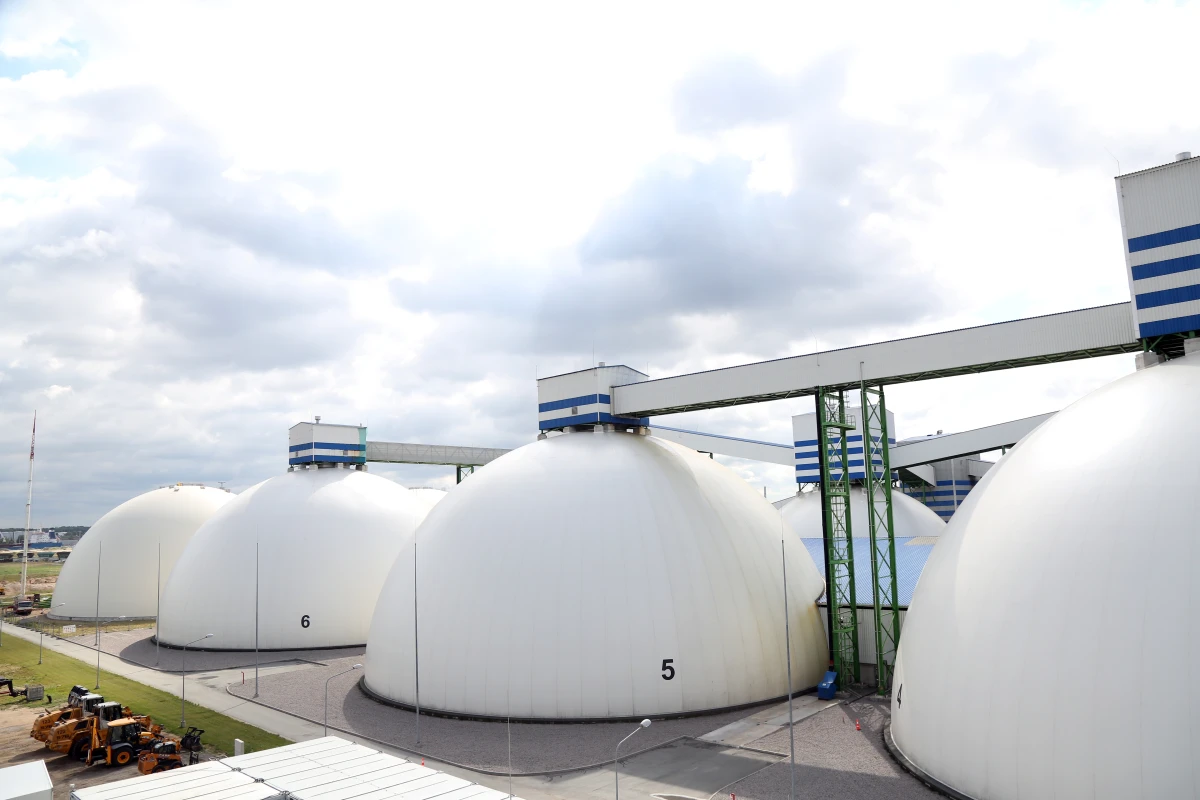
As reported by bb.lv, this week the Latvian government will decide the fate of the Riga Fertilizer Terminal, which handles mineral fertilizers. It was opened in the Riga port in 2013 as one of the largest joint projects of the port business of Latvia and Russia. More than 60 million euros were invested in it, and fertilizers from Uralchem were to be supplied to global markets through Riga.
Several years ago, the terminal fell under sanctions; however, this year the Riga Fertilizer Terminal company requested a special permit – that is, an exemption from the sanctions regime – to resume operations.
The terminal promises to implement a so-called "fire barrier," that is, to completely separate the sanctioned Russian oligarch Dmitry Mazepin from the management of the company and from receiving profits.
The company promises the restoration of 150 jobs, payments to the Riga Free Port and "Latvian Railways," as well as a contribution to the economy of more than 5 million euros per year.
The final decision is to be made by the Latvian government.