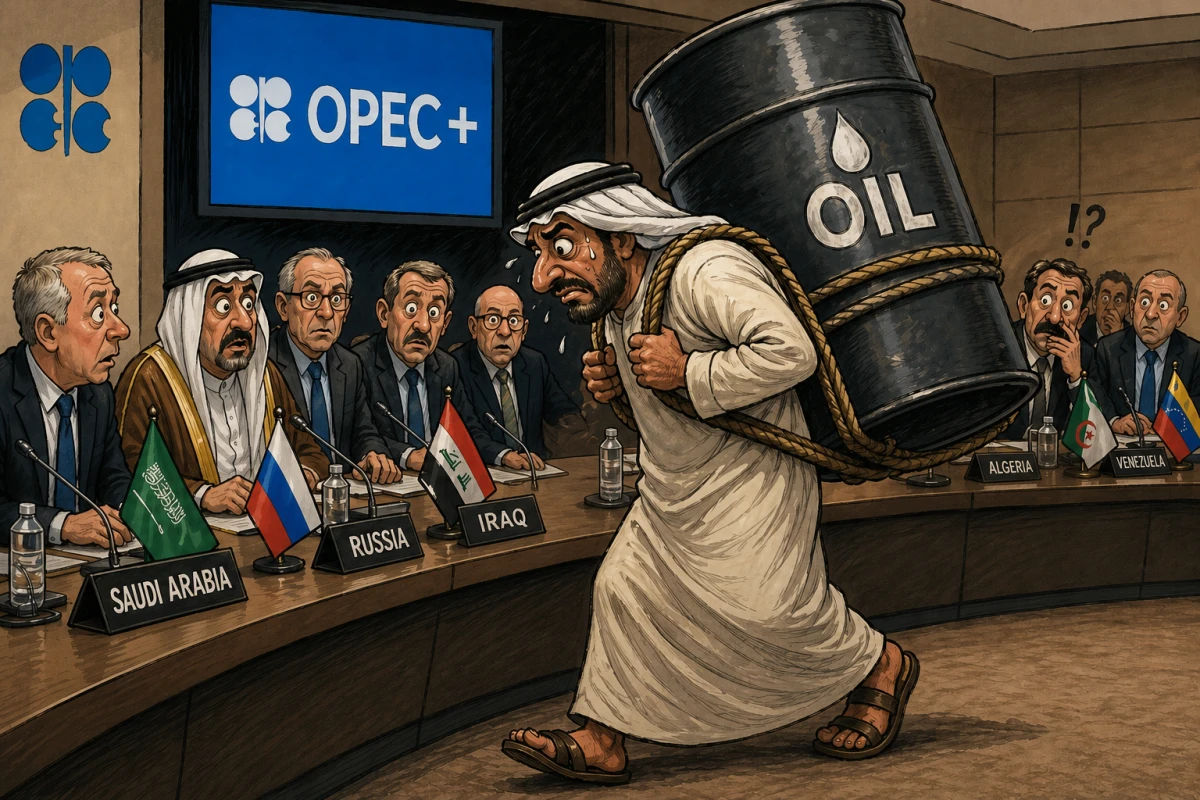
Five years ago, the disagreements between Saudi Arabia and the United Arab Emirates (UAE) regarding oil production plans in the OPEC+ alliance were referred to by the Kingdom's Minister of Energy as "Game of Thrones," which were resolved and came to an end. Last week, the UAE announced its exit from OPEC, in which it had been for nearly 60 years, intending to increase production in accordance with national interests.
Analysts expect a potential surplus in the market in the long term and fear further exits from the organization.
Accumulated Discontent
At the end of 2020, when OPEC+ imposed the largest oil production cuts due to the COVID-19 pandemic, nearly 10 million barrels per day, a scandal erupted within the alliance. Saudi Arabia wanted to continue the restrictions, while the UAE, usually its closest ally in the Persian Gulf, insisted on previously agreed production increases.
One of the UAE's arguments was that some participants were exceeding the established production levels – at that time, Iraq was the biggest violator. The negotiations were difficult, meetings were postponed, even at night, and Saudi Arabia's Minister of Energy, Prince Abdulaziz bin Salman, relinquished his powers as co-chair of the meeting, offering the "throne" to the UAE's Minister of Energy, Suhail Al-Mazrouei. However, a consensus was reached: quotas were raised, but with the condition of a monthly review, and the increase in production was limited.
During the final press conference, Abdulaziz bin Salman urged journalists not to exaggerate the scale of disagreements between the parties, noting that he had watched "Game of Thrones," and the games of thrones in OPEC+ were over.
To Be Continued
The current Middle Eastern conflict has led to damage to the oil production capacities of many producing countries, as well as their logistical capabilities for oil export due to Iran's blockade of the Strait of Hormuz. Problems have arisen for Saudi Arabia, the UAE, Iraq, Kuwait, Oman, and Qatar.
The current state of affairs in OPEC+ is also causing irritation among some participants in the deal, particularly regarding violations of agreed production levels, mainly by Kazakhstan and Iraq. However, while the closure of the Strait of Hormuz has "helped" Iraq bring its compliance with the agreement back to normal, Kazakhstan has significantly exceeded the agreed levels for more than a year.
Last year, with the help of American operators, Kazakhstan launched large oil production facilities at the Tengiz field, and although the republic's government attempted to negotiate with the companies, it ultimately stated that it could not dictate terms to them.
Nothing Personal – Just Business
Saudi Arabia, experts note, needs high oil prices – around $90 per barrel – to finance government spending and the ambitious Vision 2030 program, a complex of large-scale infrastructure projects aimed at reducing the kingdom's economy's dependence on fossil fuels.
Among them is the futuristic city of NEOM, with construction costs estimated at $500 billion. Every additional barrel that the country does not export means a loss of revenue, which negatively affects its ability to develop the economy.
All this is happening at a time when many analysts believe the cartel's overall influence is declining. Once it controlled more than half of the world's oil supply, today it controls less than a third.
Where Is the Strength?
Analysts agree that the loss of the UAE is significant for OPEC+ since the country was one of the few with spare production capacity. Furthermore, the UAE intends to increase production to 5 million barrels per day by 2027 (before the war in Iran, the country produced 3.4 million b/d, almost in line with its quota). The UAE, along with the leader of OPEC and OPEC+ – Saudi Arabia – are among the few players with significant spare capacity – a mechanism through which the alliance exerts influence on the market and responds to supply shocks.
"The strength of OPEC and OPEC+ has always depended solely on the willingness of member states to restrain production volumes, and the UAE was one of those. The loss of a participant with a production capacity of 4.8 million barrels per day and a desire to increase production deprives the group of a real tool," said Jorge Leon, head of geopolitical analysis at Rystad Energy.
According to him, as demand for oil approaches peak levels, for low-cost producers, "waiting in line in the quota system (production restrictions) begins to look like a missed opportunity." Leon believes the market is losing one of the few ways to "absorb shocks," and Saudi Arabia will have to take on more responsibility to ensure price stability.
Although short-term consequences may be minor due to ongoing disruptions in the Strait of Hormuz and overall geopolitical uncertainty, long-term consequences are much more significant, Rystad Energy emphasized.
Who's Next
Some analysts believe that the UAE's decision may provoke others to exit OPEC and OPEC+. It remains to be seen whether this decision will set a precedent for other countries, as the UAE has already become the third country in the last seven years to leave the cartel. Perhaps, at a difficult moment currently being experienced in the Middle East, the contradictions regarding production between the UAE and Saudi Arabia have seriously escalated, which also served as a trigger for such a decision by the UAE.
The main candidates for the next exit from OPEC could be Iraq and Kazakhstan (if we consider economic reasons rather than political ones, as in the case of the UAE). Additionally, Iran and Venezuela are at risk due to their relationships with the United States and Saudi Arabia. However, two unnamed representatives from Iraq told Reuters that the country does not plan to exit OPEC and is interested in a strong alliance to ensure stable and acceptable oil prices.
The current physical oil deficit due to the logistical shock in the strait keeps prices high. However, fundamentally, the UAE's decision shapes expectations of a supply surplus in the medium term. The UAE's decision de facto means the collapse of the previous price regulation system. Once logistical risks in the Persian Gulf decrease, the market will face an excess of capacity.
Entering and Exiting
The oil cartel OPEC was founded in 1960 by Iran, Iraq, Kuwait, Saudi Arabia, and Venezuela. They were later joined by Qatar, Indonesia, Libya, the UAE, Algeria, Nigeria, Ecuador, Angola, Gabon (which ceased its membership in 1995 but returned in 2016), Equatorial Guinea, and Congo. Since OPEC's inception, Indonesia (in 2009 with a brief return in 2016), Qatar (since 2019), Ecuador (first in 1992, then from 2007 to 2020), and Angola (since 2024) have exited the organization.
Countries primarily left the organization due to disagreements over their quotas.
In 2016, the OPEC+ deal was established for joint regulation of oil production levels. In addition to OPEC member countries, OPEC+ includes Russia, Kazakhstan, Mexico, Oman, Azerbaijan, and other states.