
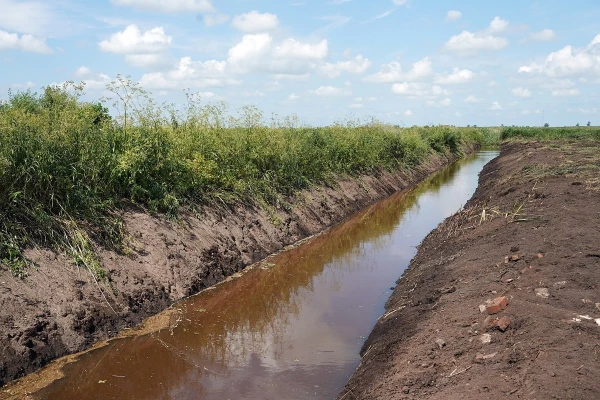
In the European Union, there are very few such low-lying areas, in the direct, geographical sense, as the one we are fortunate to live in. Climate changes affecting our country mean a significant increase in precipitation, and large territories may turn into marshes.
Since the collapse of the planned economy, drainage activities have taken a back seat, large enterprises in this sector have been liquidated, and EU funds are only sufficient for urgent needs.
Drama on Poperechnaya Street
In a fairly prosperous capital neighborhood, known for its prestigious new buildings, a truly wild incident occurred: an elderly woman left her private house, attempted to clear an overflowing drainage ditch, lost her balance, fell into the water, and drowned. The incident took place on a street called Shkersiela, and its drainage systems have been featured in a couple of documentaries that made it famous.
It turned out that we, in the capital of an EU and NATO member state, live in somewhat medieval conditions in everyday life. Although it is enough to look at a map of Riga to understand – the very structure of the urban area, which includes vast expanses of forests, various wastelands, and quite large bodies of water, makes our metropolis resemble a rural biotope more than a highly developed urban organism.
For example, your author feels quite comfortable donning Ukrainian-made boots and strolling through a marshy meadow, gazing at the sky and crows. The other thing is that tens of thousands of people live in such conditions in Riga, on the outskirts, and not so far from the Center. I myself had to spend half an hour digging my car out of a rut in the Skantes area!
Meanwhile, in a document recently discussed at a government meeting, it was honestly stated that there are no plans to address the drainage issues in Riga: "The overarching goal of the Ministry of Agriculture is to promote the well-being of people living in rural areas, to care for safe and quality food, and to ensure the prerequisites for the long-term management of Latvia's natural resources."
Save Nature, Damn It
Catastrophic floods and smaller-scale water overflow incidents in Latvia have recently been taken into account when drafting the budget. For instance, there is a program 26.03.00 "Annual Payments for Compensation for Damage Caused to Land Resources by the Daugava Hydroelectric Cascade"; or 26.02.00 – "Maintenance of the Drainage Cadastre, Operation and Maintenance of State Drainage Systems and Drainage Systems of State Importance."
However, it is clear that today no one intends to return to the practice of five-year plans – and to lay thousands of kilometers of drainage ditches. On the agenda are "environmentally friendly elements of drainage systems." Complex and quite expensive – for example, bioreactors made from wood bark; controlled drainage; artificial wetlands… While studying the documents issued by the Ministry of Agriculture, I learned many new words. For example, sedimentation. This is the deposition of particles in water or air conditions, resulting in the formation of various genetic types of sediments – terrigenous, biogenic, chemogenic… Latvia will create special basins for sedimentation!
Or, meandering. This is the name of a type of channel process, a scheme of deformations in the form of successive stages of the river channel's sinuousness. Our drainage specialists use artificial straightening of rivers – to prevent blockages from forming on them.
A few years ago, a drainage program was developed in our country until 2027, but unfortunately, as noted by the agency of Armands Krauze (the Union of Greens and Farmers): "the period coincided with many significant international events."
"That is, both the COVID-19 pandemic and the military actions initiated by the Russian Federation in Ukraine also affected the planning and implementation of drainage policy in Latvia, the organization of various processes, the definition and implementation of new priorities, including the rising costs of construction."
Now, on top of all this, the crisis in the Middle East can also be added, and as a result, the cost of diesel fuel, necessary for tractors and excavators working in the drainage field, will become exorbitant. Although, of course, all this could have been anticipated in advance – and not participate in the self-imposed restrictions on purchasing fuel from neighbors…
Marshes in Service of the Motherland
However, even before the last fuel crisis, there was a lack of money: "Despite the fact that preventive anti-flood investments in drainage were made, in 2025, an additional 486,486 euros were needed to cover the costs of emergency maintenance of state drainage systems due to the aftermath of floods in areas affected by ongoing rains and storms."
Until December 2025, the Ministry of Agriculture received 45 projects, totaling 12 million – now they are pondering whom to grant and whom to deny.
The money, of course, is insignificant – compared to the 2.16 billion euros allocated for military expenses this year. By the way, in Latvia, there is a serious discussion about a concept according to which marshes in the East should not be minimized in any way. On the contrary – the area should be made more waterlogged. To hinder the advance of enemy tanks through our lands! Perhaps they recalled the plans from the time of Karlis Ulmanis, when in 1939 it was intended, with the help of sluices and reservoirs, to flood the Lubana lowland…
In fact, Latvia has long needed to learn from the Netherlands (translated as "Low Countries"), a quarter of whose territory is located below sea level. The drained and cultivated areas of the Dutch coast – polders, are protected from the sea or other surrounding bodies of water by dikes, dams, and other hydraulic structures. The groundwater level in the polders is regulated by drainage devices, often with mechanical pumping of water. Polders are characterized by high fertility and are usually cultivated.
According to the Ministry of Agriculture, there are also polder pumping stations in Latvia, with sonorous names – Strimeni, Zvidzienas, Kreicha – and they are ready to operate in a 24/7 mode if necessary. Only, again, there is a lack of funds to pay for electricity and fuel.
According to statistics, the area of agricultural land in Latvia is about 1.97 million hectares – or less than a third of the country's territory. The drainage activities, if carried out, are expected to benefit – 64,000 hectares, and even then, the program continues to be implemented. In our country, one must live long!






Leave a comment