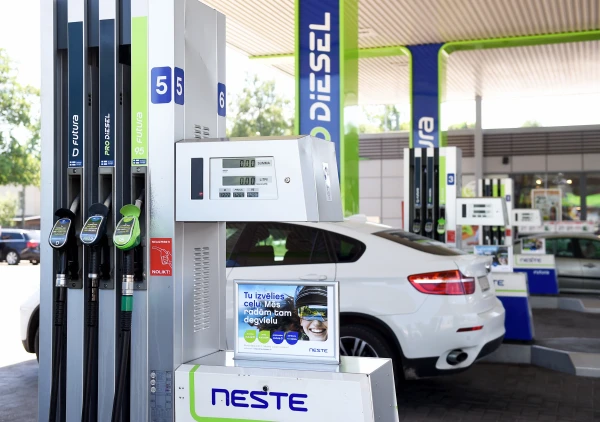
The government on Tuesday supported the Ministry of Economics' proposal to apply a solidarity payment to fuel traders if their actual retail price exceeds the objectively calculated estimated retail price by more than 3%, LETA reports.
According to the draft law developed by the Ministry of Economics, if the established retail price of fuel exceeds the calculated estimated price by 3%, the amount of income exceeding this threshold will be included in the base for the solidarity payment at a rate of 100%.
At the same time, the solidarity payment will not be applied if the retailer can document that the actual procurement costs for fuel during the relevant period exceeded the procurement price used to calculate the estimated retail price by more than 3%. In this case, the base for the payment will be proportionally reduced according to the confirmed excess of the procurement price.
The ministry notes that the draft law "Law on Solidarity Payment for Fuel Traders" is designed to mitigate the negative socio-economic impact on the national economy caused by the sharp rise in retail fuel prices, as well as to ensure additional financial resources in the state budget to strengthen supply security and cover related fiscal needs.
The solidarity payment will be a temporary mechanism that will be applied only in cases where the retail price of fuel significantly exceeds changes in fuel prices in global markets. This will provide additional funds to cover fiscal needs and reduce the impact of rising fuel prices, the ministry states.
The draft law is designed as a short-term, emergency, and proportionate solution aimed at specific risks in the retail fuel market and protecting consumer interests. It is currently stipulated that the law will be in effect until December 31, 2026. Thus, the duration of its application is clearly defined. The mechanism for the solidarity payment will not be launched immediately after the law comes into force — it will be activated by resolutions of the Cabinet of Ministers, which will determine the specific period of application and technical parameters, including the methodology for calculating the estimated retail price.
The Ministry of Economics indicates that the mechanism is aimed at strengthening supply security, reducing the impact of rising fuel prices, and ensuring additional funds to cover related fiscal needs. The payment will also be applied to ensure timely and accurate reflection of tax changes in retail prices, as well as in cases where the rise in retail prices significantly exceeds the dynamics of global fuel prices or does not correspond to tax changes.
An institution designated by the Cabinet of Ministers will calculate and publish the estimated retail price for diesel fuel and gasoline on its website every first working week. All major elements of price formation will be taken into account in the calculation, including the procurement cost of fuel, delivery costs, storage, logistics, and other parameters.
The ministry emphasizes that the estimated retail price will allow traders to make a profit, as the solidarity payment will be directed only against excessive markup. If the actual price exceeds the permissible threshold of 3%, the entire amount of income above this level will be included in the payment base at a rate of 100%.
The regulation stipulates that in such cases, retailers will be obliged to pay the solidarity payment in the amount established by law, which will be directed to cover expenses and fiscal needs related to the sharp rise in fuel prices.
Traders will be required to submit a declaration for the solidarity payment at the moment when the obligation to pay arises. The calculated amount must be transferred to the state budget no later than the 23rd of the month following the reporting period.
It is stipulated that traders will have to provide documentary confirmations — invoices for fuel purchases, customs declarations, and declarations for the solidarity payment — to the LLC "Public Asset Manager 'Possessor'".
It is planned that the administration of the payment will be ensured by "Possessor", which will control the correctness of the calculation and payment, as well as compare actual retail prices with published estimates. To conduct inspections, "Possessor" will cooperate with the Consumer Rights Protection Center, which has the right to request information and documents, conduct inspections, and consider consumer complaints.
It is also provided that "Possessor" will have the right to control the calculation and payment of the solidarity payment and, in case of discrepancies, send notifications about the need to pay the amount and penalties. A penalty of 0.05% will be charged for each day of delay. Payment must be made within ten days from the date of receipt of the notification.
For providing false information, failing to provide it, or actions resulting in non-payment of the solidarity payment, the Consumer Rights Protection Center may impose administrative liability.
It is planned that the law will come into force the day after its proclamation.
It was previously reported that the draft law was submitted for approval by April 10.
Several objections were received regarding the draft law — they were submitted by the Council of Foreign Investors in Latvia, the Latvian Confederation of Employers, the State Chancellery, the Ministry of Climate and Energy, and the Latvian Association of Fuel Traders. At the same time, the Ministry of Climate and Energy, the Ministry of Finance, the State Chancellery, the Competition Council, and the Ministry of Justice presented a number of proposals to improve the draft law.
The Executive Director of the Latvian Association of Fuel Traders, Ieva Ligere, stated that fuel traders do not conceptually support the draft law developed by the Ministry of Economics, as they believe it contradicts the principles of a free market and may not comply with the Constitution.
"This is not about a windfall tax — it is actually direct price regulation. This is a political initiative in an election environment. Traders do not see economic justification, and it lacks an economic assessment," Ligere said.
She explained that the draft law is actually trying to regulate a price, the main components of which traders cannot control: 93% of the price consists of procurement costs and taxes, while only 7% is the part that the trader can manage.