
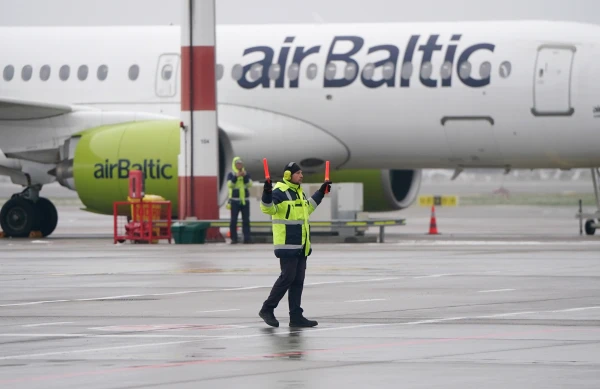
Worse than during Martin Gauss's time — the current management of airBaltic does not communicate with employees, intimidates workers, deals with the disobedient by dismissing them, and every employee must consider the risk of sudden dismissal.
This and other things unknown to the general public happening inside airBaltic are discussed in an interview with Maris Krautmanis from the portal nra.lv by Dace Kavas, the chairwoman of the Latvian Aviation Union.
How do you assess the government's intention to grant airBaltic a loan of 30 million euros?
From the union's side, it is difficult for us to comment on this, as we are not informed about such plans — we are excluded from the information exchange. It is hard to say whether this money is needed or not. Information about any restructuring plans or other decisions affecting employees is not provided. Consultations on these issues are not conducted.
The union emphasized during the COVID pandemic — and this should be repeated now — that any loans should not be issued without clear criteria. From the workers' perspective, there should be clear conditions for responsible handling of money. During the pandemic, the only criteria were environmental issues, while social ones were absent. There were no requirements to control and ensure social protection for workers — for example, that employees could not be hired in Serbia for Serbian salaries, thus creating new problems.
It is difficult for us to assess whether this loan is needed — we assume that it probably is. This is the government's decision. airBaltic may or may not want to involve employees in the process, but it is still a government decision.
Last week, airBaltic lost another court case regarding the dismissal of an employee. There are several current and serious issues related to the accounting of working hours for pilots and flight attendants, and an administrative investigation is ongoing in Switzerland regarding the crews of leased aircraft. The 30 million euro loan should have conditions related to social protection for workers to avoid a repeat of the situation during the pandemic when employees were simply faced with the fact: all airlines need to agree on deviations from collective agreements and transitional periods during which workers agree to a salary reduction for a year to avoid mass layoffs.
Other significant Latvian airlines have entered into such agreements, while airBaltic has taken a different path — not negotiating anything and acting at its discretion, dismissing as many employees as it deemed necessary — as if with a knife.
Could it be that this 30 million — perhaps the entire amount — is needed by airBaltic for purchasing aviation fuel? After all, the Strait of Hormuz is closed, and fuel prices have risen sharply.
This is possible, however, we do not have such information, and employees are not informed either in advance or at all. Employee representatives are excluded from any negotiations. The same applies to issues where consultations are mandatory — for example, changes to the rules for accounting working hours.
From open sources, we see a significant difference in how airBaltic used to purchase fuel and how it does now. Previously, the company actively hedged fuel (entered into forward contracts to reduce the risks of sharp price increases) — about on par with other airlines. This provided a certain sense of security. Now, however, there are reports that only about 10% of annual consumption is hedged or even less. Why? Who made these decisions? Who should be held accountable for them, considering their consequences? Is this related to a lack of cash flow or something else?
Such decisions are made not only by the company itself — they are made by the highest state leadership. And now we all pay for it.
Previously, the CEO and chairman was Martin Gauss, now he works in Bahrain. The airline has a new executive director — Erno Hilden. What has changed?
Martin Gauss was a "communication person" — although not often, he met with employee representatives. The new executive director, who has been in office since December, does not consider it necessary to meet.
He came from a financial background. We consulted with colleagues from the Nordic countries to understand the reasons for such behavior. I think this is not his personal decision — various "intermediaries" have appeared between him and the employees.
In general, there is a trend of excluding employee representatives from social dialogue. It would be good to sit down with management at least once a month to address issues, rather than creating new ones and constantly hearing the same thing: "Do as you wish, if you don’t like it, go to court."
Unfortunately, employee representatives are currently being sidelined, especially the Latvian Aviation Union. We are the only union representing airline employees in courts, and the only one winning these cases. This means we are doing everything right — but someone does not like it.
This trend is extremely negative: information is not provided to us, and employees receive it at the last moment. This was the case, for example, with changes to employment contracts when airBaltic began operations in Brussels. It seems that many decisions are made at the last minute, which raises doubts about the quality of medium- and long-term planning.
The union's goal is not to manage the company but to address labor conditions, including in Belgrade, Vienna, Brussels, Munich, as well as the chaotic transfer of employees to Vilnius and Tallinn.
Before Easter, we received quite positive changes to the contracts of employees in Brussels, but not from the company, rather from the employees themselves — airBaltic did not deem it necessary to notify the union.
It cannot be said that everything is bad, but it is very difficult. The management, in my opinion, is unable to take responsibility and acknowledge mistakes.
Where do the transferred employees pay taxes?
They work abroad for up to three and a half months and therefore continue to pay taxes in Latvia.
The situation is legally complex: employees in Brussels and Belgrade pay taxes in Latvia, while those working in Vilnius and Tallinn pay income tax in Latvia and social taxes in Lithuania and Estonia.
airBaltic does not share its plans, and the union learns about them post factum. For example, there is an announcement about hiring flight attendants in Serbia. On what terms? For what salaries? At the same time, they are formally not employees of airBaltic. But then how do they work on the company’s flights?
Many questions could be avoided if plans were discussed in advance. Our task is to point out the risks. If management is willing to accept them — that is their decision, but someone must be held accountable.
Why hire employees outside the EU and the Baltic states? To circumvent Latvian labor laws? This resembles the situation with SmartLynx Airlines, where flight attendants were not registered in Latvia but in Dubai and other places under self-employed contracts.
Martin Gauss's remuneration was about one million euros a year, while current executives earn about half a million, while other employees earn little. What is the salary situation in airBaltic?
We have been negotiating to prepare a collective agreement for four years, trying to find common ground — what should be included in this agreement. This included discussions about the salaries of technicians, flight attendants, and pilots, who have specific working conditions.
In April last year, airBaltic management canceled all previous agreements, although there was hope that the collective agreement would be signed in May. The company took a roundabout way, excluding the Latvian Aviation Union and entering into an agreement with one of its "old" union organizations, essentially signing a collective agreement for pilots.
Last year, there were changes in pilot remuneration. Pilots can receive higher salaries if they sign a contract that provides for deviations from the collective agreement and even from the law. This is illegal in itself, but according to management, everything is correct. A major court case is currently being prepared regarding this matter.
Flight attendants' salaries do not match the market: 8 to 12 aircraft in Switzerland are serviced by flight attendants with Latvian salaries. Their income ranges from 1200 to 2000 euros and slightly higher — depending on experience and qualifications. This is why an administrative investigation is underway, as flight attendants' salaries in Switzerland are three times higher.
Flight attendants are an extremely important profession; they bear enormous responsibility: the safety of the flight depends on them — whether panic will ensue among passengers during turbulence or not. However, they earn significantly less than, for example, managers who post information about airBaltic on social media.
Salaries can be seen on the airBaltic website: there is a vacancy for a flight attendant in Belgrade — the base salary is 600 euros net per month, plus a productivity bonus depending on flight hours (block hours). On average, the total monthly income reaches 970–1000 euros net with about 75 flight hours per month.
The guaranteed annual base salary for pilots ranges from 54,060 to 70,800 euros gross.
As for pilots, the union's work over the past five years has led to positive changes: there is no longer a scheme where pilots worked through a subsidiary and received half of their salary as "loans," which were then converted into dividends.
This practice has been stopped, and now the salary is paid fully as wages. This was achieved through very difficult means.
Both the State Revenue Service and other state institutions were aware that half of the salary was issued as a loan with subsequent conversion into dividends, but no one reacted.
State authorities do not act! It turns out that an individual employee whose rights are violated has to go to court against a multimillion-euro company. This is disproportionate.
Abroad, there are often large strikes by airline workers. Even very well-paid pilots at Lufthansa strike from time to time. Why don’t Latvians strike?
Because they are afraid.
Technicians, flight attendants, and pilots asked me to join as an "external person" when the union was formed in 2018, not working at the airport, airBaltic, or any other airline — precisely so that it would be harder for companies to "reach" me.
Nevertheless, despite this, I even receive written threats — for example, there was a discussion about banning me from using airBaltic services.
When I reported this to the airBaltic council (the previous composition), they acknowledged that this was unacceptable, but no action was taken. Attempts to pressure me continue.
Just recently, an employee recounted a conversation with one of the airBaltic executives, who advised not to get involved with the union under any circumstances, but to resolve all issues directly with management. But the employee replied that they had been trying to talk to management for several months — without success.
Problems are not resolved and ultimately collapse at the last moment. There is "squeezing" of the union, threats are sounded, and management claims that the union is supposedly damaging the company’s reputation.
When we ask what exactly we are doing or publishing that undermines the reputation, there is no answer. This means these are empty words.
When I met with one of the former ministers of transport, it turned out that he knows details of my family life — about my husband, who flew and was fired after 14 years of work, and now there is a court case. If they cannot pressure me directly, they exert pressure in other ways.
And people in airBaltic are scared — simply scared. Employees understand that if they organize a strike, they will be considered disloyal and fired.
We also wrote to the airBaltic council that there is a toxic work environment in the company. Last year, when the previous head of human resources left, she signed numerous documents for initiating disciplinary proceedings — such a wave had not occurred before, and the cases were absurd.
There is a pressing practice where management seeks to control every step of employees. This intimidation is particularly directed against the Latvian Aviation Union, as we are considered a union that supposedly wants to destroy the company.
Martin Gauss sometimes asked very direct questions — for example, whether we were involved in spreading any news about airBaltic — but at least there was dialogue. Now there is not even that: the new executive director does not talk.










Leave a comment