
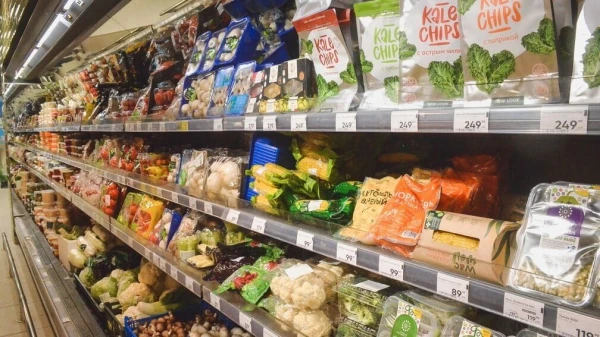
As long as people buy reduced packages, there will be no limit to the tricks.
A trip to "Pyaterochka" or "Magnit" now resembles something like a quest for an honest kilogram. Rosstat claims that annual inflation is recorded at 5.9%, but at the same time, there is a process of hidden "shrinkage" on the shelves. Experts explained why the baskets of domestic consumers are "losing weight" faster than prices.
Kasrilovka-2026: "Cut the herring into five pieces"
This very shrinkflation (reduction in volume while maintaining price) has become the norm in 2026. Anatoly Baranov, a member of the Central Council of the "New Labor" trade union, believes that behind this modern Anglicism lies an age-old practice of survival in poverty.
"Just don’t think that something new has been invented besides this amusing Anglicism. In the story 'Tevye the Dairyman,' Sholem Aleichem writes: 'Kasrilovka lived poorly; it was a vale of poverty. I remember the little shops where the goods were worth about three rubles altogether. The owner bought herring for three kopecks, cut it into five pieces, and sold each piece for a kopeck. Together with a pound of bread, that made a meal or dinner,'" the expert quotes from the work and points out that today this "Kasrilovka" economy is returning in the form of milk sold in 700 ml and packages of six eggs.
According to Anatoly Baranov, in the provinces, for example, in Taganrog, in the mornings, cars come from villages to certain places and sell milk in bulk into the buyer's container, while at markets, eggs are sold individually.
"The question is only about the purchasing power of the population, which cannot spend too much — and they are offered a manageable packaging, of course, with a small margin," the interlocutor shares with the publication.
Trick of the Year: Expansion of Store Brands
If earlier we looked for a catch in the weight of a butter package, now the problem is much broader. Igor Bevzenko, the creator of the "Postmarketing Daily" platform, noted the dominance of private label brands — the store's own brands that are actively pushing out familiar brands.
"And if at the dawn of this phenomenon, fifteen to twenty years ago, private labels were mainly created in the super-economy category and were clearly noticeable on the shelf (the typical product legend in deliberately simple packaging: we do not spend money on marketing — therefore we have an honest, low price), now private labels have penetrated all segments — even premium, and their packaging easily mimics the design of familiar products," the expert says.
Today, large retailers already have hundreds of different private brand names. A buyer often picks a product that looks like a quality brand, but in reality, it is a network order with reduced production costs.
Numbers Against Feelings: A Trillion on "Air"
Why do Rosstat's data (a price increase of only 0.08% in a week in March) diverge so much from reality? Igor Bevzenko explains this by the difference in the methodology of calculating the "basket."
"If you compare an individual consumption 'basket' of any person on the street with Rosstat's data, the difference will be significant. If you compare the shelf of a specific store in any region with the average statistics, the data will also differ. Somewhere by 10%, and somewhere by 20% or more. It all depends on the task of this exercise. Some researchers record price increases for certain groups of food products at 30% — this is also fair. Moreover, we can find products that have risen in price several times," the expert states.
Is There a Limit to "Compression"?
As long as people buy reduced packages, there will be no limit to the tricks. Igor Bevzenko believes that the limit is determined only by the buyer's willingness to "vote for the product with their ruble."
"In many countries, you can buy one egg in individual packaging — significantly more expensive than one from a dozen. Is this a trick? Probably not. This is a new way to meet the market's need for individual product packaging. And, most importantly, it reveals the willingness to pay for it. It is important to distinguish between underfilling milk, for example, as an attempt to deceive the careless consumer or to provide a new solution for those for whom a liter is too much," the interlocutor concluded.











Leave a comment