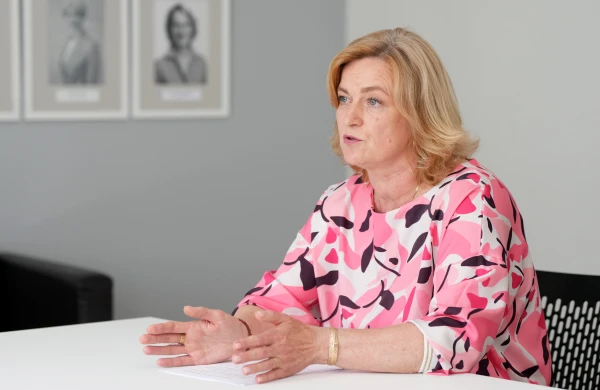
The second pension level in Latvia has undergone significant changes over the past five years, reported LETA the head of the insurance and pension supervision department of the Bank of Latvia, Evija Dundura, writes LETA.
Less than ten years ago, Latvia's second pension level looked unconvincing in international comparison, acknowledges Dundura. According to the nominal return indicators of funded pension plans, that is, returns without taking inflation into account, in the OECD report "Pensions at a Glance 2019," Latvia ranked 31st out of 35 countries in 2018.
Currently, the situation has completely changed, emphasizes Dundura. In the OECD report "Pensions at a Glance 2025," Latvia ranks 6th in return indicators for 2024. This represents a rise of 29 positions — one of the fastest improvements among OECD countries.
Dundura explains that this growth has been achieved thanks to a targeted set of changes that have significantly altered the functioning of the system in recent years. Therefore, when assessing the effectiveness of the second pension level, it is important to focus on the indicators of recent years rather than on the average indicators over 25 years, as there were shortcomings in the system at the initial stage that have now been addressed.
Additionally, the Bank of Latvia has outlined further directions for the pension policy developer — the Ministry of Welfare — where improvements to the system are still possible. The Bank of Latvia regularly and actively participates in submitting proposals, and data shows that this has brought significant improvements to the system and long-term benefits to society.
Dundura notes that the main principle of Latvia's pension system is that the more social contributions paid today, the higher the pension will be in the future. The simultaneous existence of all three levels ensures the stability of the system, as it smooths out the demographic and financial risks inherent in each of them.
In all three levels, the amount of pension depends on the contributions made, so those who pay more receive higher incomes in retirement, explains Dundura. A common feature is also that in all three levels, these contributions accumulate — conditionally or directly — earning interest and forming a larger pension capital.
In the pension system that existed before the introduction of the three-tier model, the amount of pension depended solely on work experience and the average salary in the country, explains Dundura. Furthermore, there was no provision for accumulating pension capital, allowing individuals to participate in forming their savings by tracking financial market indicators and especially the results of the chosen investment plan.
Dundura points out that over time, the number of pensioners will grow, while the number of workers will significantly decrease due to the demographic situation. This means that the current situation cannot be directly transferred to the future. In the future, the first pension level will not be able to provide pensions at the same level as now, so the importance of the second and third levels will continue to grow.
For a long time, the returns of the second pension level were limited by an overly cautious approach to investments, acknowledges Dundura, explaining that the law on state-funded pensions simply did not allow significant investments in capital markets — where the highest long-term profits are formed. Gradually, these restrictions have been lifted, and today they no longer apply.
According to her, this has significantly changed the structure of investments — the share of capital securities (stocks) in the portfolio has increased from about 33% to 65%, meaning that a large portion of pension funds is now working in the global economy rather than being in low-yield instruments.
Dundura also notes that previously the system was based on the assumption that individuals would choose the most suitable second-level pension plan for themselves. In practice, this often did not happen — many participants remained in conservative plans with low returns for years. The approach is now different — if a person does not make a conscious choice when starting their career, the system automatically directs them to a plan appropriate for their age. Furthermore, starting in 2024, managers have the right and obligation to actively reach out to clients and explain a more suitable choice, allowing for greater accumulation.
"However, the final choice always remains with the individual — it can be made at any time by connecting to the 'Latvija.lv' portal and selecting the most appropriate plan based on age and goals," explains Dundura.
She notes that the result is measurable — the share of participants in capital market-oriented plans has increased from 33% to 45%, and thanks to this improvement, accumulations have increased by 37.5 million euros in a year and a half.
Dundura also points out that for a long time, high management fees were a significant problem. In recent years, this has been systematically changed — fee caps have been introduced, significantly reduced in 2019, and reviewed again in 2025.
As a result, about 400 million euros have been saved over seven years, and an additional savings of at least 60 million euros is expected over the next ten years. Currently, the average fee is about 0.36% per year. Dundura emphasizes that this allows most of the profits to remain in people's accounts.
Additionally, she states that the quality of management has improved — stricter performance targets have been established, comparative indices have been improved, and motivation has been created to invest in more productive instruments.
The foundation of the second pension level in Latvia is automatic mandatory accumulation. Dundura explains that this is important because experience shows that if accumulations are voluntary, many do not make them. Currently, there are more than 1.3 million participants in the system, and the total volume of accumulations exceeds 10 billion euros. This ensures both scale and a sustainable foundation for future pensions, she emphasizes.
In her opinion, the next important issue is the stage of receiving a pension. Currently, accumulations at retirement are mainly "fixed," which means there is a risk of receiving pension funds at a time when financial markets are at a low level. Furthermore, considering that on average people spend about 17 years in retirement, it makes sense to seek solutions that allow capital to continue generating income during this period, believes Dundura.