
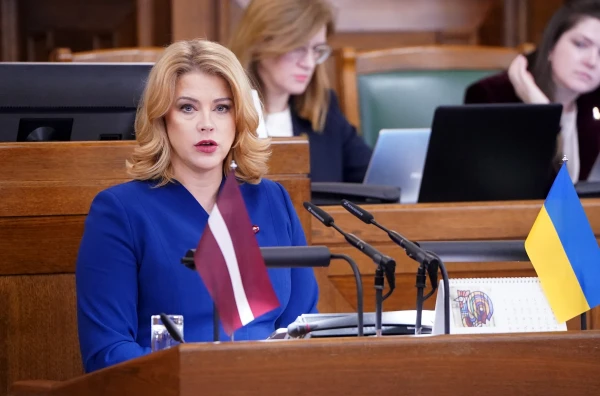
The above quote refers to the speech of the head of government, Evika Silina ('New Unity'), with a report before parliament. A kind of preface to the prime minister's address was the meeting of the Public Expenditure and Audit Commission, where the Ministry of Economics presented data on the development of Latvia.
Twice as Much as in 2000
This is how the current gross domestic product of the republic looks in comparable prices. However, if it weren't for the 2008 crisis, when GDP reached as much as 180% of the level at the beginning of the century, today we would have simply seen a tenfold increase. At least, if we extrapolate the beautiful upward curve that led us to the 'dijkybelis' of 17 years ago.
However, there followed such a dramatic decline that it took Latvia 10 years to climb out of it and return to pre-crisis levels! Only to drop again in 2019 due to the corona crisis. However, it was not so dramatic – recovery started as early as 2021. And a quite reasonable plateau is emerging.
But at the same time, the Latvian consumer, the creator of that very GDP, hardly felt it in their wallet. In 2025, private consumption grew by only 0.8% – a figure within the statistical margin of error, while in 2022, during the time of COVID 'helicopter money', it was a whole 5.1%.
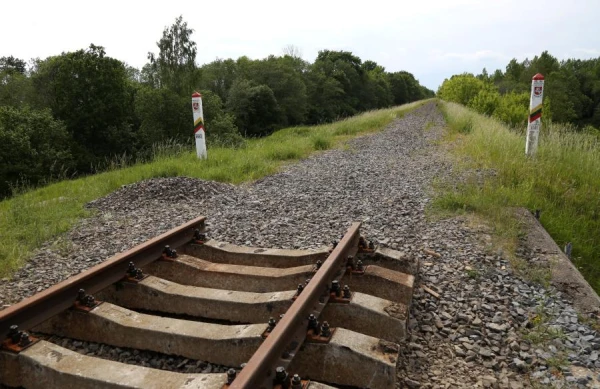
The strongest growth was in investments – last year it was 9.8%, followed by imports at 5.7%, and government consumption at 3.3%. As for exports, it was, so to speak, at the floor – it 'grew' by only 0.1%, which in conditions of significantly higher inflation can be characterized as a decline. That is, the growth of Latvia's national economy, which the head of government boasted about, represents the inflation of government spending on various megaprojects – from the Eastern border to Rail Baltica. With the corresponding import of materials and equipment that do not enter the consumer market in any way, but do shape the statistics of foreign trade and GDP.
Sectoral Twitches
If we consider the contribution of individual sectors of the republic's economy, first of all, we should pay attention to the remarkable stability of retail trade. Over the past two years, there were only a few months when it showed a decline, and otherwise – growing columns of growth on the charts, the last one in January 2026 was even 4.9%, as if the New Year had not yet ended.
On the other hand, the manufacturing industry collapsed in the same January to -1.3% – which is almost TEN TIMES lower than the September growth of 11.3%. As if our industrial producers knew what would soon happen in the Middle East and preemptively said – stop, machine.
Overall, in 2025, Latvia's GDP grew by 2.1% – and relatively equal shares in this growth belong to manufacturing (0.5%), trade (0.4%), construction (0.4%), commercial services (0.4%), and information and communication technologies (0.3%). Agriculture and forestry (0.1%), transport and logistics (0.1%), and real estate transactions (0.1%) contributed very little to the national economy.
All-Consuming Price Growth
The only period when the population of Latvia had the opportunity to live in deflation was the beginning of the Covid-19 pandemic. Price reductions began in March 2020 and continued for a whole year, after which they started to rise – initially moderately, then wildly, at one point exceeding 22% per month. Such were the inflationary trends of the autumn of 2022, which, however, did not affect the success of the ruling party.
Overall, inflation in 2022 was 17.3%, in 2023 it dropped to 8.9%, in 2024 to 1.3%, and in 2025 to 3.7%.
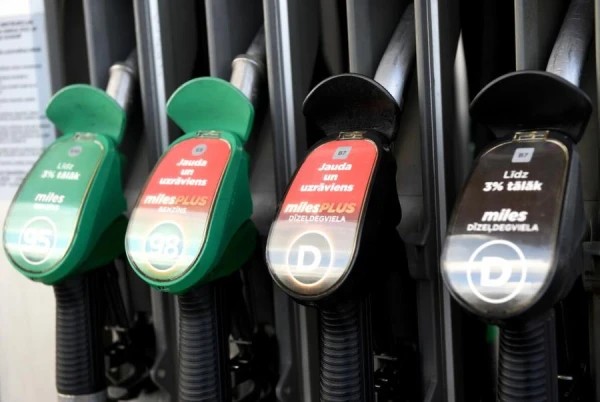
Whether we are currently witnessing the beginning of a new surge can be visually confirmed by visiting fuel stations, where the price of diesel has confidently broken the psychological 2-euro threshold. The fuel used by the overwhelming majority of heavy-duty vehicles involved in the supply chains of everyday necessities is tied to the stock price of gas, which has skyrocketed due to the 'Epic Fury'... So soon we will all feel the delayed effect of American and Israeli bombs falling on Iran, as well as the ayatollahs' drones.
Where to Find the Extra Seven Billion?
This figure is the planned indicator of the Ministry of Economics for just a three-year perspective. That is, if in 2025 the total value of local GDP was 43 billion euros, by 2028 it should already be 50.3 billion. The calculation likely included the extrapolation of the previous three years, when the economy increased from 36.1 to 43 billion.
At the same time, as believed in the department of Viktors Valainis (Union of Greens and Farmers), the annual growth rate will not be lower than a couple of percent, and rather closer to three. For 2026, we are planning 2.7%, for 2027 – 2.8%, for 2028 – 2.9%. However, it is not entirely clear where such optimism comes from – because in 2023 we experienced a decline of 0.9%, and in 2024 everything was strictly at zero, a textbook stagnation. At that time, Latvia was indirectly experiencing the effects of the war in Ukraine, and now the Middle East has been added – so where will such serious growth, by our standards, come from?
And in the rest of Western Europe, as noted by E. Silina in her speech before parliament, things are not so great. The country – the world leader in the happiness ranking, Finland, shows only 0.2% GDP growth, while the former 'Baltic Tiger' Estonia shows 0.6%. "Riga is outpacing Tallinn in new housing construction," boasted the head of the executive power.
At the same time, the Ministry of Economics promises that in 2026-28, annual inflation will remain within 3%, which, for the aforementioned reasons, is hard to believe. The targeted reduction of unemployment from 6.9% in 2025 to 6.2% in 2028 also looks doubtful. Of course, within the margin of error, one can stretch an owl over a globe – but still, the complete ban on trade with Russia initiated by 'New Unity' may lead to a spike in unemployment.
What Will Be the Locomotive?
In the vision of official economists, the driving force of GDP in the next three years should remain construction (+5.6% by 2028), industry (+4.4%), accommodation and food services (up 3.7%).
Through the European Union, 3.5 billion euros will be invested in Latvia – primarily for infrastructure and digitalization. The development of the defense sector promises to allocate up to 3% for its own military-industrial complex and production. In the construction sector, growth drivers are seen in renovation and energy efficiency programs, as well as the aforementioned Rail Baltica.
The growth of lending is viewed as a way to positively influence the increase in investments and private consumption. The latter, along with exports, is still 'below long-term potential' – so in the medium term, significant growth should be expected.
The Ministry of Finance, which also presented its report to the parliamentary commission, indicates that 'from the end of 2024, lending to enterprises and households will increase, and by the end of 2025, the growth rate of the loan portfolio will approach 20% for enterprises and only slightly more moderate for households.'
Last autumn, Latvians took out new loans totaling one billion euros for the first time since 2019. However, if we take a closer look at the debt structure, we find that 'non-financial corporations' play the leading role in it. That is, the population either acquires consumer goods on credit and leasing – or uses the quick cash function to pay for the same utilities. If we consider mortgages, they are also growing, but only once did they exceed the threshold of 100 million euros in new loans for a month.
Constraining Factors
The Ministry of Economics divided the risks into two categories. The 'high' risks include: the Russian-Ukrainian war, the conflict in the Middle East; as well as 'insufficient labor force'. The latter is interpreted as 'the mismatch between the demand and supply of skills, as well as negative demographic trends limiting production capabilities.'
Medium-level risk factors include supply chain disruptions caused by 'geopolitical tensions', which, in turn, increase the costs of importing raw materials and negatively affect Latvian exports. Also classified as medium-risk are: the decline in private investment activity; slow absorption of EU funds; a decrease in growth rates in Latvia's export partner countries, which lowers demand for our products; and the increase in interest rates by the European Central Bank due to rising inflation. This may 'negatively affect lending and increase the costs of financing the state budget.'
However, the Ministry of Finance promises neighboring growth – in Poland, GDP will increase by as much as 3.5% in 2026, in Lithuania by 3%, in Sweden by 2.6%. So it is likely that top fans of Latvian exports will contribute to our coffers. It is ironic that the department of Arvils Aseradens included Russia in the table 'GDP Growth in Latvia's Export Partner Countries'... promising it an economic increase of 1.1%. For comparison – Finland is only at 0.9%.
Our Personal Money
So how does the Minister of Finance from 'New Unity' see the overall effect for consumers? There will be no miracle here:
"In 2025, food products contributed the most to the growth of the price index (CPI). It is expected that in 2026, food prices will remain one of the main influencing factors on prices. This, along with rising service prices, will increase the average CPI by 2.9%."
But there is light at the end of the tunnel: "The growth of food prices in Latvia and the EU slowed down at the end of last year. This trend is expected to continue this year. Food traders raised prices faster than food producers, but since the introduction of the low food basket, it seems that the trend has balanced out."
"Registered unemployment continues to decline – summarizes the Ministry of Finance, which is facilitated by faster growth (of the economy – note N.K.) and a decrease in the working-age population. The labor force participation rate is increasing, simultaneously contributing to employment growth while also supporting a slightly higher level of unemployment..."
"The growth of average wages last year slowed to 7.7%, with a slightly slower growth in the public sector – at 6.9%, while in sectoral terms, the fastest wage growth was in private services." "Private consumption in previous years, among other things, was hindered by a reduction in spending on food and housing, while still rapid wage growth, increasing savings, and stabilizing privacy allow for expecting stronger growth in the coming years."
By the end of 2025, the average gross salary across sectors in Latvia was distributed as follows: financial services – 3000 euros (growth 7.9%), mining – 2000 euros (7%), arts and entertainment – 1500 euros (5.4%). The latter somehow does not align with the declared 'creative economy' of Latvia. In fact, at the very bottom of the food chain are those who are supposed to provide tasty and healthy food – employees in the restaurant and hotel business do not even earn one and a half thousand, before tax deductions. And considering that this includes both top managers of catering and hotels along with maids and waiters, the situation looks even more dismal. Can we expect high contributions to GDP from chronically underpaid categories of workers?










Leave a comment