
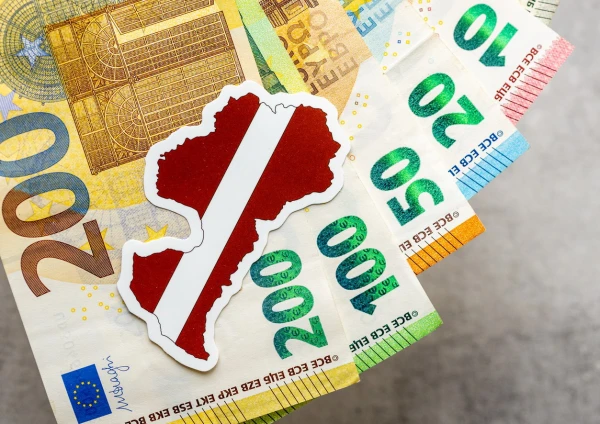
This year, Latvia's gross domestic product (GDP) may grow by at least 2.3%, but the ongoing uncertainty may limit potential growth, banking economists note.
Retail Has Shot to the Moon
Daina Paula, economist at the Bank of Latvia:
– Perhaps the improvement in entrepreneurs' sentiments and the reduction of uncertainty in global trade policy in the second half of 2025 has already been somewhat forgotten. However, it is these factors, along with the revival of lending, that contributed to Latvia's economic growth, with GDP increasing by 0.6% in the fourth quarter of 2025. Overall, for the year, GDP was 2.1% higher than the previous year.
In the fourth quarter of last year, significant growth was observed in trade, financial services, and manufacturing. Consumption was supported by rising incomes and more active lending while maintaining attractive borrowing costs.
Although the European Central Bank (ECB) did not change interest rates, lending conditions remained favorable — competition among lenders intensified, and residents actively took advantage of refinancing opportunities to reduce expenses.
The volume of investments remained significant after a rapid increase in the first half of 2025 — new large projects continued to be announced, for example, in energy and manufacturing, including for strengthening defense.
External demand has so far strengthened weakly, and the geopolitical situation does not contribute to this.
Meanwhile, at the beginning of this year, inflation is decreasing, allowing consumers to make more considered decisions about spending or investments. Retail turnover data for January in comparable prices resembles almost a "journey into space." The impressive contribution came from fuel trade, as well as certain non-food items — clothing, footwear, and some home improvement products.
Surveys of sentiment for February show that the "appetite" for spending may remain stable. And a thick snow cover at the end of February almost certainly promises an increase in electricity production at hydroelectric power stations in the spring when the steady melting begins.
When the snow melts, it will be possible to see whether the economy is ready for a sharper leap than last year after a deep winter sleep. If last year agriculture suffered from rains, this year, perhaps, the deep winter has damaged the fruit and berry harvest.
Uncertainty Has Decreased
Dainis Gashpuitis, economist
– In the fourth quarter of 2025, GDP grew by 2.9%. The quarterly growth allowed the annual figure to rise to 2.1%, which is significantly better than mid-year expectations.
Last year and the fourth quarter were not very successful for agriculture and the transit sector. However, strong growth returned in construction, manufacturing, and commercial services. The positive dynamics in the information and communication technology sector should be particularly highlighted.
The first half of 2025 was characterized by numerous challenges and a deterioration in prospects. In the second half of the year, forecasts gradually improved — uncertainty decreased, risk appetite returned, and labor market prospects improved. Growth in investments and the recovery of service exports created a favorable environment for more active consumption and strengthened economic dynamics this year.
This year, growth will primarily be stimulated by increased capital expenditures, the utilization of EU fund resources, further expansion of exports, and a gradual recovery of private consumption. Inflation rates are slowing down, purchasing power is strengthening, creating favorable conditions for growth in activity.
However, risks remain related to fluctuations in external demand and the impact of geopolitics on consumer confidence.
The U.S. Does Not Want to Buy
Liva Zorgenfreya, economist:
– Latvia's economy grew throughout the last year. In the fourth quarter, real GDP increased by 0.6% compared to the previous quarter (seasonally adjusted data). Compared to last year, GDP in the fourth quarter grew by 2.9%, and overall for the year — by 2.1%.
Last year, the economy was driven by domestic demand: investments grew by 9.8%, government spending — by 3.3%, household spending — by 0.8%. In the fourth quarter, consumer spending was 2.2% higher than a year earlier. Particularly rapid growth in spending occurred in restaurants and hotels at the end of the year, while grocery purchases in stores slightly declined.
However, exports remained weak: overall for the year, service exports grew by only 1%, while goods exports even decreased. In the fourth quarter, turnover with the U.S. decreased by almost 27% compared to last year, which is related to tariffs. The situation regarding trade restrictions remains uncertain, and the impact on Latvia's export opportunities is yet to be assessed.
Builders Have Woken Up
Pēteris Straujiņš, economist:
– The year 2025 turned out to be significantly better for Latvia's economy than expected at its beginning. GDP grew by 2.1%. In the fourth quarter, year-on-year growth was 2.9% — the best result since the end of 2018 (excluding short-term post-pandemic jumps).
The economy grew for seven consecutive quarters, with the main drivers being manufacturing, commercial services, and information and communication services. The fastest-growing sector was construction (+9%).
In 2026, GDP growth may exceed 3% if favorable conditions persist. Potential double-digit increases in energy, stabilization of transport, and better trade performance could accelerate growth.
Updated Forecasts
Ministry of Finance of Latvia:
– In early February, the Ministry of Finance updated its macroeconomic forecasts, suggesting that GDP in comparable prices may grow by 2.6% in 2026. In subsequent years, GDP growth is projected to be within 2.5–2.7%.
Who Is Bigger
Ministry of Economics of Latvia:
– According to our forecasts, in 2026 GDP growth may reach at least 2.5–3% with an increase in investment volumes and economic activity, a decrease in geopolitical tensions, and a faster recovery of external demand.








Leave a comment