
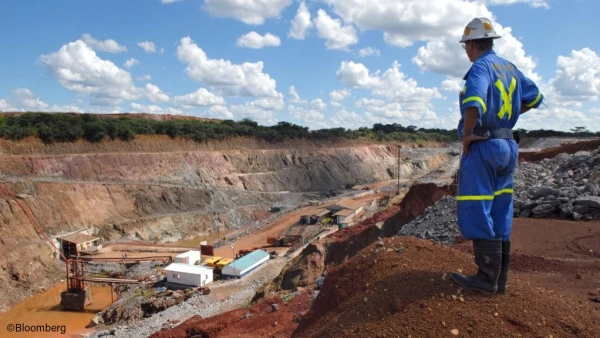
The mining industry also carries environmental risks.
Even during the COVID-19 pandemic, Zambia became the first country in Africa to declare a debt default. Today, however, the situation has changed dramatically: the country is experiencing a noticeable economic upturn, and the reason for this is copper. China, the USA, Canada, European countries, India, and Gulf states are eager to establish a foothold in the Zambian market and secure supplies of this strategic metal.
"Investors have returned," said Zambian President Hakainde Hichilema at the African Mining Indaba conference, one of the main investment platforms for the mining industry in Africa. According to him, more than $12 billion has flowed into the sector since 2022.
Zambia ranks second in copper production in Africa. Moreover, the political situation in the country remains politically stable for Africa.
Today, copper is in high demand on the global market. It is used in the production of solar panels and wind turbines. This metal accounts for about 15 percent of Zambia's GDP and brings in over 70 percent of export revenue.
Last year, copper production in the country increased by eight percent, exceeding 890,000 tons. The authorities have set an ambitious goal to triple production within the next decade.
It is the mining sector that is currently driving the economy forward. The International Monetary Fund forecasts Zambia's GDP growth at 5.2 percent in 2025 and 5.8 percent this year. This places the country among the fastest-growing economies on the continent.
"The seeds sown are sprouting, and the harvest is near," Hichilema stated. He also announced plans to conduct a nationwide geological survey to identify new, yet-to-be-exploited deposits.
Chinese companies have long established strong positions in Zambia's copper sector. They control significant shares in key mines and smelting plants. Among the major players is the Canadian company First Quantum Minerals, the largest corporate taxpayer in the country. Investors from India and Gulf states are also expanding their presence in Zambia.
The United States is also returning to the country. Washington is forming strategic copper reserves. Trump launched the $12 billion Project Vault initiative. This public-private partnership includes the largest companies in the country and aims to ensure supplies of critical minerals to reduce dependence on China.
In September, the U.S. Agency for International Development announced a $1.4 million grant for the subsidiary of the mining company Metalex Commodities – Metalex Africa. The funds will be used to expand operations in Zambia.
An additional factor driving copper prices has been the American tariffs introduced last year. Thanks to these tariffs, companies began actively purchasing both semi-finished products and refined metal.
However, the copper rush also has its downsides.
Experts warn of the possibility of a so-called "pit-to-port" model, where raw materials are simply exported abroad without deep processing within the country.
According to Daniel Litvin, founder of the consulting group Resource Resolutions, there is a risk that the elites will enrich themselves while the majority of the population will not feel the benefits. At the same time, the rhetoric of "partnership" used by world powers may conceal ordinary economic interests.
"The rivalry of great powers may turn into a race for resources on terms favorable to international companies, but not to the people in producing countries," believes Deprose Muchena, director of the Open Society Foundation's program on rights protection and sustainable development in Africa.
Despite rich mineral resources, more than 70 percent of Zambia's 21 million residents live below the poverty line (World Bank data).
Environmental damage also remains a serious problem. The country's copper belt has long faced the consequences of pollution.
In February 2025, at a mine owned by a Chinese company near the city of Kitwe, about 285 kilometers north of Lusaka, a complex containing industrial waste burst. Millions of liters of toxic substances spilled into the environment.
The emissions reached a tributary of the Kafue River – the longest river in Zambia and an important source of drinking water. Zambian farmers filed a lawsuit for $80 billion.











Leave a comment