
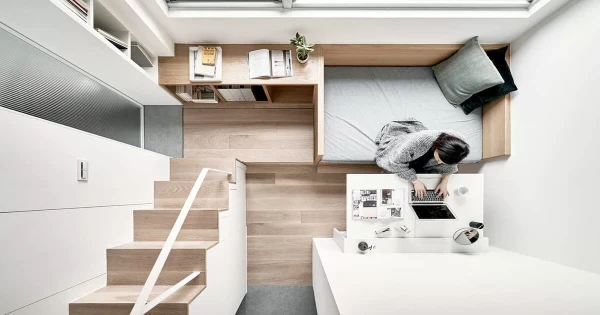
A significant portion of such listings is bought up by investors for rental purposes.
In Russian megacities, there is a new construction boom: apartments with parking spaces.
Just five years ago, a studio of 25 sq. m was considered a 'student' option, a kind of temporary compromise. Today, the real estate market in Moscow and St. Petersburg has hit another low. Regularly, listings appear for properties that are officially called apartments or flats, but in fact have areas of 8.8, 11, and 12 square meters. This is comparable to the size of a standard garage or kitchen in a Stalin-era building.
According to analytical reports from CIAN and the portal ERZ.RF (Unified Resource for Developers), the average area of residential housing under construction in Russia has shrunk to a historical minimum. If in the early 2010s this figure was around 55–60 sq. m, by the beginning of 2026, it had fallen to 42–45 sq. m. In Moscow, this trend is even harsher: over the decade, apartments have 'thinned' by almost a third.
To understand the scale of the disaster, it is enough to look at the largest aggregators. Most often, such listings are disguised as 'apartments' in reconstructed industrial zones and former research institutes. For example, on CIAN or Avito Real Estate, one can find offers in the areas of the 'Botanical Garden', 'Bauman', or 'Electrozavodskaya' metro stations. Here, for 8–9 million rubles, housing is offered where the distance from the front door to the window is only four meters.
The main deception of the 'concrete hives' lies in their cost. Developers use the psychological barrier of a 'low check'. However, if you recalculate the cost per square meter, it turns out that in a studio of 15 sq. m, the price per square meter is 20–30% higher than in a spacious family apartment in the same building. The buyer pays excessive profit to the developer for the mere opportunity to own any property, effectively buying a place in a 'vertical dormitory'.
Architectural Violence: Why Walls Provoke Aggression
When we talk about micro-apartments, it is not only about everyday discomfort but also about a phenomenon that experts call 'architectural violence'. The World Health Organization (WHO) in its housing recommendations as early as the late 20th century indicated that crowding and lack of privacy directly correlate with the rise of mental disorders.
Russian researchers, whose works are published in the scientific library CyberLeninka (in studies on urban environment psychology and urbanism), emphasize: the human brain instinctively perceives limited space as a trap. In conditions where the personal zone (in proxemics, this is a radius of about 1.2 meters) is constantly violated by walls or the presence of another person in an '11-meter patch' — the adrenal glands begin to produce excess cortisol (the stress hormone).
In neuropsychology, there is a concept of territorial imperative. If a person has no opportunity to physically distance themselves from irritants (kitchen smells, TV sounds, movements of a cohabitant), the brain switches to 'fight or flight' mode. Since there is nowhere to run in a studio, the hormonal background maintains a state of constant background aggression. Prolonged stay in such an environment leads to erosion of empathy: a person shuts down and becomes emotionally 'blunt', protecting the remnants of their mental resources.
Professor Dak Kopec, an expert in environmental psychology, notes that living in micro-spaces after the age of 30 is a direct path to depression and an increase in domestic violence. What can be resolved in a normal apartment by going to another room becomes a detonator for a scandal in a 'concrete hive'.
The Economy of Temporary Workers and the Ghetto of the Future
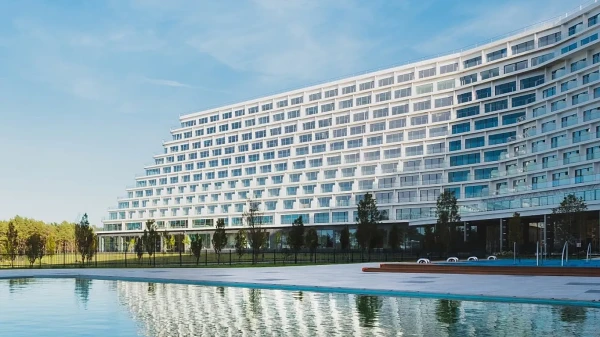
The problem of 'concrete hives' goes far beyond a single apartment. A modern residential complex with a corridor system, where 25–30 doors are located on one floor, is an ideal environment for social apathy. A significant portion of such listings is bought up by investors for rental purposes. As a result, the building turns into a transit zone where no one knows their neighbors, and the turnover of residents excludes any care for common property.
Urbanists predict that in 10–15 years, these areas will become new centers of slum degradation. When the initial gloss of the new building wears off and the engineering systems begin to fail, the affluent class will finally leave these 'hives'. According to studies published by the Institute of Urban Economics (IUE), housing in megacities goes through cycles of 'aging'. When an area is oversaturated with micro-apartments, it quickly loses its appeal to the middle class. Families with children and affluent professionals move to more spacious and quality neighborhoods. Their place is taken by those who have no choice: temporary labor migrants, socially vulnerable groups, and marginalized communities.
As a result, the area is 'filtered' from top to bottom until it turns into an enclave of poverty. As noted by IUE expert Nadezhda Kosareva, the lack of a proper social infrastructure in such residential complexes only accelerates the process of turning an 'investment paradise' into a zone of alienation.
Today's trend for micro-meters is a consequence of economic impotence and urban planning cynicism. As long as the law allows calling 11 meters an 'apartment', developers will squeeze the maximum out of every piece of land. Architecture shapes consciousness. And if we agree to live in hives, we should not be surprised when society begins to resemble a swarm, devoid of individuality and the right to personal space.










Leave a comment