
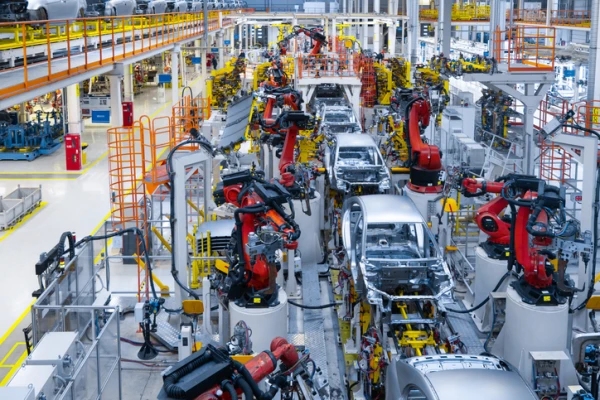
If by 2027 the share of Chinese electric cars reaches 25%, German factories will be forced to halt assembly lines.
While Europe is trying to resist Chinese industrial expansion, Germany is not only opening its electric vehicle market – it is also willing to pay extra. The decision to include Chinese electric vehicles in a new €3 billion subsidy program looks either like a brilliant political move or a scenario from an alternate reality.
The official rhetoric from Berlin sounds extremely naive. Environment Minister Carsten Schneider states that he sees no "evidence of a supposed significant influx of Chinese automakers into Germany, either in the numbers or on the roads."
However, the reality is much more complex than the statistics. German automotive giants Volkswagen, BMW, and Mercedes-Benz are already critically dependent on the Chinese market, where they earn the lion's share of their profits, and any new protectionist move from Berlin is likely to lead to a complete takeover of the German car market by Chinese electric vehicles.
In fact, German subsidies for electric vehicle manufacturers from China are a kind of insurance premium. It is presumed to guarantee the uninterrupted operation of VW factories in Shanghai and Audi assembly lines in Changchun. Essentially, Germany is trying to negotiate with China: "We won’t build barriers for you here – you won’t touch our production there." However, such an attempt does not look like an equal agreement but rather an acknowledgment of the inability to influence the situation, as the German side has far fewer levers of influence over its "partner."
While Berlin plays at openness, its European neighbors are building barriers. France is currently rolling back incentives for electric vehicles produced outside of Europe, while the UK is introducing subsidies that effectively nullify all benefits from purchasing Chinese models. All of this creates a striking picture where the seemingly unified European market displays three different approaches to the same "threat."
This division is a gift for Chinese manufacturers. It allows them to use Germany as a springboard to enter the entire EU market. If Brussels could previously formulate a unified response, now the EU's position is riddled with internal contradictions. Berlin (whether consciously or not) is weakening pan-European protectionism, primarily protecting its own economic interests.
The German government apparently hopes that subsidies will become a tool for forced evolution for its own automotive giants. German corporations have dominated for decades thanks to internal combustion engines, creating a powerful but very inert business model. Now, when a buyer with a government €6000 in their pocket can choose between the base version of a German electric vehicle and a fully equipped, gadget-laden Chinese model for the same money, this will come as a cold shower for Europeans.
It should not be thought that only automotive corporations will suffer; the problem will spread to the entire supply chain of component manufacturers.
German auto component manufacturers, such as Bosch and Continental, will find themselves between a rock and a hard place. On one hand, their old European partners will demand a 30-40% reduction in costs. On the other hand, they will have competitors in the form of Chinese manufacturers and auto parts suppliers. In such conditions, only those who can radically reduce production costs without losing quality will survive.
In the next two years, Germany will likely achieve the desired result – a sharp increase in electric vehicle sales. The market will be flooded with affordable models from BYD, Nio, and Xpeng. Prices will fall, and choices will soar. The climate goals set by eco-activists for the government will become closer.
However, the voluntary renunciation of its interests does not go unnoticed, and many Russians still remember the consequences of fully opening the domestic market to all comers in the 1990s. The situation, where it was easier to buy ready-made than to invent one’s own, led the country to lose production, skilled personnel, and technological dependence on "respected partners."
Likely, the same will happen with the German automotive industry when systemic risks manifest by 2027-2028. What if for the new generation "made in Germany" becomes associated with conservative, expensive technology of the past, while "made in China" is linked to smart and affordable cars?
It should not be forgotten that the German automotive industry comprises not only engineers but also hundreds of thousands of workers in assembly plants. Their jobs are protected as long as final assembly takes place in Germany, but basic business logic pushes manufacturers to move assembly lines as close as possible to sources of cheap batteries and components. Subsidies will only accelerate this process.
The most optimistic scenario for the German industry will occur if the "shock therapy" works and automakers find the strength to create competitive vehicles. In that case, by 2028, the German car market will feature its own lines of electric vehicles on new, simplified platforms, while Chinese brands will remain niche players.
The most realistic scenario: Chinese manufacturers will stake their claim in the budget and mid-range segments, capturing 15-20% of the market, while German brands will migrate to the premium segment, but their overall share will irreversibly decline.
The most catastrophic scenario: if by 2027 the share of Chinese electric cars reaches 25%, German factories will be forced to halt assembly lines. In this case, Germany may be compelled to introduce emergency protective measures, potentially provoking a trade war with China.
However, the experience of the "soft" expansion of the Chinese into other sectors of the EU industry shows that no strict measures and demands work when dealing with China. Frankly speaking, any ultimatums will only lead to China imposing a trade embargo on component supplies, and there will be nothing to replace them.
Ironically, Germany, which once created the most powerful automotive industry, is now gambling it in a risky game with China. From the German government’s perspective, this is far from a sudden bout of generosity, but a forced acknowledgment of the deep crisis of the old model of economic relations. Berlin is trying to buy time, using support measures for all automakers, including Chinese ones, as an incentive.
But will it succeed in conducting this operation on itself without signing a death warrant for its automakers?










Leave a comment