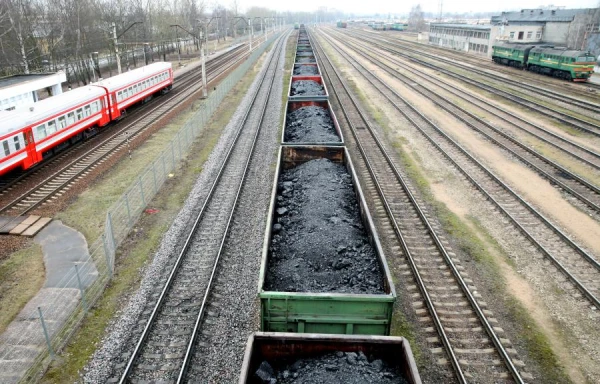
The volume of railway freight transport in Latvia is rapidly declining: a 17.6% drop is expected in 2025, which is comparable to the decline in birth rates, data for which will be released later, writes Arnis Kluiņš on nra.lv.
The dynamics of changes in the volume of freight transported and the number of newborns in Latvia are indeed similar both in terms of direction and timing: a sharp decline in the 1990s, a rise during the "fat years" up to the 2008 crisis, recovery after the crisis, and a new prolonged decline since 2015. This year became peak for both birth rates and freight transport: at that time, the volumes were still at a safe level, allowing "Latvijas dzelzceļš" (LDz) to maintain infrastructure without subsidies. However, now transport volumes have fallen so much that the state has to allocate up to 100 million euros annually to maintain the railway.
For the LDz infrastructure to exist without state support, it is necessary to transport about 50 million tons of cargo per year. In 2018, this figure was 49.3 million tons — already on the brink. In 2019, volumes decreased to 41.5 million tons — and the need for subsidies began. In 2025, only 9.4 million tons are expected, which is already less than one-fifth of the level in 2015:
| Year | 2015 | 2018 | 2025* |
|---|---|---|---|
| Cargo (million tons) | 55.6 | 49.3 | 9.4 |
| Change (%) | 100 | 89 | 17 |
| Newborns | 21,979 | 19,314 | 11,685 |
| Change (%) | 100 | 88 | 53 |
*Forecast assuming the birth rate remains at the level of the first 11 months of 2025.
Hope Dies Last
The good news is that the recovery of freight flow is not yet ruled out. Every day, forecasts and statements about the imminent end of the war in Ukraine emerge. In such a scenario, LDz's cargo volumes could theoretically double or triple — as long as the corresponding infrastructure remains: locomotives, drivers, equipment. However, over the last ten years, infrastructure has been reduced to cut costs.
A typical example is the announcement from January 18, 2026: LDz plans to auction two diesel locomotives, with a starting price of 177,600 euros each. LDz is also continuing attempts to sell wagons stuck in Ukraine.
Among the legacies of 2025 that carried over to 2026 is the question: "Is Latvijas dzelzceļš a useless goat that needs to be slaughtered?" — this is how Neatkarīgā described the then-discussed but later postponed plan to dismantle the rails on the eastern border — between Latvia and Russia/Belarus. The idea: if there are no rails, then the Russian army will not be able to quickly reach Riga, Liepaja, or Ventspils in the event of Ukraine's defeat and the West's capitulation. However, even without this, the defense of Latvia in such a scenario would be in great doubt.
If the eastern railway branches are dismantled, LDz risks being abolished as an independent enterprise and turned into a division of "Pasažieru vilciens," serving passenger infrastructure.
Latvia Between Lithuania and Estonia
A comparison with the results of the railways in Lithuania and Estonia shows that the situation in Latvia is not unique. In Lithuania, the decline in volumes in the first half of 2025 was 5.7% — from 12.2 to 11.5 million tons. But “Lietuvos Geležinkeliai” does not publicize these figures, hiding behind data on the growth of military transport, reduction of CO₂, etc.
In Estonia, the situation is even worse. “Eesti Raudtee” did not publish a report for the first half of 2025 at all, and the annual report recorded a 40% decline compared to 2023. In 2024, the volumes amounted to only 2.9 million tons.
In Latvia, in the first half of 2025, transport volumes decreased by almost 28% — from 6.1 to 4.4 million tons. In the second half of the year, the situation improved slightly: volumes more than doubled, and the annual decline was reduced to 17.6%.
The Future of LDz: In Search of a Vision
Of the 9.4 million tons transported in 2025, 7.6 million were for international transport (–21.7% compared to 2024), while domestic transport grew to 1.9 million tons (+4.5%). The cargo flow to ports decreased significantly — to 5 million tons (–29.3%).
Encouraging is the growth of land transit through Latvia — +20.4%, to 933 thousand tons. The question arises whether this corridor between Lithuania and Estonia can continue to develop at such a pace for many years and justify the billion-euro investments in the “Rail Baltica” project.
The situation in LDz is so alarming that it has already led to personnel changes. The chairman of the board of LDz Andris Liepiņš and board member Reinis Ceplis lost their positions, even though their mandates had been extended until 2029. They were replaced by Zlata Elksniņa-Zaščirinska, who previously headed the Council of Foreign Investors in Latvia for a long time. Perhaps she knows the answer to the main question: does Latvia even need railway transport — and if so, what kind: freight or passenger, east-west or north-south, with a gauge of 1520 mm or 1435 mm?