
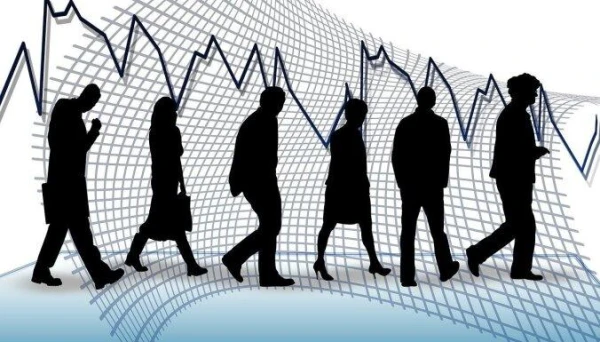
The actual unemployment rate in Latvia by the end of this year may be around 6.2–6.6%, bank analysts forecast, reports LETA.
Senior economist at Swedbank Agnese Buceniece pointed out that a slightly stronger economic growth combined with a declining number of working-age residents means that the labor market will become a bit tighter. It is expected that the actual unemployment rate will decrease from approximately 7% on average in 2025 to 6.6% in 2026. However, the growth in employment will be quite insignificant.
She added that entrepreneurs' expectations regarding employment at the beginning of 2026 are rather cautious. The number of workers is planned to be increased mainly by construction companies, and there is also some optimism among industrial enterprises. Meanwhile, no significant changes in staffing levels are expected in the service and retail sectors. Employment growth is not planned in state and municipal institutions, with some exceptions.
Luminor Bank economist Peteris Strautins predicted that the job-seeking rate in 2026 will average around 6.3% compared to 6.9% last year.
"This is quite natural in the context of accelerating economic growth. Finding new employees and retaining existing ones will become one of the main tasks for enterprises," Strautins said, adding that they are currently managing to cope with this.
Despite the decline in the working-age population, the number of employed and the number of jobs slightly increased in the third quarter of 2025, indicating a reduction in both the economically inactive population and the number of unemployed.
He noted that among the economically inactive, there are always those who are capable of working but are not looking for a job either due to unwillingness or because they have lost hope of finding one. A growing economy provides the first incentive in the form of higher wages and the second — hope. For those already seeking employment, the economic cycle will improve the situation, reinforcing long-term trends — population relocation closer to development centers and the growth of professional skills.
Strautins also indicated that all of this points to gradual changes.
"Perhaps in 2026, the labor market will feel the impact of technological changes more acutely, as artificial intelligence begins to replace more categories of workers. This technology holds the potential for significant productivity growth but may also cause serious disruptions. The question of how AI will transform the labor market remains extremely uncertain worldwide," he said.
Macroeconomic expert at SEB bank Dainis Gashpuitis noted that the main news regarding 2026 is that the labor market will become more active following the economy.
According to him, significant demand is expected from the manufacturing industry and the construction sector, and there will also be a more active recruitment of workers in the service sector. This will create more opportunities for participation in the labor market. However, one of the key challenges will remain the mismatch between the expectations and capabilities of employers and employees — the parties will need to work on this, with government support on certain issues.
"It is expected that the job-seeking rate will decrease," he added.
Gashpuitis also acknowledged that it is difficult to predict how actively economically inactive residents will want to start working — this will affect the pace of unemployment reduction. In this case, the decrease may occur more slowly, but this will be a positive factor.
"It is important that employment will grow in 2026," he emphasized.
According to him, the situation is characterized by data from the third quarter of 2025, when the unemployment rate reached 6.9%. Although this might seem like a worrying signal, it actually indicated an improvement in the perception of the future — the number of job seekers increased due to those who had not previously looked for work, rather than due to layoffs.
"As employment has increased, this is a good sign — more people are getting involved in the labor market. Not everyone will be able to find a job immediately, so some will be looking for longer, temporarily increasing unemployment. However, the acceleration of economic growth promises improved opportunities," Gashpuitis said, predicting that by the end of 2026, the unemployment rate could decrease to 6.2%.











Leave a comment