
The main partners are Europe and Southeast Asia.
The state corporation "China Railways" announced statistics for the outgoing year 2025 on the eve of the new year 2026. According to the agency, from January to November, nearly 3.73 billion tons of cargo were transported across the country and beyond the borders of China, which is 2.7% more compared to the same period last year.
According to the Xinhua news agency, during the mentioned period, 31,200 trains were dispatched as part of international rail freight transport – China-Europe / China-Central Asia. Compared to last year, this represents a 9% increase. In November, the number of dispatched trains increased by 21% to 1,852, setting a new monthly record.
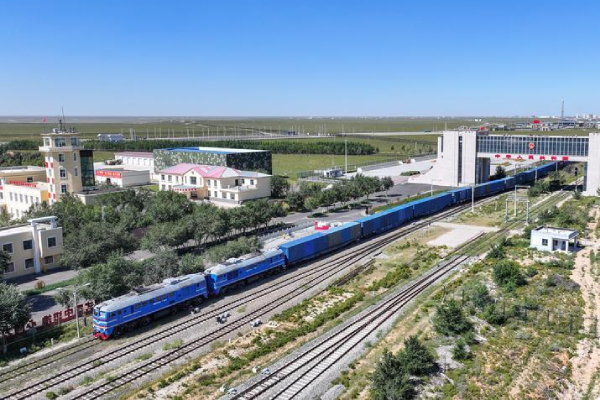
The volume of rail freight transport between China and Laos increased by 15% this year, reaching 4.98 million tons, noted the state corporation.
In particular, the corporation stated that "green" channels were created to ensure the efficient delivery of coal, metallurgical raw materials, grain, and other cargoes. From January to September of this year, more than 1.5 billion tons of coal were transported by the country’s railways, including over 1 billion tons of this fuel for electricity generation.
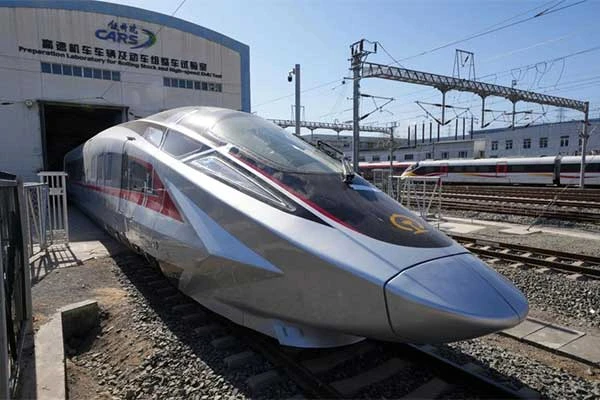
Earlier, preliminary tests began in China for the world's fastest high-speed train CR450. During a test run, it accelerated to a speed of over 450 kilometers per hour. Currently, the train is undergoing qualification tests on the high-speed railway connecting the megacity of Shanghai in eastern China with the cities of Chongqing and Chengdu in the southwest of the country. As reported by the "Keji Ribao" ("Science and Technology News"), the train reached a speed of 453 km/h.
The train can accelerate from zero to 350 km/h in just four minutes and 40 seconds. Two trains set a record by overtaking each other with a combined speed of 896 km/h.
Testing of the CR450 train began in March. It is designed for a maximum test speed of 450 kilometers per hour and a commercial operating speed of 400 km/h. According to technical requirements, before being put into operation for passenger transport, the CR450 must travel 600,000 kilometers.
Compared to its predecessor CR400, this model features a longer and sharper front end, a reduction in the height of the car body by 20 centimeters, and a decrease in weight by 50 tons. This allows for a 22% reduction in aerodynamic drag.
The CR400 "Fuxing" high-speed trains are currently operating at a speed of 350 kilometers per hour.











Leave a comment