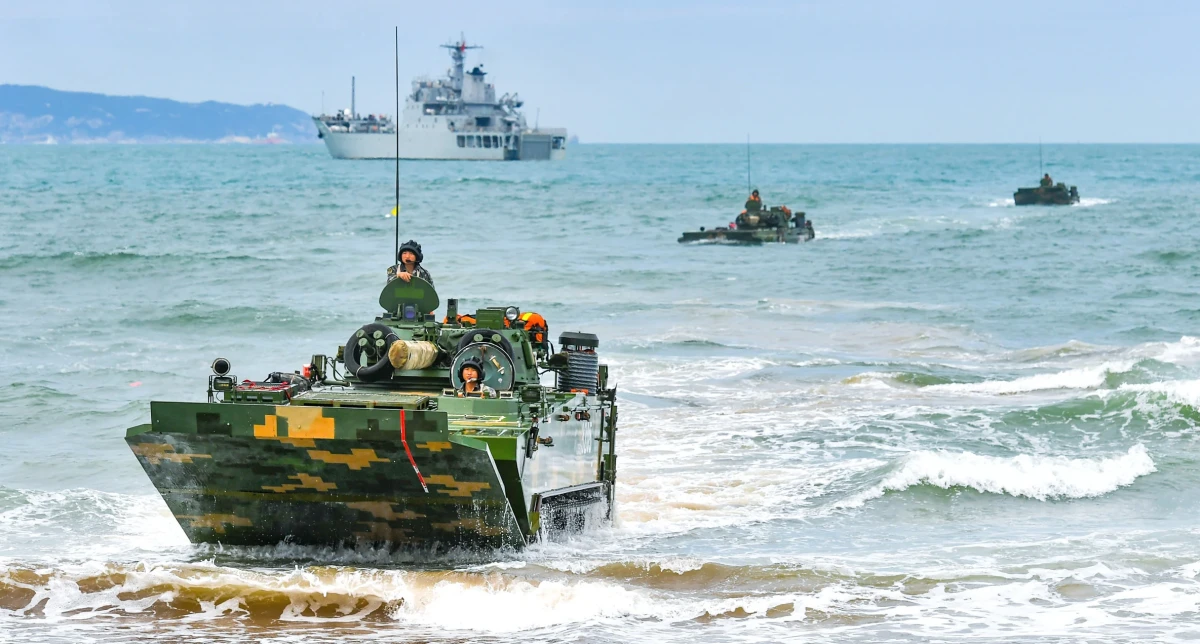
To conduct an amphibious operation, it is necessary to cross the strait via a limited number of routes.
Beijing does not have sufficient resources to capture and hold Taiwan, stated former head of the US Pacific Command and former Director of National Intelligence (2009-2010) Dennis Blair.
Despite the ongoing military buildup of the PRC, the PLA currently lacks the necessary capabilities for a successful "capture" and subsequent retention of Taiwan, and in the short term, the likelihood of developing such potential remains limited.
Blair notes that the main limiting factor for Beijing is the insufficient ability to conduct a large-scale amphibious operation. According to the results of American military exercises and studies, the most vulnerable element of the Chinese plan for a possible "invasion" is the lack of troop transport means across the Taiwan Strait. The existing capabilities of the PLA do not guarantee the delivery of the necessary number of personnel, weapons, and supplies to the island for conducting a full-scale operation with subsequent retention of the territory.
Additional risk factors for Chinese command include corruption issues within the military, and the lack of practical experience in modern joint operations and decision-making in rapidly changing combat situations among a significant portion of the senior officer corps.
According to Blair, alternative scenarios of coercive pressure on Taiwan, including massive missile and air strikes, maritime and aerial blockades, or displays of force, also do not guarantee the achievement of Beijing's strategic goals. Taiwan has been implementing a program of dispersal and underground placement of important military facilities in recent years, which reduces the effectiveness of a first strike and increases the resilience of the command system. A blockade and invasion would only provoke resistance among the Taiwanese people and lead to international economic sanctions and US intervention.
Blair pays special attention to the factor of time. In his opinion, covert preparation for a large-scale amphibious operation is practically impossible. The redeployment of troops, concentration of transport fleets, and preparation of infrastructure will be timely detected by US and Taiwanese intelligence, allowing for the defense forces to be brought to the highest levels of combat readiness in advance and to organize countermeasures even at the stage of deploying the PLA grouping.
The development of modern military technologies is considered an additional deterrent factor. Blair points to the accelerated deployment of long-range hypersonic strike systems by the US, capable of overcoming air and missile defense systems. Such systems, according to Blair, could be used to strike important military infrastructure targets in the PRC, including naval bases, ports, and supply facilities on the coast.
The influence of the geographical factor is emphasized separately. To conduct an amphibious operation, the PLA must cross the Taiwan Strait via a limited number of routes, making the amphibious transport groups vulnerable to strikes from anti-ship missiles, unmanned systems, and aviation. At the same time, the US and its allies retain the ability to disperse forces along the first island chain, which enhances the resilience of their operational structure.
From the perspective of military balance, China's military superiority over Taiwan is gradually diminishing, and the chances of capturing the island are decreasing. According to Blair, Taiwan is consistently adapting the experience of modern armed conflicts, primarily the combat actions in the so-called Ukraine. Priority areas of development include unmanned aerial systems, precision missile weapons, reconnaissance means, and asymmetric methods of warfare. Additional factors strengthening the island's defense capabilities include increased military spending and extended military service terms.