
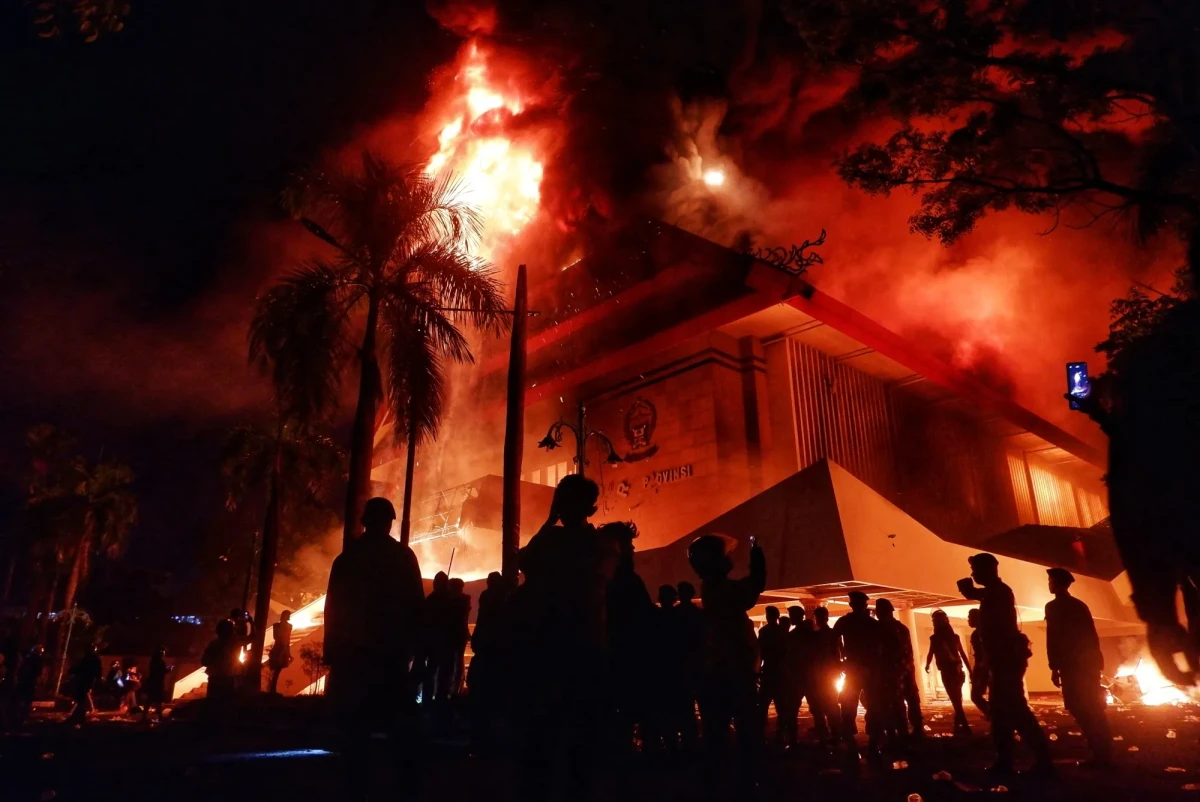
“We want to show that not everything is right in the country.”
Indonesia has been swept by a wave of student protests against the policies of President Prabowo Subianto and his Gerindra party. The demonstrations began following news of a sharp increase in fuel prices, first in Jakarta and then in other cities across the country. In some areas, serious clashes occurred between protesters and law enforcement forces.
The protesters have put forward a wide range of demands: they are calling on the authorities to lower fuel and basic food prices, stabilize the exchange rate of the rupiah, and cut expenditures that they deem wasteful. The main target of criticism is the flagship program of free meals for children and pregnant women, one of Prabowo's key projects. Opponents of the president believe that the program burdens the budget, is poorly monitored, and is used by the authorities to strengthen political support in remote regions.
Hundreds of Indonesian students took to the streets of Jakarta, demanding lower prices for fuel and food, as well as urging President Prabowo Subianto to abandon costly state programs amid rising economic pressure. This was reported by the Associated Press.
The protests were sparked by a sharp jump in prices for certain types of fuel: last week, they rose by 32%. This occurred against the backdrop of the war between the U.S. and Iran, which heightened tensions in energy markets. For Indonesia, this blow has been particularly painful: the country is already experiencing a difficult economic period — prices are rising, the cost of living is increasing, and the rupiah fell to a historic low of 18,000 per U.S. dollar in early June.
After Friday prayers, about 1,500 students attempted to march to the traffic circle near the Hotel Indonesia — one of the most famous squares in the center of Jakarta. However, their path was blocked by the police. This area has been closed to rallies for many years, as it is located in the heart of the business and commercial district of the Indonesian capital.
To ensure security, the authorities deployed more than 6,000 police officers and military personnel. They guarded the presidential palace and other key sites, directing protesters toward the parliament area and the National Monument. However, many students refused to change their route, stating that they wanted to hold the demonstration precisely in the business center of the city, as the protest is primarily related to the worsening economic situation.
"People will not remain silent. They will speak out when they cannot afford food, cannot find work, and cannot live with dignity. That is why we are out on the streets today," said a protest participant named Jordan to the Associated Press.
Some demonstrators attempted to break through police barricades, kicking the metal shields of law enforcement officers. At one point, the crowd began chanting, "Revolution!"
Students in yellow and blue university jackets held placards demanding the cancellation of the fuel price hike and referred to Prabowo Subianto's cabinet as a "wall of shame." They also called on passing motorists to honk in support, Reuters reports.
According to one of the leaders of the student movement from the University of Indonesia, Yatalathof Ma'shum Imavan, the protesters are demanding that the government meet several key demands: not only to lower fuel and basic food prices but also to stop what the participants of the rallies call wasteful government spending, particularly to abandon the free meal program and the rural cooperative project.
"Due to excessive spending on free meals, the authorities have started to cut other forms of support for the population," said protest participant Rafael Arreva to the publication.
The free meal program is considered the main social project of President Prabowo. It is aimed at 83 million children and pregnant women across the country. However, government critics label it as ineffective, pointing to large-scale financial abuses and believing that the authorities use the program to strengthen political support in remote regions of Indonesia.
The program faced a new wave of criticism after thousands of schoolchildren were poisoned by food distributed under the project. For opponents of the government, this became yet another proof that the authorities poorly monitor one of their main social initiatives.
Another reason for discontent has been the expanding role of the military in civilian affairs. Students and human rights activists fear that such a policy could return Indonesia to the authoritarian practices of former President Suharto.
"We want to show that not everything is right in the country. We cannot remain silent when our country is moving toward bankruptcy in economic, democratic, and moral terms," Yatalathof Ma'shum Imavan told Reuters.
In response, the head of the government communications agency, Muhammad Kodari, stated that the authorities view the protests as a normal manifestation of democracy and are ready to listen to the opinions of citizens. He also emphasized that the government has already cut some non-essential expenditures but insisted that the free meal program is necessary to protect public health.
The protests were not limited to a single rally in Jakarta. As reported by the Indonesian publication The Jakarta Post, on Monday they continued and spread to other cities, including Semarang in Central Java, Surabaya in East Java, Medan in North Sumatra, Lampung province, and Bandung in West Java. In Bandung, according to the publication, clashes occurred between demonstrators and the police.
Student discontent manifested not only on the streets but also within university walls. On Monday, a group of students disrupted a public discussion at Gadjah Mada University in Yogyakarta, where Deputy Minister of Agriculture Sudaryono, a representative of Prabowo's Gerindra party, was speaking. The students demanded that the event be stopped. Later, Sudaryono reported that he was struck during the scuffle, after which security escorted him out of the building.
Political scientist from the National Research and Innovation Agency, Lily Romli, told The Jakarta Post that the recent protests reflect discontent and are not just about fuel prices. According to him, it is about deep disappointment in how the authorities make decisions and respond to criticism.
He added that the House of Representatives, which is currently dominated by pro-government parties, is also failing in its oversight function. As a result, many citizens no longer feel that the parliament represents their interests and take to the streets, turning mass protests into the main means of pressure on the authorities.









Leave a comment