
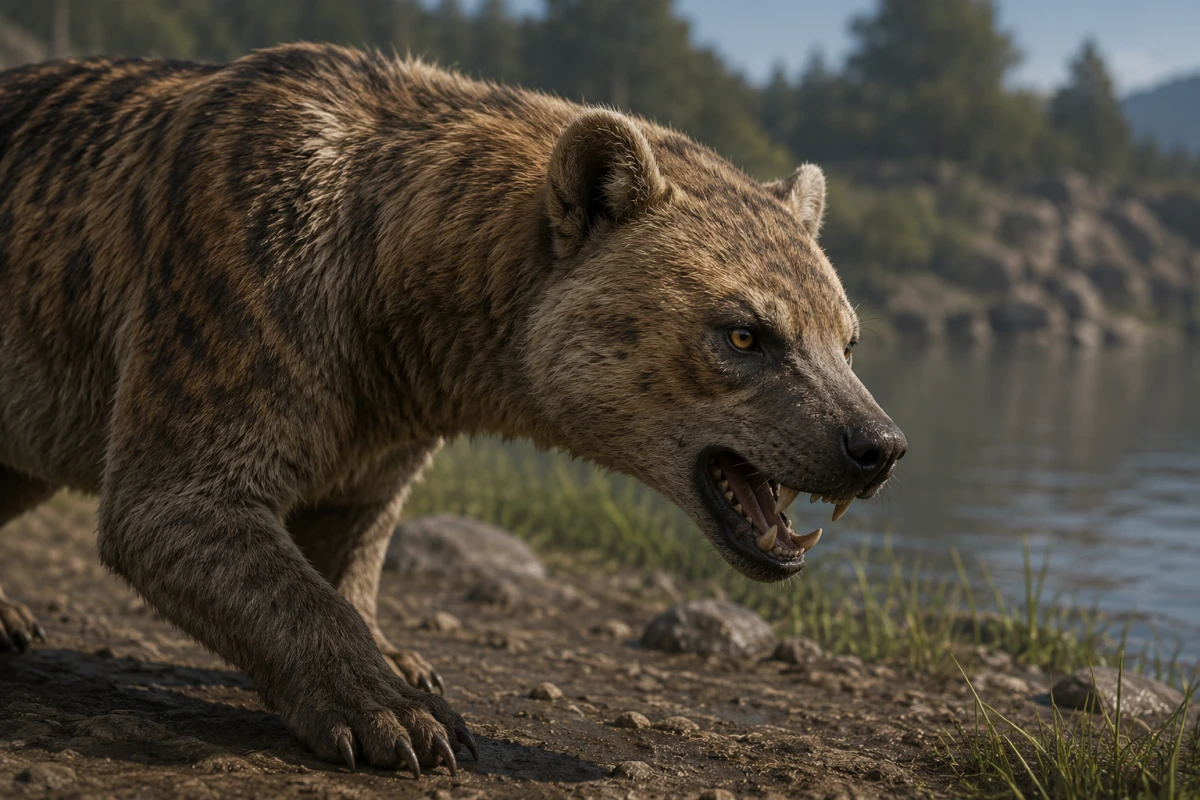
A nimble creature slightly smaller than a leopard roamed the shores of lakes 15.9 million years ago.
Paleontologists have described a new species of extinct predators named after the famous Spanish scientist Salvador Moyà-Solà. The fossils were found in northeastern Spain, at the Els Casots site, reports Phys.org.
The new species is named Paludocyon moyasolai. It lived about 15.9 million years ago during the early to middle Miocene and belongs to the amphicyonids—a group of predators colloquially known as "bear-dogs." This name is misleading: these animals were not direct relatives of either bears or dogs. They represent a separate extinct family within the order Carnivora that thrived in North America and Eurasia for much of the Cenozoic era—from the Eocene to the late Miocene.
The "bear-dogs" were remarkable for their diversity. Among them were hypercarnivores whose diet consisted of nearly two-thirds plant matter—their teeth resembled those of bears. There were also hypercarnivorous forms that fed on meat more than 70% of the time and had teeth similar to those of cats. Previously, paleogeneticists unraveled the mystery of cave lions.
Paludocyon moyasolai belongs to the subfamily Amphicyoninae. Its genus is characterized by a hypercarnivorous dental system: robust upper molars and reduced premolars. Scientists described the new species based on a fairly well-preserved but laterally compressed skull with almost a complete set of upper teeth, as well as an isolated second lower molar.
Analysis of the morphology of the upper teeth showed that P. moyasolai differs from all known relatives. Firstly, it has unique proportions of the upper molars. Secondly, it has a more developed third molar with well-defined anterior cusps. Such features are absent in any other species of paludocyon. Incidentally, the name Paludocyon translates to "marsh dog."
This predator was a medium-sized hunter—noticeably smaller and nimbler than the second, yet-to-be-described species of amphicyonids the size of a leopard, which also inhabited Els Casots. The paludocyon's neighbors in the ecosystem included primitive cats, large weasels, and small crocodiles from the genus Diplocynodon. It likely hunted small to medium herbivores—deer, pig-like animals, and small horned ungulates. Recently, geneticists discovered the reasons behind the extinction of the last mammoths.
The Els Casots site is a true treasure trove of the Miocene epoch. It is one of the reference sites for vertebrates in southeastern Europe. Its age (about 15.9 million years) has been determined based on biostratigraphic and magnetostratigraphic data. The site was discovered in 1989 and excavated until 1994. Since 2018, systematic excavations have resumed and continue to this day. To date, more than 5,000 remains of macrovertebrates representing nearly 80 species—fish, amphibians, reptiles, birds, and mammals—have been found. Judging by the fauna, flora, and rock composition, there was a shallow freshwater lake nearby at that time. The climate was warm—the Miocene climatic optimum.









Leave a comment