
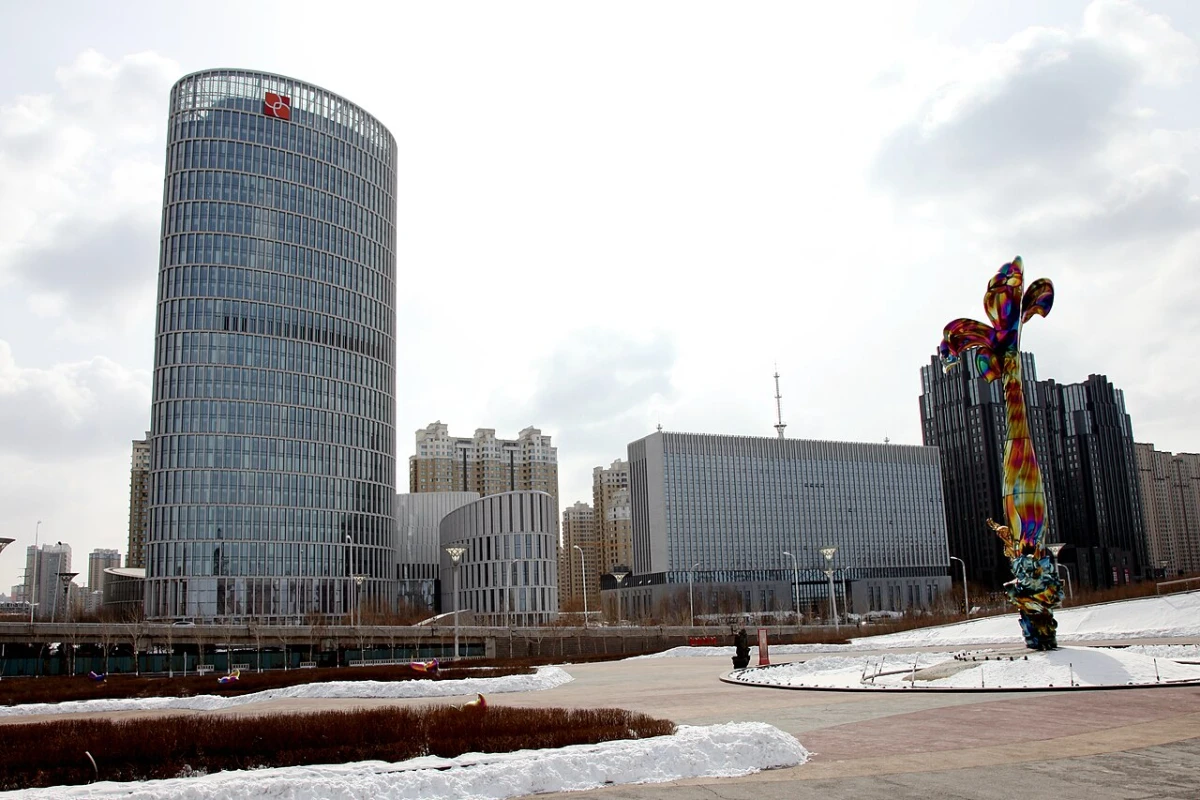
The Celestial Empire needs control over peripheral territories.
The special attention of Chinese authorities to changing the economic map of the PRC may mark the beginning of a trend. By planning to relocate part of its production and related infrastructure from the coast to the central and western regions of the country, the CPC is addressing not only military security issues.
In recent years, China has been facing the problem of declining birth rates and overall population numbers. It is incorrect to assume that being second in the world in this regard (after India) makes the PRC invulnerable to demographic threats. Depopulation tends to develop in a geometric progression, and the outflow of population in some provinces, including Heilongjiang, which borders Russia, is becoming economically noticeable. People are moving to the more economically developed coastal areas, and the relocation of production could potentially help, if not solve the problem of population distribution imbalance, at least begin to address it.
Russia has historically faced a similar problem: the overpopulation of its central and western provinces and the limited capacity to facilitate the outflow of excess population to Siberia and the Far East has been a headache for the government for 120 years. Despite all the approaches taken since then to solve the issue, only one in four Russians still lives east of the Urals.
In recent decades, the Russian establishment has dominated a vision of the future in which the gradual concentration of the entire population into a few million-strong cities, connected by increasingly convenient transport arteries, was not perceived as a problem at all. Beyond the megacities, there remained extractive infrastructure that could be maintained through a rotational work method, mono-cities where jobs had disappeared, and other settlements devoid of prospects.
The transition to planning a network of support settlements has already reflected an understanding that the path described above leads to a loss of control over territory. However, it has not yet included an understanding of the need to reprogram the economic role of the 'supporters', nor an awareness of the danger of entire segments of the social fabric in the provinces falling away due to the mass migration to the big city, nor ideas aimed at reversing this migratory 'vacuum cleaner'.
Cities are unlikely to cease to exist, including as a leading model for organizing society in space. New – or radically updated and relaunched 'old' cities will probably be needed not only by China but also by Russia. But the initiative of the Chinese comrades is also valuable because it brings questions of spatial distribution of human and economic resources, the role of cities, and the search for alternative life models out of the realm of interest of a few dozen researchers into the current political mainstream.









Leave a comment