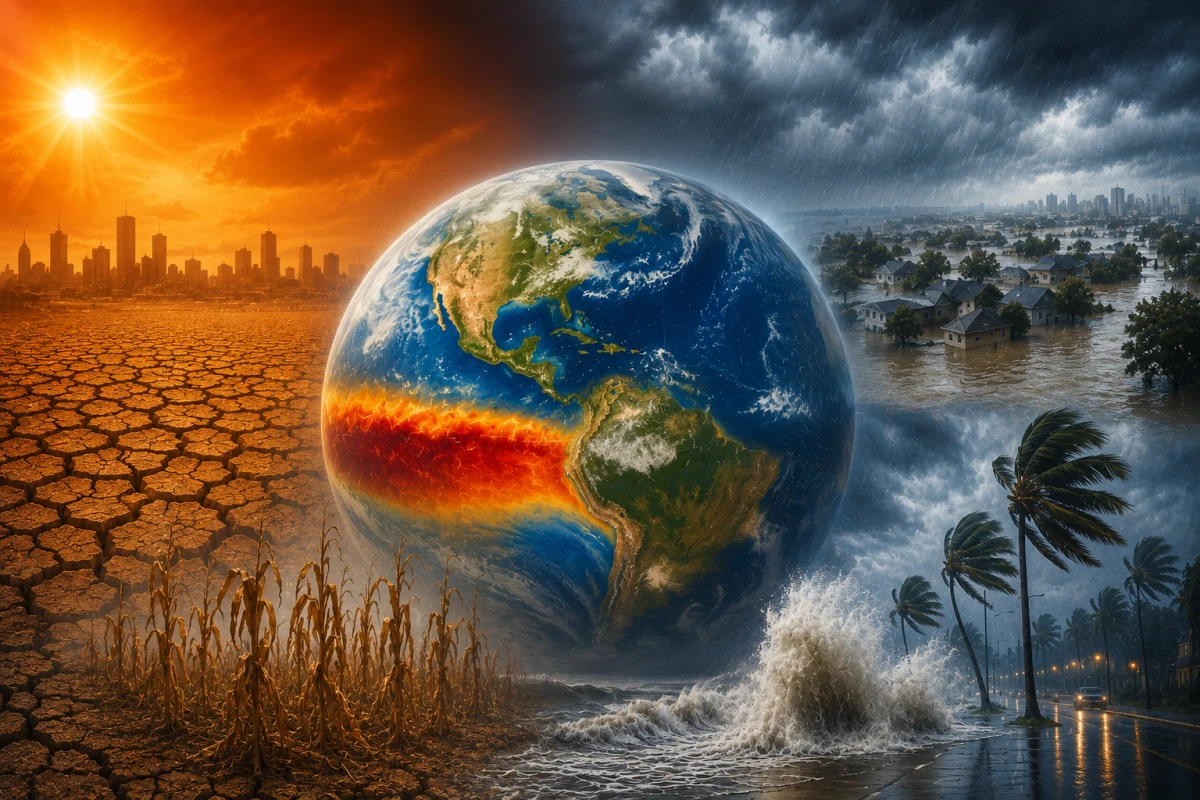
Meteorologists and climatologists are warning of the possible development of a powerful super El Niño as early as the middle of the year. According to experts, this natural phenomenon could lead to extreme heat, droughts, floods, and other weather anomalies in many countries around the world.
Scientists are sounding the alarm: a terrible ecological catastrophe could occur in the middle of this year. This is all due to the super El Niño. This natural phenomenon has the potential to drastically change the weather in many countries — causing droughts in some regions and heavy rains with flooding in others.
Let’s understand what El Niño is, why this one could be particularly powerful, and what weather surprises to expect in the coming months.
What is El Niño
El Niño is a natural phenomenon in which the water in certain parts of the Pacific Ocean becomes noticeably warmer than usual. Because of this, the weather changes all over the world: in some places, prolonged rains and flooding begin, while in others, drought sets in.
El Niño has a "counterpart" — La Niña. During La Niña, the water in the same part of the ocean, on the contrary, becomes colder than usual, and this also affects the weather around the globe.
El Niño essentially "redistributes" heat across the Earth, explained chief meteorologist of WFLA-TV Jeff Berardelli. Right now, the heat that has accumulated deep beneath the surface of the Pacific Ocean is starting to move eastward and rise closer to the surface. These are the first signs that El Niño is beginning to develop.
Scientists refer to super El Niño as particularly powerful episodes when sea surface temperatures rise above normal by more than 2 °C. Such phenomena have occurred several times since the 1950s. However, the threshold of 2.5 °C has only been exceeded once — in certain areas of the equatorial Pacific Ocean.
What to Expect from Nature in the Coming Months
Meteorologists warn that this year we may face a very strong El Niño. Forecasts suggest it could become the most powerful one on record and lead to extreme weather events worldwide.
"I think we will see weather phenomena that have never been recorded in modern history," quotes Jeff Berardelli from the Associated Press.
According to the World Meteorological Organization (WMO), El Niño is expected to occur in the middle of the year. It could significantly affect air temperature and precipitation levels in many parts of the planet. It is worth noting that forecasts in spring are not always accurate — predicting the strength of the phenomenon during this period is more challenging.
What Scientists Are Saying
Data from the WMO's Global Seasonal Climate Outlook shows that sea surface temperatures are already rising rapidly. Scientists are almost certain: El Niño has already begun and will become even stronger in the coming months. The WMO notes that such phenomena typically occur every 2–7 years and last 9–12 months.
Daniel Swain, a climatologist from the California Institute of Water Resources, agrees with this. He emphasized that the volume and intensity of warm water beneath the ocean's surface are among the highest on record. It is these "waves" of warm water that trigger the El Niño mechanism.
Are We Facing Catastrophe
The UK Met Office has released a forecast indicating that the likelihood of an extremely powerful El Niño is increasing. Experts warn that the new episode could be the strongest of our century.
Some forecasts suggest that in scale, this phenomenon could rival the catastrophic El Niño of 1877.
At that time, severe droughts and extreme heat occurred. The consequences were devastating for many countries. In India, China, Brazil, and Egypt, a large-scale famine began, claiming millions of lives. Epidemics then broke out. The poorest segments of the population suffered the most — they lacked the resources to survive the disasters.