BloombergNEF analysts warn that the duration of the Hormuz Strait blockade will be a decisive factor for global oil prices.
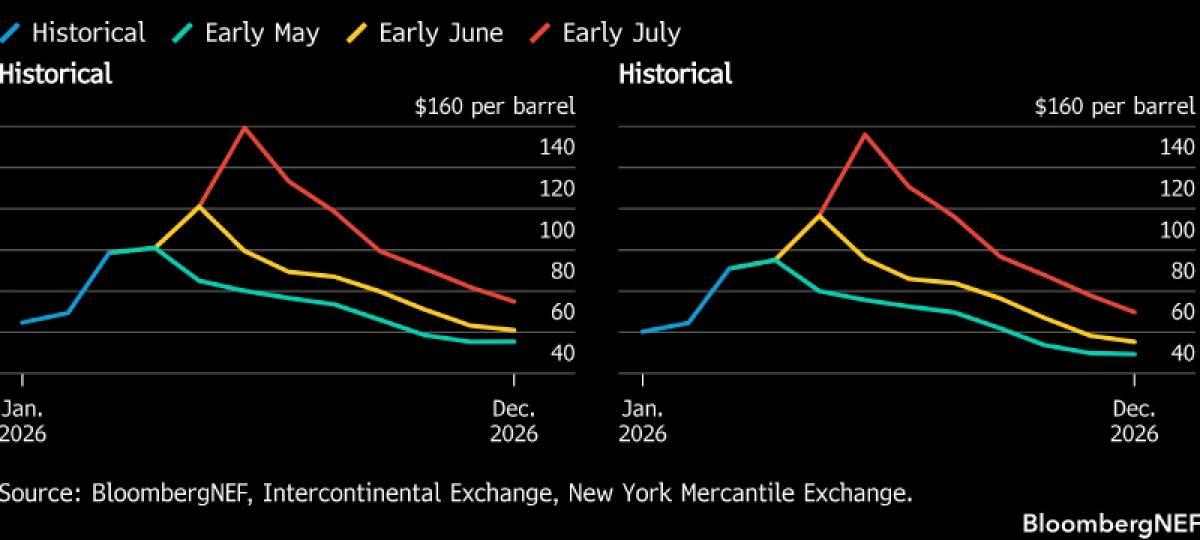
Analysts at BloombergNEF assert that the dynamics of Brent oil prices critically depend on how long the Hormuz Strait remains inaccessible to shipping. The company's forecasts clearly demonstrate this dependence, showing how the price of Brent changes based on the timelines for the resumption of shipping.
Scenarios for Brent Oil
For example, if the strait opens in early May, Brent quotes are likely to remain around $100 per barrel. However, if this timeline is pushed back by two months to early July, there is a serious risk of prices soaring to a staggering $160 per barrel, the company's experts warn.
Their current baseline forecast still assumes the resumption of shipping through the Hormuz Strait in early May, rather than July. Nevertheless, despite this cautious optimism, BloombergNEF significantly revises its forecast for excess supply in the global oil market in 2026. It has been reduced from 2.23 million barrels per day to 0.96 million barrels per day.
"Despite the risk of rising oil prices, our baseline scenario assumes that ongoing negotiations between the U.S. and Iran will keep the average Brent price in 2026 at $74 per barrel," the BloombergNEF experts summarize. Thus, dialogue between the countries plays a crucial role in stabilizing the market.