
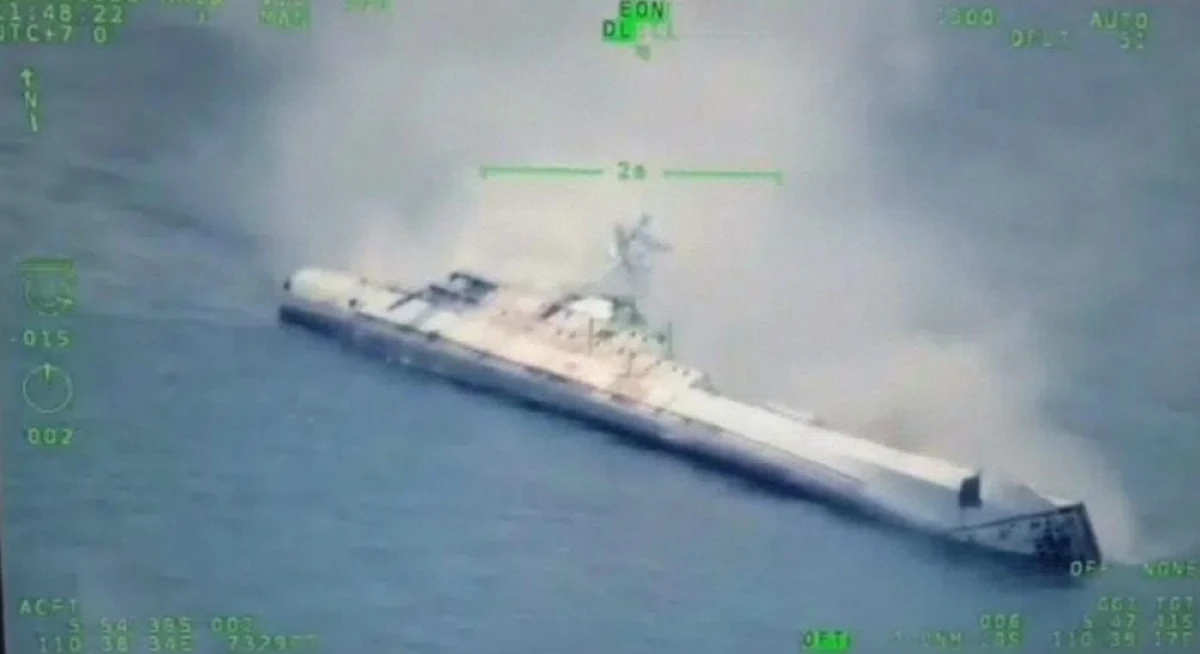
During large-scale maneuvers, the Indonesian Navy turned a former German landing ship into a target, striking it with a powerful French Exocet anti-ship missile.
The Indonesian Navy conducted impressive exercises in the Java Sea, culminating in the sinking of a decommissioned landing ship. This event was reported by Naval News, highlighting the scale of the maneuvers conducted.
The ship chosen as a target was named Teluk Hading and belonged to the Frosch class. Indonesia acquired it from Germany in the 1990s as part of a major deal worth $482 million. Its service ended in 2024 after a serious fire occurred in the waters of South Sulawesi, leading to the vessel's removal from the fleet. The destruction of the ship was carried out by the French-made Exocet MM40 Block 3 anti-ship missile.
This powerful missile was launched from the SIGMA 10514-class frigate I Gusti Ngurah Rai, demonstrating the combat capabilities of the Indonesian fleet.
The portal "Militarny" also reported on another significant episode of the exercises. One of the Indonesian Navy's fast boats successfully launched a Chinese-made C-705 missile.
The target for this missile was a ground position on Pulau Gundul Island. This island had already been used as a testing ground in December 2024 when the Indonesian Navy first employed the Exocet missile for a land strike. Notably, these exercises marked the second publicly known instance in which the Indonesian fleet used anti-ship missiles to hit ground targets. This underscores the expansion of the fleet's tactical capabilities.
Frosch Class Corvettes: Detailed Overview
This class of landing ships includes two main modifications, each with its own features. Project 108, known as Frosch I, is a standard medium landing ship.
At the same time, Project 109, or Frosch II, was developed as a combat support ship. Both projects played an important role in naval operations. The Frosch I ships are 98 meters long, 11.1 meters wide, and have a draft of 2.8 meters. Their full displacement reaches approximately 1,950 tons. The power plant of these vessels consists of two diesel engines with a total power of 5,000 horsepower, operating on two shafts. This provides them with the necessary maneuverability and speed.
Project Frosch II is slightly more compact: its length is 90.7 meters, width 11.1 meters, and draft 2.8 meters. The full displacement of these ships is about 1,700 tons. The power plant also includes two diesel engines, but their power is somewhat lower—4,408 horsepower on two shafts. Both modifications can reach speeds of up to 18 knots.
The crew of each ship, regardless of modification, consists of 46 people. The payload capacity of Project 108 reaches 600 tons, while Project 109 can carry up to 650 tons.
All ships are equipped with a 5-ton crane conveniently located in the midship section. This significantly simplifies loading and unloading operations.
The initial armament included two twin 57-mm AK-725 artillery mounts. For Project 108, two twin 30-mm AK-230 mounts were additionally provided.
Project 109, in turn, was equipped with two twin 25-mm 2M-3 automatic guns. Some ships of Project 108 also received two 40-tube launchers for 122-mm rocket shells. Both versions of the ships were equipped with the Muff Cob fire control radar system. This system increased the accuracy and effectiveness of weapon use.
Indonesia's Armament Modernization
The authors of the publication reminded that Indonesia has undergone significant rearmament of its ships. In particular, Project 108 received one 40-mm Bofors L/60 gun. Additionally, these ships were fitted with two twin 37-mm V-11 mounts and two twin 25-mm 2M-3 guns. These changes significantly enhanced their firepower. Ships of Project 109 also underwent modernization. They were re-equipped with two twin 37-mm V-11 mounts and two twin 25-mm 2M-3 guns.











Leave a comment