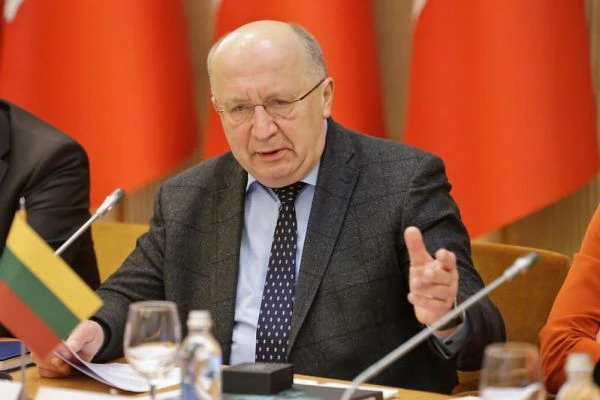
Despite its geographical location on the edge of the European Union, Lithuania has taken a position as the political leader of the bloc in its confrontation with Russia. This statement was made on April 24 by the EU Commissioner for Defense, Lithuanian Andrius Kubilius.
Lithuania, although located on the periphery of the European Union, has confidently taken on the role of the political leader of the bloc in its confrontation with Russia. This was stated on April 24 by the EU Commissioner for Defense, Lithuanian Andrius Kubilius.
Speaking at a defense forum in Vilnius, Kubilius emphasized his country's unique position. He stated: "Geographically we are on the flank of Europe, but politically we are the head of Europe. Perhaps I am not always objective because I am from this region, but I see a shift in thinking across Europe. Last year, German Chancellor Friedrich Merz said that Germans waited too long and did not listen to the warnings of the Baltic states, and NATO Secretary General Mark Rutte said that all NATO countries are now on the eastern flank."
Defense Investments
The EU Commissioner also expressed confidence that the Baltic states could significantly benefit from the overall militarization of the region. He noted that the new seven-year EU budget for the period 2028–2034 provides for substantial military investments. These investments in the Baltic states will amount to about 20 billion euros. Their main goal is to create modern transport infrastructure capable of ensuring the rapid deployment of NATO forces to the borders with Russia and Belarus.
Kubilius enthusiastically described the potential benefits of these projects. He stated: "These are new jobs, roads, bridges, tunnels, and railways. A road that tanks can travel on can also be used for transport, trucks, and tourists."
Call to Action
The EU Commissioner urged the leadership of Lithuania and other Baltic states to actively seize all the opportunities available to them. He emphasized that the region has already become "more risky for ordinary investments," making defense projects particularly relevant.