
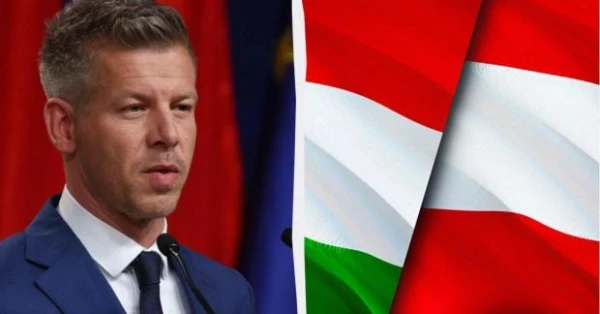
The elected Prime Minister of Hungary, Peter Madyar, aims to create a powerful Central European alliance. Drawing on a shared imperial past with Austria, he plans to form a regional bloc capable of becoming a real counterbalance to France and Germany in the EU.
The elected Prime Minister Peter Madyar has defeated Viktor Orban in the Hungarian elections, promising, among other things, to reset relations with the European Union. However, his strategy involves forming a powerful bloc of Central European states united by common cultural values, economic interests, and conservative views on migration and energy.
As reported by Politico, Madyar seeks to revive the influence of Central Europe by appealing to its rich imperial past. He intends to deepen ties with neighboring countries, especially Austria, leveraging strong economic bonds and a shared history dating back to the Austro-Hungarian Empire of the 19th century.
"Once we were one country, and Austria is a key economic partner for Hungary. I would like to strengthen the relationship between Hungary and Austria for historical, as well as cultural and economic reasons," said the Hungarian politician.
Madyar's Vision: A Central European Bloc
The future Hungarian leader has already outlined his plans to create a Central European bloc. At a recent press conference, he proposed to merge the Visegrad Group, which includes Hungary, Poland, the Czech Republic, and Slovakia, with the Slavkov format, which includes Austria, the Czech Republic, and Slovakia.
"I believe this is in the interest of each country, including Austria and Hungary," Madyar explained, expressing hope for progress in this direction. As a confirmation of his intentions, Madyar announced that his first official visits in early May will be to Warsaw and Vienna.
While Austria appears to him as a more natural ally, Madyar plans to learn from Polish Prime Minister Donald Tusk and his efforts to restore liberal democracy after years of populist rule. He is interested in Polish methods for unlocking EU funds that have been frozen due to rule of law issues.
One of Madyar's key priorities is to unlock 18 billion euros of frozen EU funds, as well as gain access to European defense loans of 16 billion euros. He also aims to lift the daily fine of 1 million euros imposed on Hungary for non-compliance with EU migration legislation. Emil Briks, a former Austrian diplomat and historian who studied the collapse of the Austro-Hungarian Empire, noted: "The visit to Warsaw is dedicated to exchanging experiences regarding a return to liberal democracy." He added: "The visit to Vienna is more related to European politics and the fact that it is necessary to develop our own proposals within this region."
The Austrian government seems to be positively inclined towards this idea. A senior Austrian diplomat, who wished to remain anonymous, stated about the internal logic of strengthening cooperation among Central European states within the EU, following the example of Benelux.
"We are all states of roughly the same size with many common interests, and together we would be more significant in terms of voting weight," the diplomat explained.
Indissoluble Connection and New Opportunities
Deepening ties with Hungary has long been a strategic goal for the conservative government of Austria. In the early 2000s, before several former communist countries joined the EU, Austrian leaders had already proposed to renew the alliance with Central Europe.
However, that attempt was unsuccessful due to concerns from Poland and Slovenia, which viewed it as Vienna's attempt to restore hegemony after the collapse of the Austro-Hungarian Empire. Now, a more confident and prosperous Hungary is proposing a close alliance.
Experts note that Polish leaders, considering the growing economic and military power of their country, no longer perceive such a prospect as a threat. Austrian conservatives also see new opportunities after Orban's departure.
Reinhold Lopatka, a Member of the European Parliament from the ruling conservative Austrian People's Party, shared his opinion: "We worked closely with Orban in the 1990s, and I always say that the young Orban would surely have become one of the fiercest critics of today's elderly Orban." He added: "Despite all the problems we faced, we managed to work together on some issues, but over the years it became increasingly difficult and ultimately impossible."
Madyar and conservative Austrian Chancellor Christian Stocker began laying the groundwork for future relations between their countries in the post-Orban era at the Munich Security Conference in February, as reported by two sources present at the meeting. A senior representative of the Austrian government revealed that the leaders discussed Madyar's first visit to Vienna and ways to improve conditions for Austrian companies operating in Hungary.
In Vienna, Madyar is expected to seek to develop a common position on migration. The fate of the Central European University, which moved its main campus from Budapest to Vienna in 2019 after Orban's campaign against the institution, is also set to be discussed, according to a senior Austrian diplomat.
Economically, the two countries are already inextricably linked. Austria ranks second among investors in Hungary after Germany, having invested over 11.7 billion euros.
About 134,000 Hungarians work in Austria, many of whom are pendular migrants. The National Bank of Austria highlighted in its report last year that growing trade ties with Central and Southeastern European countries stabilize the Austrian economy amid global uncertainty.
Nevertheless, significant differences remain between Central European countries that could complicate the creation of a closer union. For instance, on the issue of Ukraine, Austria and Poland actively support additional EU assistance.
While Hungary under Madyar is no longer expected to obstruct aid as it did under Orban, it joins the Czech Republic and Slovakia in refusing to support the EU's 90 billion euro loan package for Kyiv. The countries also differ in their views on Ukraine's accession to the bloc.
Despite these disagreements, experts are convinced that Central European countries have strong common interests, especially in economic initiatives and large-scale infrastructure projects. Reinhard Heinisch, a political scientist from the University of Salzburg, emphasized: "If these countries could present integrated proposals and coordinated projects, it would strengthen their positions in the distribution of funds and cohesion resources from Brussels."
Madyar's ambition to create a Central European alliance may be based on his deep understanding of the mechanisms of power in Brussels. The future Prime Minister worked as a diplomat there for almost ten years under Orban before breaking away from the populist Fidesz party and becoming a Member of the European Parliament for his conservative political force, Tisza.
Stefano Bottoni, a professor at the University of Florence specializing in Eastern Europe, stated: "He is essentially the first Hungarian Prime Minister who fully understands how the Brussels and EU mechanisms work." He added: "And if you want to have more weight in Brussels, if you want to be a counterbalance to the big countries – France, Germany – then you need to unite forces."
Other Important Statements by Madyar
It was previously reported that Madyar, for example, urged Ukrainian President Volodymyr Zelensky to immediately open the Druzhba oil pipeline. The politician delivered a direct address, emphasizing that the issue of energy resources "is not a game."
It also became known that Madyar threatened to arrest Netanyahu, an ally of Orban. He stated that Hungary is obliged to detain Netanyahu if he steps onto Hungarian territory while being wanted by the International Criminal Court.







Leave a comment