
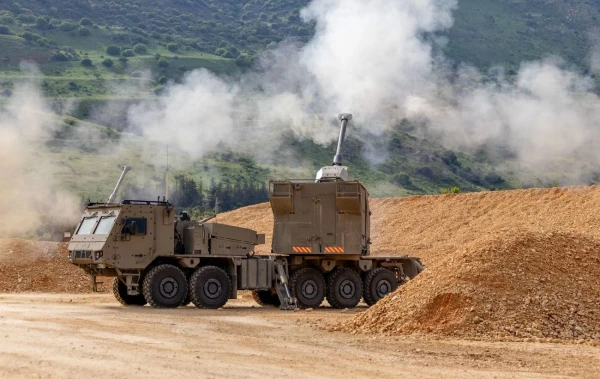
The Israel Defense Forces (IDF) successfully deployed its advanced self-propelled howitzer Ro'em in the confrontation with Hezbollah militants. This unique weapon has already demonstrated its power in combat conditions, despite the ceasefire.
The name of this system, "Thunder," sounds quite symbolic in Hebrew. Engineers unanimously state that this is not just another artillery piece, but a genuine technological breakthrough. The Ro'em howitzer is capable of firing significantly faster, hitting targets with unprecedented accuracy, and radically transforming traditional approaches to the use of firepower.
The IDF's chief artillery officer, Ehud Bibi, commenting on the situation for Fox News, emphasized the significance of the new system. He stated: "Ro'em provides new capabilities to the artillery corps and the Israel Defense Forces as a whole, changing the way firepower is used on the battlefield. This marks a historic milestone that begins a new era of more precise, faster, and flexible fire, allowing us to support troops on the ground more effectively."
The development of this advanced system belongs to Elbit Systems, widely known internationally under the SIGMA brand. The manufacturing facilities are located at a subsidiary in South Carolina, USA.
The Ro'em howitzer has a number of outstanding characteristics that make it unique. Its crew consists of only three soldiers, which is a significant reduction compared to outdated systems that require a much larger number of personnel. The firing range reaches an impressive 40 kilometers, and full automation allows the system to independently select the optimal shell and powder charge. Additionally, the gun automatically aims at the target and maintains a high rate of fire, ensuring exceptional speed and efficiency.
This innovative weapon guarantees lightning-fast actions on the battlefield. The howitzer can instantly take up a firing position and immediately open fire. Equally swiftly, the Ro'em leaves the launch site, significantly reducing the likelihood of a retaliatory strike from the enemy.
Combat Baptism in Ceasefire Conditions
The Israeli army has already successfully tested the Ro'em in real combat conditions. This occurred even during the 10-day ceasefire regime. The military emphasizes that fire was conducted solely for defensive purposes, as militants were actively preparing attacks on Israeli forces.
In an official statement, the Israel Defense Forces said: "During this operation, the troops conducted precise artillery fire on several positions of Hezbollah's anti-tank and ground-to-ground missile systems that were launching attacks on the Israel Defense Forces. The fire was effective, achieved operational results, and introduced new artillery capabilities, thereby reducing the threat to the Israel Defense Forces and the Israeli civilian population."
Situation in Gaza and Lebanon
Earlier reports indicated that the head of Hezbollah expressed readiness for a ceasefire but set several conditions for Israel. Among them are a "permanent cessation" of Israeli attacks on Lebanese targets and a complete withdrawal of Israeli troops. A ceasefire between Lebanon and Israel concerning Hezbollah was achieved with U.S. mediation on April 16. The Lebanese Prime Minister warmly welcomed the announcement of the ceasefire made by Trump. In turn, the Israeli Prime Minister specifically noted that the IDF would maintain its "strategic positions" throughout the 10-day ceasefire. Meanwhile, the United Nations and the European Union conducted assessments indicating that at least $71.4 billion would be needed for the reconstruction of Gaza. Experts warn that the recovery process for the region could take up to ten years and call for immediate action.












Leave a comment