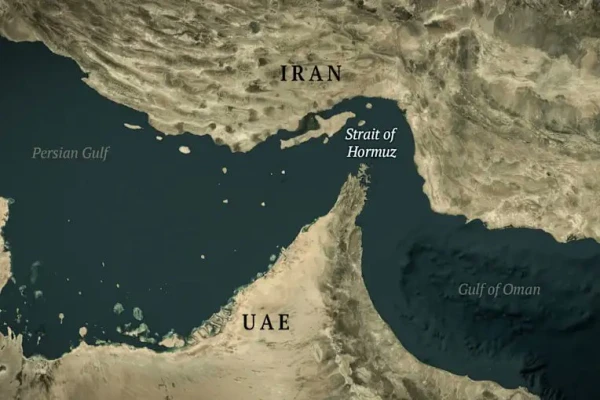
The Strait of Hormuz is once again blocked by Iran. The hardline position of the IRGC seems to have prevailed in Tehran. There are 3 days left until the ceasefire ends, and no new negotiations are in sight.
After a brief sigh of relief regarding the reopening of the Strait of Hormuz, Iran resumed its confrontation by opening fire on vessels attempting to cross the waterway on Saturday. This triggered a new escalation amid questions about who is making decisions in Tehran, with three days remaining until the ceasefire deadline and new peace talks yet to be scheduled.
The Islamic Revolutionary Guard Corps (IRGC), which answers only to the country's supreme leader, stated that it determines the shipping conditions in the Strait of Hormuz. However, this contradicts Iranian Foreign Minister Abbas Araghchi's statement on Friday that the strait is open in a corridor "agreed upon by Iran," and subsequent comments by U.S. President Donald Trump about reaching a broader agreement with Tehran.
On Saturday morning, the IRGC warned that the strait "has returned to its previous state of strict military control," as the U.S. blockade of Iranian ports continues, and then proceeded to fire upon and pursue vessels attempting to cross the Strait of Hormuz following Friday's agreements.
The IRGC then declared that the strait is closed until the U.S. blockade is lifted, warning that "no vessel should make any movements from its anchorage in the Persian Gulf and the Oman Sea, and approaching the Strait of Hormuz will be considered cooperation with the enemy," and that such vessels would become targets.
Iran's chief negotiator, Parliament Speaker Mohammad-Bagher Ghalibaf, appeared to align with the IRGC's position on Sunday, about 24 hours after the "Guardians" statements, reiterating that the strait is now under Iran's control and linking the reopening of the route to the lifting of the maritime blockade by Washington.
U.S. President Donald Trump dismissed Iran's latest moves on Saturday, stating that they "have gone a bit too far," but that "very good" negotiations are underway, with more information expected by the end of Saturday. "They cannot blackmail us," he added.
To emphasize the instability of the situation in the strait, an audio recording surfaced on marine frequencies on Saturday morning, indicating that Iranian forces opened fire on the Indian oil tanker Sanmar Herald, marking the first such incident, as India is one of the largest importers of Iranian oil.
The recording captures the captain of the Sanmar Herald desperately pleading with Iranian forces to cease fire, stating that he has permission to cross the border. In response, India summoned the Iranian ambassador in New Delhi, urging Tehran to restore safe passage through the strait.
The Washington-based Institute for the Study of War claims that "the IRGC appears to control the decision-making process in Iran instead of Iranian political officials negotiating with the United States, particularly Foreign Minister Abbas Araghchi."
"The IRGC's decision to intervene in international shipping and act contrary to Araghchi's statement reflects broader disagreements within the Iranian regime, which ISW-CTP has consistently reported on in recent weeks," the ISW statement reads.
As another warning, one of the Iranian commanders stated on Saturday on Iranian state television that "if war resumes, Iran will use missiles that were created only this month," and that the war "this time will be global."
The Iranian commander's statement aligns with the views of American intelligence and military officials quoted by The New York Times on Saturday, who believe that Iran still retains about 40% of its pre-war arsenal and long-range strike drones, as well as 60% of its ballistic and cruise missile launchers.
The NY Times reports that Iran has maintained fire systems buried in caves and bunkers and has restored up to 70% of its pre-war missile stockpiles, also buried under rubble as a result of attacks on its bunkers and warehouses.
Meanwhile, on Saturday, the Wall Street Journal, citing American officials, reported that U.S. military forces are preparing in the coming days to board Iran-related oil tankers and seize commercial vessels in international waters.
Additionally, the aviation monitoring portal Flightradar24 shows that U.S. military equipment continues to be deployed to the Middle East at the same levels as during the war.
Thus, the last 72 hours before the ceasefire deadline will be defined by decision-making in Tehran. The hardline, autonomous IRGC demonstrates that it is the undisputed master there. Meanwhile, the military buildup on both sides shows no signs of abating.