
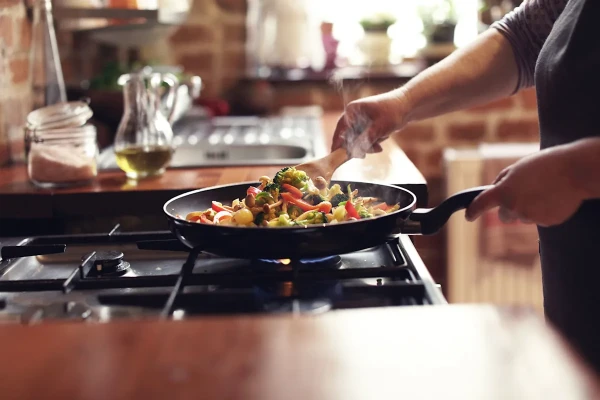
Food preparation has long ceased to be merely a household necessity. Modern research in psychology shows that cooking can play an important role in maintaining mental health, helping to cope with stress, anxiety, and emotional tension.
Mindfulness and the "Here and Now" Effect
The cooking process engages several senses at once: a person feels the texture of the ingredients, inhales the aromas of spices, and observes how the ingredients change during preparation. This involvement naturally shifts attention to the present moment.
This effect is similar to the practice of mindfulness, where a person focuses on actions without judgment. Such a state helps reduce the level of intrusive thoughts characteristic of anxiety and depression, creating a sense of inner calm.
Even simple actions—stirring a sauce or kneading dough—can serve as a form of meditation.
Sense of Control and Confidence
Cooking fosters the development of a sense of self-efficacy—confidence in one’s actions and ability to achieve results. In the kitchen, efforts almost always lead to a visible and understandable outcome.
Following a recipe or adapting it provides a sense of completion and success. This is especially important during periods of instability when other areas of life seem unpredictable.
A structured cooking process—with a clear beginning, stages, and result—helps create a sense of order and stability.
Cooking as a Form of Creativity
Food preparation is not only a technique but also a means of self-expression. The choice of ingredients, combination of flavors, and presentation of the dish all open up space for creativity.
Unlike many other forms of creativity, the result in cooking is felt immediately: the dish can be seen, tasted, and evaluated. This enhances positive emotions and contributes to psychological well-being.
Stress Reduction and Emotional Regulation
Focused activity in the kitchen helps lower stress levels. Repetitive and predictable actions—chopping, mixing, cooking—create a sense of control and order.
Moreover, the taste of the finished dish and the associated memories can evoke positive emotions and a sense of comfort. Familiar recipes, especially those linked to childhood or family traditions, have a particularly strong effect.
Social Connections and Sense of Belonging
Cooking often goes beyond an individual activity. Preparing food for loved ones, sharing meals, and exchanging recipes strengthen social bonds.
Such practices help form a sense of belonging, support family traditions, and transmit cultural values. Cooking together also develops interaction and collaboration skills.
The Role of Routine in Psychological Well-Being
Regular cooking helps establish a daily rhythm. This is especially important during anxiety or depression when structure and predictability become a support.
Cooking aligns with the principles of behavioral activation—a therapeutic approach used to improve emotional states. Even a simple dish can provide a sense of completion, while more complex recipes offer additional motivation.
Ultimately, cooking combines several factors important for mental health: mindfulness, creativity, a sense of control, social connections, and a stable routine. This is what makes cooking not just a daily task, but a full-fledged tool for restoring and maintaining inner balance.















Leave a comment