
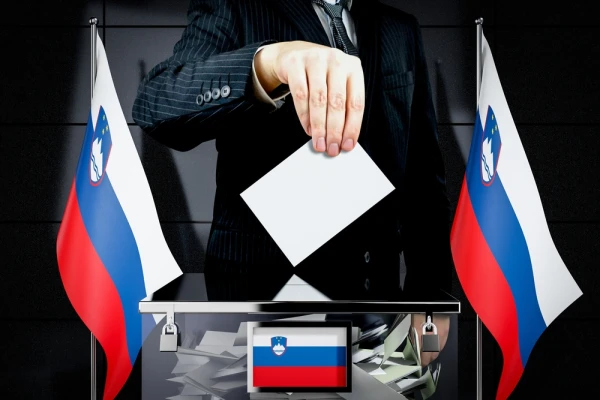
To form a coalition, support from at least 46 parliamentarians is needed.
The ruling party of Slovenia won the parliamentary elections by a narrow margin of less than 1%. The election campaign was accompanied by scandals and mutual accusations of foreign interference. Why did Brussels pay such close attention to the tiny Balkan country, and what role did the USA and Hungary play in this story?
Prime Minister Robert Golob's party won the elections to the lower house of parliament. The margin over the main opponent, the opposition "Slovenian Democratic Party" (SDP) led by Janez Janša, was minimal: 28.6% to 28.1%. As a result, the liberal movement "Freedom" will receive 29 mandates, while the Democrats will have 27.
Also entering parliament is the center-right bloc, consisting of the "New Slovenia – Christian Democrats" party, the Slovenian People's Party, and the Fokus party (9.3%), the "Democrats" party of former SDP member and Slovenia's Foreign Minister Anže Logar (6.7%), and the Eurosceptic party Resnica ("Truth", 5.6%). According to the Constitution, two seats are reserved for representatives of the Italian and Hungarian minorities.
To form a coalition, support from at least 46 parliamentarians is needed. Golob has already stated that forming it will not be easy.
The campaign itself was marred by a major scandal. As reported by The Economist, just days before the vote, recordings of conversations with several individuals linked to the ruling left-liberal coalition, including a former minister, were published online. In these conversations, they discussed their political connections and ways to influence decision-making in the government.
Prime Minister Golob called the incident a large-scale foreign interference. The Slovenian intelligence service supported the politician, assuring that the opposition (SDP) was the client, while the executor was the Israeli private intelligence company Black Cube. The party rejected the accusations.
The pre-election polls were also controversial. According to the last poll conducted shortly before the vote, the opposition SDP was leading with a slight margin over "Freedom" – 23.9% to 20.1%. At the same time, almost 9% of respondents had not yet made their choice.
The decision-making had to take place against the backdrop of significant differences between the main favorites. Robert Golob has established himself as a politician oriented towards Brussels during his time in office. He referred to Janez Janša as "the closest ally of Viktor Orbán that he could ever get." Janša himself did not hide his sympathy for Donald Trump's policies.
Another difference was the stance on the Middle East. The incumbent prime minister and his government previously recognized Palestine, while the Democrat supported Benjamin Netanyahu. Additionally, Janša, while still prime minister in 2022, had already shown support for Ukraine and called for granting it a prospect of EU membership.
However, as experts note, recently Janša has begun to adopt Eurosceptic positions, which has attracted increased attention from Brussels. The contradictory balance of power in Slovenia has made EU leadership doubt its ability to keep the small country within its sphere of influence.
The overall antagonism between Europe and America, which continues to escalate against the backdrop of Donald Trump's policies towards the EU, also played a role. In this regard, it was extremely important for Brussels to prevent the victory of a candidate associated with the US president in the Balkans.





Leave a comment