The growth of prosperity would have been impossible without extensive government support for social programs.
The slogan "Make America Great Again" became the symbol of Donald Trump's campaign and the rallying cry of his supporters. The word "again" implies that the country was once great but has lost that status and now needs to reclaim it. The question is, which specific period in U.S. history can be considered the "golden age," and why does this time evoke a poignant sense of nostalgia among ordinary Americans?
Outside the United States, it is believed that the golden age of this country occurred in the late 1980s and lasted until the early 2000s. The victory in the Cold War, the rise of globalization: American goods and culture flooded the markets of developing countries and filled the ideological vacuum that emerged after the collapse of the socialist bloc. However, within the United States, when it comes to the "real America," people tend to recall the 1950s, a time when norms and practices were established that would long alter its internal landscape. This was a time of post-war economic boom, highway construction, a baby boom, and rapid suburban development. It was also when television entered American homes: on screens sang and acted those who are now called icons of pop culture—Elvis Presley, Marilyn Monroe, James Dean, Audrey Hepburn... This was the time when America felt like a superpower. This is a time that is still romanticized, idealized, and remembered with particular warmth in America.
The perception of the 1950s as the "gold standard of the American dream" is especially noticeable in contrast to modern realities. In 2024, the majority of Americans said they miss the "more homogeneous world of the 1950s," contrasting it with "today's political division along racial and political lines." However, it is not so straightforward. For example, regarding the question of whether America has changed for the better since the 1950s, respondents were almost evenly divided: 48% said it has improved, while 49% are convinced otherwise. Looking at who exactly stands behind these numbers, it becomes clear what the issue is. Sixty-eight percent of Republicans believe that the "way of life" in America has worsened, compared to 48% of independents and 31% of Democrats (conversely, 69% of Democrats do not think so). In other words, the notion of the 1950s as a "role model" is much more widespread among "angry white men," Trump supporters. The main critics of this period are the left wing of the Democrats, the progressives. Sociologist Stephanie Coontz, who holds left-liberal views, noted: "The golden age was primarily for white Christians who did not have to share wealth, culture, and political power with people of color."
Indeed, racial segregation prevented Black people and Latinos from accessing well-paying jobs and the opportunity to move to the suburbs. It was during this time, in 1955, that landmark events in the history of the civil rights movement occurred: the murder of teenager Emmett Till and the arrest of Rosa Parks sparked protests across the country and gave new momentum to the struggle for Black rights. Leftist activists were persecuted for suspected ties to communists (McCarthyism). It was also then that the habit of making external threats part of the struggle against domestic political opponents took root. In general, if one were to seek a reconciliatory formulation for the "phenomenon of the 50s," one could say that it was a good time, but certainly not for everyone.
Since then, the racial and ethnic composition of the United States has changed significantly. In 1950, about 89.5% of the population was white and 10% Black. By 2023, the percentage of whites had dropped to 58.4%, while Black Americans made up 13.7%, with another 19.5% being Latino and 6.4% Asian. Naturally, such changes have led to demands to "redistribute" rights and privileges. But if everything was so ambiguous, why does the myth of the 1950s persist?
The first and foremost circumstance associated with nostalgia for the 50s is that it was a time when Americans, even those in "less privileged positions," once again believed in America and in their own future. Until the early 20th century, most households in the U.S. had no reliable guarantees of stable income. People had to rely solely on themselves and start working from a young age. In the early 1920s, the "ideal family" began to take shape as it was then envisioned: dad as the "breadwinner," mom as the homemaker, and children having a chance to attend college. But in 1929, the stock market crashed, and with it went the hopes for a better life—the Great Depression began. The 1930s saw even worse conditions: murder and domestic violence rates surged; birth rates dropped significantly; thousands of young people had to leave their hometowns in search of work.
The desired stability did not arrive in America immediately after the war either. Most families were uncertain about the future, racial tensions were palpable in society, workplace conflicts were common, and the right wing was battling the remnants of the radical labor movement of the 1930s. The government needed to find a place for veterans—many women began to lose the jobs they had come to rely on during the war. Veterans themselves also found it difficult to adapt to civilian life. Single veterans needed to start families. Those who were married had to regain authority among household members who had grown accustomed to different arrangements: sociologists say that only one in four family reunifications in the post-war period was "happy," while the others were "painful" and even "traumatizing."
But there was good news as well: World War II kickstarted the economic recovery of the U.S. The post-war economic boom gave hope to millions of Americans dreaming of creating an "oasis of stability." Everything quickly fell into place; all that was needed was a little patience.
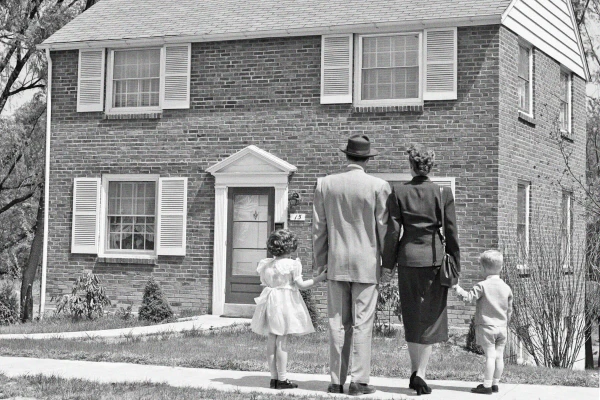
The central institution and symbol of prosperity in the 1950s was the family as a "chance for a new beginning." First, the home served as a place where young people could, as it was then said, "concentrate their emotional and financial capital." Popular themes in TV shows and tabloid literature included stories of "escaping" from boring parents and unmarried aunts who pestered with "helpful advice" on how to manage their lives and raise children.
Secondly, the family and home became a "safe haven" where one could escape from politics—the constant scare stories about nuclear war with the USSR and Senator McCarthy's "witch hunts." Having "unreliable" friends or even just a hint of sympathy for the left could ruin a career and reputation. It was safer to stop associating with old circles and fully dedicate oneself to family.
Thirdly, creating a "cell of society" implies having children. After World War II, the peak of the birth rate was observed in many developed Western countries, but it was in America that the baby boom became a socio-cultural phenomenon. From 1946 to 1964, 76 million people were born in the U.S. Having children was also economically advantageous at that time: prices and inflation were low (from 1.25% in 1954 to 4% in 1959), and real wages grew even faster in one year than during "Reaganomics" in the 1980s.
Even those born into families with low incomes recall this period as a time "when children and parents faced fewer difficult choices, when there was more predictability, and when there was a 'moral order' in their community that served as the basis for family norms."
All these trends contrast sharply with what is happening today, although, to be fair, America has managed to correct many of the even more negative trends that emerged in the 1980s. Currently, the divorce rate in the country stands at 41–50%, and the share of unmarried women aged 18–29 is 32% (compared to 28% in the 1950s). But the situation is much more serious among white men: while in the 1950s, the percentage of unmarried men aged 18–29 was 19%, by 2020 it had risen to 51%. It is no surprise that they form the backbone of the Republican electorate and are most receptive to the idea of returning to the "good old America."
Another reason for nostalgia for the 1950s is that it was a "law-abiding" time. Americans remember the decade in the mid-20th century as an era "when everything was calm and measured." This perception sharpens in contrast to the second half of the "tumultuous 60s" and today's rampant disorder in American cities. The youth of the 1950s took the prevailing social order for granted and shared conservative views. After the hardships of the Great Depression and the anxieties of World War II, the "American dream" manifested itself not in demonstrations of personal or political freedom, but in the desire to become a "productive member of society." For young university graduates, including those who, having returned from the front, managed to study through government programs and scholarships, "safety and stability" were synonymous with white-collar jobs (preferably in large companies), starting a family, and buying a home in developing suburbs—the formula for success for the middle class.
This feeling of "widespread good intentions and growing abundance" was fueled by books, magazines, and increasingly popular sitcoms. The country "became addicted" to television, and sitcoms and TV commercials shaped the tastes and expectations of the audience.
The growth of prosperity would have been impossible without extensive government support for social programs—the third component of success in the 1950s. Citizens responded with gratitude: the level of confidence in the country's key institutions (government, business, education) was unprecedented. The leaders of America's political class at that time also largely inspired trust among voters. And this naturally defined Americans' attitudes toward their everyday lives.
In 1950, spending on "public works" at all levels of government accounted for nearly 20% of total expenditures. In comparison, by 1984 this figure had dropped to 7%, and by 2024 it would fall to just 1.4%. In the 1950s, spending on non-military and non-residential public construction rose by a record 58%; spending on new school construction increased by 72%; and spending on the construction and modernization of water supply and sewage facilities rose by 42%. Finally, the government covered 90% of the cost of then-President Dwight Eisenhower's favorite project—the new interstate highway system.
Unlike modern social support programs, the programs of the 1950s encouraged citizens to invest in "long-term assets"—to go to universities, to buy homes. The entire housing finance system was revised: the government encouraged the issuance of loans with low down payments and long-term mortgages—everything that businesses had abandoned because such practices were unprofitable for them.
Government policy towards large corporations was also different. The tax rate for them was significantly higher than it is today, and they were still required to distribute up to 70% of excess profits (rents) in the form of bonuses for employees at all levels, not just among the company's management. Many firms considered it important to maintain loyalty to the cities and regions from which they originated: business owners continued to hire local residents, pay taxes to local budgets, and productivity growth usually led to wage increases. Today, companies are much more mobile: they seek cheaper labor, low taxes, and lower business costs. Of course, there are still those who think about their responsibility to the "community," but their numbers have significantly decreased.
The idyll of the 1950s had its dark side, which became apparent in the following decade. Today, some American historians view the practices of engineering the American family more as an experiment than an expression of a stable tradition. The organization of family life in the 1950s promoted values that were previously not entirely familiar to Americans: particularly the idea that one should invest "soul and money" only in the so-called nuclear family, that is, a family consisting of parents (spouses) and their minor children living separately from other relatives. Until the 1940s, friends, work, neighbors, and so on were considered no less important—if not more important—"ecosystems of life."
The 1950s were also marred by a whole range of problems for women. In many states, they did not possess full civil rights: women were not allowed to serve on juries or take out bank loans. The social engineering of the 1950s directed women towards early marriage, and for this reason, life without a husband was seen as much more challenging. But married women were expected to fully "invest their energy" into the family. The popular board game "Barbie"—not to be confused with the doll—encouraged girls to accept patriarchy: "He criticizes your hairstyle—go to the beauty salon"; "He called, and you’re not ready yet—you lose your turn."
With the expansion of educational opportunities, employment, and consumer habits, it became harder to maintain clear gender roles of "man as breadwinner" and "woman as homemaker." This is where sitcoms came in handy: these shows were not watched to see a reflection of one's own life but to see how families should live. And also to feed the confidence that you and your family are moving "in the right direction."
Today, liberal sociologists write that the stability of the 1950s, with its "carrots" in the form of economic opportunities, was constructed to balance the "stick" of racial segregation and repression against women, people of color, and other minorities, and citizens of that period were politically passive and consumerism-oriented. Critics even label the generation of the 1950s as the "silent generation." In the next decade, some of these "silent ones" became uncomfortable with their own prosperity and the necessity of blindly accepting the political status quo. These citizens (and especially their children) began to ponder the nature of the political processes occurring in the country (the Vietnam War), their own purpose in life, and their responsibility for the fate of America. Saturation became unfashionable—it gave way to a rejection of bourgeois comfort and civil disobedience (the hippies). Thus, the satiated 1950s were succeeded by the protest-filled 1960s. Americans demanded a new set of values. And they got them: the expansion of civil rights for Black Americans, feminism, the rejection of the husband's "ownership" of the wife, and the parents' ownership of children. In the 1960s, rebellious Americans rejected what they considered "wasteful materialism," but in its place came "me-first individualism."
Americans have been nostalgic for their country as it was in the 1950s at least since the early 2000s. The longing for the times when everything was "as it should be" arose from growing systemic problems in the economy and was exacerbated by the wars in Iraq and Afghanistan. Government policy, including changed priorities in funding, employment programs, and subsidizing support for young families and students, has also noticeably shifted for the worse compared to the 1950s.
The nostalgia of modern conservatives for the "yesterday's world" is not just an attempt to return to the past through economic renewal and a reboot of the value system. It is an attempt to find in the past a source of inspiration for creating an attractive future. However, implementing a new model of development requires political effort and time, and politicians (both Democrats and Republicans) living in the logic of electoral cycles will not be given that time—results are needed now.