
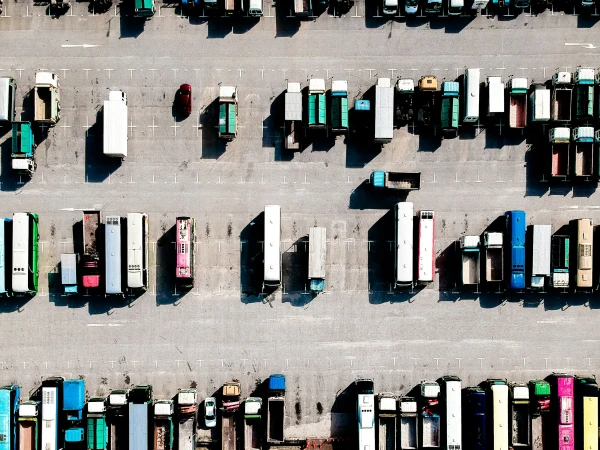
Lithuanian carriers do not know how to legally pay the sanctioned Belarusian company that owns the parking lots for trucks detained in Minsk, while the Financial Crime Investigation Service of Lithuania (FCIS) warns that direct payments, transactions through intermediaries in Belarus, or cash will be considered violations of sanctions.
Meanwhile, the National Association of Road Carriers Linava claims that carriers are not receiving clear recommendations from the Financial Crime Investigation Service (FCIS) on legal payment methods. The association believes that companies that have already retrieved their trucks likely settled with "Belcustomsservice" through Belarusian partners, possibly violating sanctions.
According to the FCIS, any payments to "Belcustomsservice" are prohibited by the EU sanctions regulation against Belarus and the national Law on International Sanctions.
"The provisions of the regulation and the law provide grounds to assert that payments to the sanctioned 'Belcustomsservice' are considered a prohibited provision of funds to a sanctioned entity. Payment to a sanctioned entity through third parties may be regarded as a violation of the prohibition on participating in activities aimed at circumventing the freezing of funds and economic resources," the FCIS stated in a comment to BNS.
"The regulation is mandatory in its entirety and directly applies in all EU member states; it is binding for all legal entities registered or established under the legislation of a member state," the agency emphasized.
COULD HAVE SETTLED THROUGH BELARUSIAN PARTNERS
According to the State Border Guard Service of Lithuania (SBGS), from the beginning of last week until midnight Tuesday, 451 trucks that had been detained in Minsk from late October to mid-November last year crossed the Lithuanian border. According to SBGS representative Gedrius Mišutis, there has been an increased flow of returning trucks and trailers in the past day.
According to the border guard representative, 236 vehicles have returned through the "Mėdiininkai" point, and 215 through the "Šalčininkai" point. Minsk has stated that more than 1,900 trucks and trailers are detained in the country. Linava estimates that the number is much higher.
Linava President Erlandas Mikėnas told BNS that most carriers cannot retrieve their vehicles because they have no means to pay "Belcustomsservice."
"The situation is such that carriers have no way to safely and legally make payments. Without payment, we are not getting the trucks back," Mikėnas told BNS.
"The company that guarded these trucks is under sanctions, so Lithuanian businesses cannot pay it - banks do not conduct transfers, and exporting cash in euros (to Belarus - BNS) is not allowed," he emphasized.
According to Mikėnas, it is possible to bring up to 10,000 euros in cash into Belarus by declaring it in another currency, such as US dollars, but such an amount will not cover the debts of carriers for four months of truck storage: "The amounts of debts for carriers are 50,000, 100,000 euros, or more."
When asked how the owners of returned trucks could pay the sanctioned company, Mikėnas replied that businesses are looking for ways to do this through partners in Belarus.
"However, whether this will be interpreted as circumventing sanctions is hard for us to judge. Therefore, carriers are concerned, asking questions, seeking help (...). We have no answer," Mikėnas said.
According to the FCIS, both payments through intermediaries and cash also violate sanctions.
"The regulation also establishes a prohibition on making payments to Belarus in cash in the currency of EU member states: (...) it is prohibited to transfer banknotes of the official currency of any member state to Belarus or to any person, entity, or organization in Belarus, including the government and the central bank of Belarus, or for use in Belarus," the FCIS explained to BNS.
LACK OF RESPONSE FROM FCIS ON LEGAL EXIT
According to Mikėnas, carriers are consulting with the FCIS to avoid fines for violating sanctions, but they are not receiving clear answers or advice - the FCIS merely repeats that payments to Belarusians are not allowed.
"The carriers themselves were inquiring, calling, searching, but there are no answers (on how to act - BNS). This is a sanctioned company, and the answers are very simple - payments are not allowed," the head of Linava told BNS.
The FCIS did not comment to BNS on whether such consultations are taking place and what legal exit is possible.
"Carriers have been held hostage for four months, and after four months, we still do not have these answers, which greatly frustrates the carriers," Mikėnas said.
According to him, entrepreneurs are frightened by fines for circumventing sanctions, as they will equal the parking fee: "If paying six thousand for a truck and only then taking it back makes sense, then paying twelve thousand does not."
TRUCKS CAN LEAVE PARKING LOTS SINCE LAST WEEK
As reported by BNS, the first trucks and trailers of Lithuanian companies, which had been standing for about four months in special parking lots in Belarus, crossed the border last Tuesday with the permission of authoritarian Belarusian President Alexander Lukashenko.
Mikėnas had previously stated that due to high fees, carriers might not be able to retrieve about half of the cargo vehicles.
Communications Minister Juras Taminskas had previously claimed that there are no exact figures on the number of trucks stuck in Belarus, and it is too early to talk about compensating carriers for losses.
Trucks can only leave after carriers pay for their stay in the parking lots. Belarusian authorities stated that this fee is "several times lower" than the previously established fee of 120 euros per day set by Minsk.
The Minsk regime detained Lithuanian vehicles in October last year when Lithuania temporarily closed the border due to a flow of smuggling weather balloons flying from Belarus to Lithuania, which repeatedly disrupted operations at Vilnius Airport. Although the border was later reopened, Minsk still did not release the trucks from the country, directing them to special parking lots and threatening confiscation.







Leave a comment