
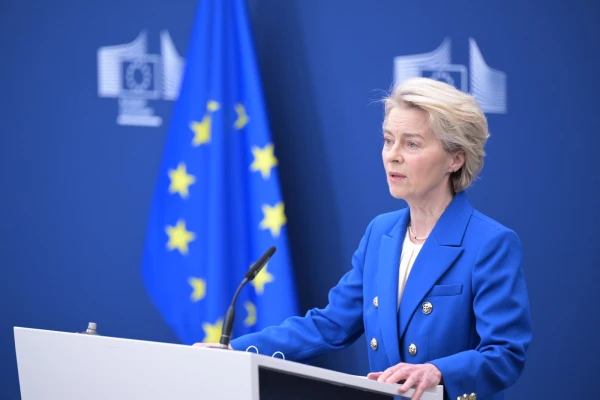
The latest public opinion poll shows that Ursula von der Leyen does not enjoy significant support in Poland. More than half of respondents rate her actions negatively, while positive opinions are expressed by a much smaller portion of respondents.
According to a survey conducted by the IBRiS studio, about one-third of respondents have a positive view of the head of the European Commission, while more than half have a negative view. A small percentage of respondents did not express an opinion or are not familiar with this figure.
These results indicate a clear predominance of critical assessments and suggest that the image of the President of the European Commission in Poland remains quite problematic.
Experts emphasize that negative opinions about the President of the European Commission do not necessarily translate into opposition to the European Union itself. On the contrary, most Poles still support the country's membership in the community.
According to Professor Robert Albertski from the Institute of Political Science at the University of Wrocław, the negative assessment of Ursula von der Leyen in Poland is largely related to criticism of EU policies rather than the personality of the President of the European Commission.
"Ms. von der Leyen embodies what is presented in the narrative of the right political scene as euro-bureaucracy from Brussels. Moreover, the fact that she is German aligns with the idea that the EU serves to limit Poland's sovereignty," the expert explains in an interview with Euronews.
At the same time, he emphasizes that most Poles still do not want to leave the EU, although critical sentiments towards European institutions are growing. "For now, these skeptics say: the Union may not be perfect, but we stay because the benefits outweigh the costs. However, if this position persists for many years, it could easily change public attitudes," warns Professor Albertski.
What Influences the Negative Image?
The image of the President of the European Commission in Poland is influenced by several important factors. Among the most frequently mentioned are the controversial EU policies, such as climate protection measures or economic rules.
A good example is the attitude of Poles towards the ETS emissions trading scheme: more than half of respondents support leaving it, indicating a skeptical attitude towards some elements of EU climate policy.
Such sentiments can directly affect the perception of the European Commission and its President, related to the implementation of these controversial measures.
The assessment of Ursula von der Leyen largely depends on the political views of the respondents.
As in many other political surveys, opinions are clearly polarized, with supporters of different parties evaluating the actions of the European Union and its leaders differently.
This means that the survey results are not just an assessment of one person but a reflection of broader disagreements existing in Polish society.
"Poles criticize primarily the EU policy, not the personality of Ursula von der Leyen. Surveys show that a large part of society does not understand how European institutions work and what decisions the President of the Commission makes. This naturally results in a low opinion of her - for many, she is just a civil servant whose actions are not very easy to understand," adds the expert.
Not Only Poles Criticize the Head of the European Commission - 2025 Survey Results
The perception of the work of the European Commission and its President has also been studied in other EU countries, and the results showed that sentiments towards Brussels and Ursula von der Leyen are not uniform across the EU.
A survey conducted by Ipsos for Euronews in June 2025 across 18 countries showed that only in three countries: Portugal, Denmark, and Spain, did the majority of respondents have a positive view of the European Commission's work under Ursula von der Leyen. In other countries, opinions were more critical, or a significant portion of respondents did not express an opinion, indicating a certain distance of society from EU institutions and its leader.
Moreover, a survey conducted in July 2025 in the five largest EU countries - France, Germany, Italy, Spain, and Poland - showed that more than half of respondents believe that von der Leyen failed to protect the Union's interests during negotiations for a major trade agreement with the USA, and some respondents even called for her resignation. Such results indicate growing dissatisfaction with the Commission's President in some major member states.
As in Poland, critical opinions regarding the work of the European Commission and its President prevail in many EU countries, indicating that the issues with the organization's image are of a pan-European nature.
A Warning Signal for Brussels
Experts note that the predominance of negative assessments could be a troubling signal for EU institutions. A decline in trust in their activities, even if it does not directly affect support for Poland's membership in the EU, could hinder the implementation of common policies in the future.
At the same time, the survey results indicate that the way information is provided and decisions made at the European level are key. The lack of clarity and understanding of these actions contributes to the growth of skepticism in society.
ADVERTISEMENT
It is worth noting that in January 2026, the European Parliament rejected a proposal to issue a vote of no confidence in Ursula von der Leyen. The majority of MEPs opposed this initiative, allowing the President of the European Commission to retain her position despite accusations, including failure in trade negotiations and inability to protect farmers' interests.








Leave a comment