
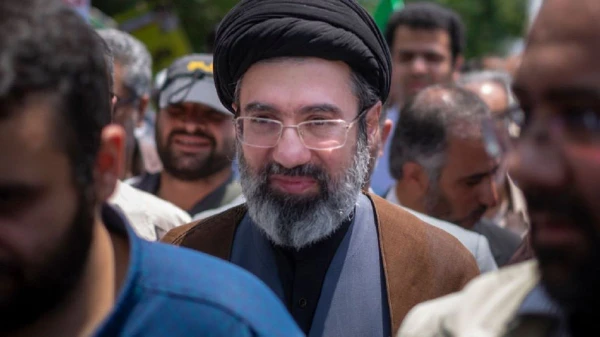
The son of Ayatollah Ali Khamenei, Mojtaba, has been elected the new Supreme Leader of Iran, reported the Iranian television channel Iran International, based in London, and Deutsche Welle, citing sources in the Islamic Republic.
The candidacy of Mojtaba Khamenei was promoted for this position by the Islamic Revolutionary Guard Corps. He is considered an even more radical figure than his father.
According to sources from various publications, this decision was made by the Assembly of Experts, consisting of 88 representatives of the Shia clergy.
Neither the Iranian authorities nor Iranian state media have confirmed the information yet.
In turn, The New York Times, citing three local officials, reports that Mojtaba Khamenei has only become the main contender for the position of Supreme Leader of the country. The publication notes that an official announcement of his election was initially planned for Wednesday morning, but this idea was abandoned out of concern that it would make the son of the slain Ayatollah a target for strikes from the U.S. and Israel.
According to NYT and DW, Mojtaba Khamenei has close ties with the Islamic Revolutionary Guard Corps (IRGC), and it was the IRGC that insisted on his election. His candidacy was not supported by everyone: the transfer of power from father to son is not welcomed by the Shia Muslim clergy, and the position of Supreme Leader is elective, not hereditary.
Other Candidates
The Supreme Leader of Iran is elected for life by the Assembly of Experts—a state body consisting of representatives of the clergy who are considered specialists in Islamic law. They are elected in direct elections for eight years.
The slain Ayatollah Ali Khamenei, who was killed during a U.S.-Israeli operation, had been the Supreme Leader since 1989 and was considered the de facto leader of Iran.
After his death, a temporary leadership of the country was taken over by a council of three people. It included President Masoud Pezeshkian (a politician in this position is directly elected by the people and has significantly less power than the Supreme Leader), head of the judiciary Gholam Hossein Mohseni-Ejei, and member of the Guardian Council of the Constitution Ayatollah Alireza Araqi.
According to NYT, the latter was also one of the candidates for the position of Supreme Leader who made it to the final voting. Another candidate, Hassan Khomeini, is the grandson of the leader of the Islamic Revolution, Ayatollah Ruhollah Khomeini. Both are considered moderate politicians, with Khomeini associated with the reformist wing advocating for the easing of political and social restrictions in Iran.
What is Known About Mojtaba Khamenei
56-year-old Mojtaba Khamenei is considered an even more radical figure than his father, Ali Khamenei.
He was born on September 8, 1969, in Mashhad, Iran, which is regarded as one of the holy cities for Shia Muslims. He was the second child in the family.
In 1999, he began studying at a religious center in Qom, became a cleric, and taught theology at a local seminary. In 2004, he married the daughter of the Speaker of the Majlis—the parliament of Iran—Gholam-Ali Adeli.
Mojtaba was a supporter of Iran's sixth president Mahmoud Ahmadinejad (2005–2013), during whose tenure liberal reforms were rolled back, and the Iranian nuclear program was actively developed. He is also believed to have been one of the key figures during the suppression of protests that began after Ahmadinejad's re-election for a second term.
In 2009, the son of Ali Khamenei joined the ranks of the Islamic Revolutionary Guard Corps.
In 2019, the U.S. imposed sanctions against him.
Mojtaba has never held government positions and has always avoided public attention, acting more as a behind-the-scenes intermediary between the Iranian authorities and the IRGC.





Leave a comment