
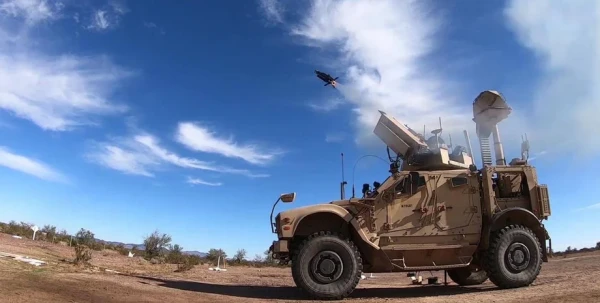
The weapon strikes the target with an electromagnetic pulse, disabling its electrical circuits.
The Coyote Block 3 UAV developed by Raytheon destroyed a swarm of drones with an electromagnetic pulse during a training battle, which represents a very rational alternative to explosive interceptors.
Coyote Block 3 tests were conducted at the Yuma Proving Ground in Arizona and aimed to verify the latest model of the fighter drone under conditions of a massive drone attack.
Coyote Block 3 is already the third version of the drone. The first (reconnaissance) was a UAV with an electric motor and retractable wings. The second was equipped with a turbojet engine and four stabilizers, turning it into a jet interceptor. Coyote Block 3 retained the airframe with a turbine engine and the specifications of Coyote Block 2, but instead of a warhead, it was equipped with an energy weapon.
This weapon strikes the target with an electromagnetic pulse, disabling its electrical circuits, after which it falls to the ground. The specifications of Block 3 are classified. It is only known that it will be able to engage UAVs of the 2nd and 3rd groups.
The U.S. Armed Forces want to acquire 6,000 jet variants of Block 2, which carry an explosive warhead, and another 700 variants of Block 3 with an unspecified "non-kinetic" payload. The Army also intends to purchase launchers and radars for these interceptors. Under the contract with the manufacturer Raytheon, the Armed Forces will also receive maintenance and repair services for the Coyote systems.
Currently, the U.S. Army already has Coyote-based counter-drone systems known as the Mobile, Low, Slow, Unmanned Aircraft Integrated Defeat System (M-LIDS) and Fixed Site LIDS (FS-LIDS). The M-LIDS system includes the M-ATV mine-resistant vehicle with a Coyote launcher and a Ku-band radar. FS-LIDS is a two-component system on pallets with a Coyote launcher and a Ku-band radar.
The U.S. Armed Forces' plans may also include the acquisition of new or improved configurations of the M-LIDS and FS-LIDS systems, including possible variants based on the Stryker armored vehicle. According to media reports, it is currently unclear why the number of mobile radars the military wants to acquire is less than the number of mobile launchers. Stationary launchers can be tied to a single radar. M-LIDS and FS-LIDS can also be integrated into a network with other sensors and effectors.
The media notes that this expansion of the Coyote-based counter-drone arsenal indicates the growing threat posed by drones, including cheap and armed commercial types. And the Pentagon expects this threat to only increase in the coming years.















Leave a comment