
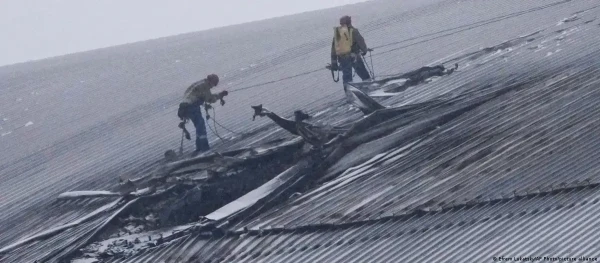
The protective shell was custom-made, and such materials are currently not available on the market.
A year after a Russian drone struck the new protective shell of the Chernobyl Nuclear Power Plant, French companies completed a preliminary assessment of the damage and outlined critical timelines for restoring the facility.
French companies Bouygues Travaux Publics and Vinci Construction Grands Projets, which designed and built the new protective shell over the fourth reactor of the Chernobyl Nuclear Power Plant, have completed a preliminary technical assessment of the damage caused by the Russian drone strike on the Chernobyl sarcophagus on February 14, 2025. According to the analysis, the facility, which took nearly 20 years and more than $2 billion to construct, is currently not fulfilling its protective functions, the European Bank for Reconstruction and Development (EBRD) reported.
"The key task is to restore the full functionality of the New Safe Confinement (NSC) by 2030 to limit the risk of corrosion of the steel arch structure and ensure long-term safety," said Balthazar Lindauer, head of the EBRD's Nuclear Safety Department. According to him, it is currently impossible to provide a final cost estimate for the repair work; however, "based on the information available at this time, the total cost could amount to several hundred million euros."
The scale of the damage after the Russian drone attack on Chernobyl
As a result of the Russian drone strike, the new protective shell of the fourth reactor lost its airtightness, which is critical for fulfilling its primary function of preventing the release of radioactive dust that has accumulated since 1986 into the external environment. Additionally, the crane installations inside the structure are not operational, as noted in the analysis.
The EBRD also clarified, citing the conclusions of the French companies, that a special membrane connecting the new safe confinement to the concrete structures of the third power unit had hindered the spread of radioactive dust. After its damage, the problem is exacerbated by the fact that the membrane was custom-made specifically for the Chernobyl project, and such materials are currently not available on the market.
The Russian strike also disrupted the temperature regime inside the confinement, making it impossible to control the humidity of the facility, and due to the loss of pressure within the structure, conditions for corrosion of the steel arch structure have arisen, which could lead to its collapse.
Experts have named critical timelines for restoring the protective shell
According to experts, the new protective shell must be restored no later than 2030, or the consequences will be catastrophic. If this does not happen, the Chernobyl problem will be exacerbated many times over, warn the authors of the analysis.
The New Safe Confinement or new protective shell of the Chernobyl Nuclear Power Plant is an arch structure measuring 165 meters in length and 110 meters in height. Its weight is 36,200 tons. The shell was installed over the destroyed fourth power unit of the Chernobyl Nuclear Power Plant in November 2016. It is the largest movable ground structure in the world, designed for operation for at least 100 years.





Leave a comment