
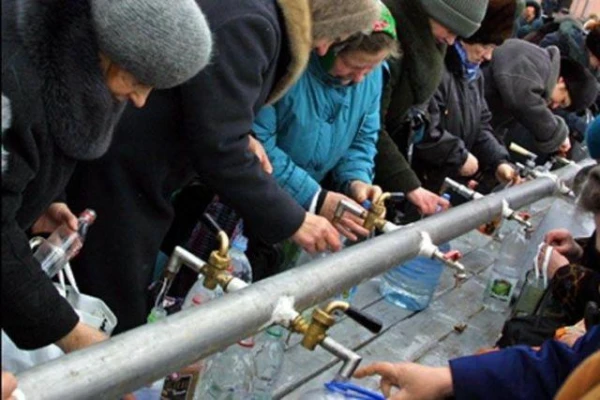
For decades, human activity, as a new report warns, has caused 'irreversible damage' to the water resources of our planet.
Human activity has pushed the world into an era of 'global water bankruptcy,' and experts are calling for urgent science-based transformation.
A new report from the United Nations University (UNU) warns that decades of deforestation, pollution, soil degradation, excessive allocation of water resources, and chronic depletion of groundwater, exacerbated by global warming, have caused 'irreversible damage' to the planet's water supplies and its ability to recover.
The document states that terms like 'water stress' and 'water crisis' no longer reflect the current harsh reality, which leads to 'fragility, displacement, and conflict' around the world.
What Does 'Water Bankruptcy' Mean?
The UNU report defines water bankruptcy as 'sustained extraction of surface and groundwater exceeding renewable inflow and safe depletion levels.' This term also implies 'irreversible or extremely costly loss of natural capital related to water.'
This differs from water stress, which reflects tense but reversible situations, and from water crisis, which describes acute shocks that can be overcome over time.
While not every basin and every country is in a state of water bankruptcy, lead author Kaveh Madani, director of the UN Water Analytical Center, states that enough critical systems have already crossed these thresholds.
'These systems are interconnected through trade, migration, climate feedbacks, and geopolitical dependencies, so the global risk landscape has fundamentally changed,' he adds.
How Does Water Bankruptcy Manifest?
Water bankruptcy is not about how wet or dry a place looks, but about balance, accounting, and sustainability. Even regions where flooding occurs annually can find themselves in a state of water bankruptcy if they consume beyond their annual 'renewable water income.'
The report emphasizes that water bankruptcy should be viewed from a global perspective, as its consequences spread worldwide.
'Agriculture accounts for the overwhelming majority of freshwater use, and food systems are closely interconnected through trade and prices,' says Madani.
'When water scarcity undermines agriculture in one region, the repercussions ripple through global markets, political stability, and food security elsewhere. As a result, water bankruptcy is not a collection of isolated local crises, but a common global risk.'
Global Water Resources in Numbers
Drawing on global datasets and the latest scientific evidence, the report presents an unvarnished picture of trends in the water sector, placing the blame for 'the overwhelming majority' of problems on human activity.
These include 50 percent of the world's large lakes having lost water since the early 1990s, with 25 percent of humanity directly dependent on these water sources, and dozens of major rivers now not reaching the sea for part of the year.
In the last five decades, 410 million hectares of natural wetlands have also disappeared, an area nearly the size of the EU. Since the 1970s, global glacier losses have increased by 30 percent.
Salinization has damaged about 100 million hectares of arable land, and 70 percent of major aquifers (which store and transmit groundwater) show long-term depletion.
'Rebooting' the Global Water Agenda
The report asserts that the current global water resource agenda, primarily focused on drinking water, sanitation, and efficiency improvements, is no longer fit for purpose.
The document calls for a new agenda that officially recognizes the state of water bankruptcy, views water as 'both a constraint and an opportunity' for meeting climate commitments, and includes monitoring of water bankruptcy in the global system.
Therefore, governments are strongly urged to take decisive action against pollution and the destruction of wetlands, support transitions for communities that need to change their livelihoods, and transform water-intensive sectors, including agriculture.
Otherwise, the authors add, the disproportionate burden will fall on small farmers, indigenous peoples, low-income urban residents, women, and youth.
'Water bankruptcy is becoming a factor of fragility, displacement, and conflict,' said UN Deputy Secretary-General Tshilidzi Marwala.
'Fair management of this process, that is, protecting vulnerable communities and equitably distributing inevitable losses, is a key condition for maintaining peace, stability, and social cohesion.












Leave a comment