
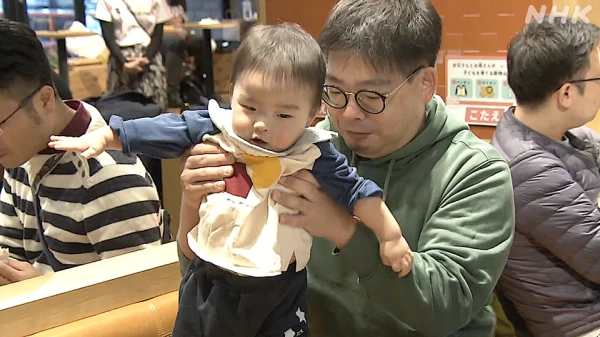
Employers do not always accommodate fathers.
Japanese men are facing a problem that was once exclusively female – how to balance work and child-rearing. New government data shows that a record number of fathers are taking parental leave, and more men are taking on a significant share of household responsibilities. However, due to deeply rooted stereotypes, fathers who are becoming more involved in domestic duties do not receive any leniency at work.
Serious social changes are occurring in Japan: according to a government survey conducted in the last fiscal year, the proportion of fathers taking parental leave exceeded 40%, which is a record high. However, many leave work only for a short time, while long working hours and low birth rates persist in the country.
As men become more actively involved in child-rearing, some are experiencing mental health issues that were traditionally reported by mothers.
Shinshu University Hospital in Nagano Prefecture opened Japan's first clinic last year specializing in helping fathers suffering from postpartum depression.
One patient, Yoshiki Ito, says that he and his wife Rena first faced difficulties when their first child was stillborn. His wife's physical and mental health deteriorated, and Ito did everything he could to support her. But he also suffered – he experienced sleep disturbances and health problems.
Ito's condition is now steadily improving. But the couple is expecting their second child, and he continues to visit the clinic to talk. He says that without these visits, he probably would never have opened up.
“‘You’re a man and you should be strong.’ ‘A man shouldn’t show weakness.’ I think because of such notions, I felt increasing pressure,” says Ito.
Dr. Hiroshi Murakami, who specializes in perinatal mental health, says he sees about 20 fathers each year. The idea for outpatient care came from his experience treating postpartum depression in women who expressed concern about their husbands' mental health. “If we want men to be more actively involved in child-rearing or to take parental leave, we need to pay attention to their mental health,” says Murakami. “It should be understood that people who take both work and child-rearing seriously are usually the most vulnerable. Therefore, it is important to promote both policy measures and mental health support simultaneously.”
For some fathers, problems arise at work. Keiji Kawanisi and his wife have three children, and both spouses work. On weekdays, he picks up the children from daycare, but this has not always been easy.
Before the children were born, Kawanisi often worked late. When the couple was expecting their first child, he wanted to pay more attention to the family.
Despite government efforts and legislative reforms that have contributed to a sharp increase in the number of fathers taking parental leave, much of Japanese society still clings to the old notion that men should work and women should raise children.
This approach still prevails, especially among executives. Many companies do not expect fathers to continue to be actively involved in child-rearing when they return from parental leave.













Leave a comment